Field Decision Intelligence
Enable field technicians to improve productivity and optimize product uptime
Enable service teams with Field Decision Intelligence for on-site diagnostics, repair procedures, and service parts, accelerating resolution and increasing first-time fix rates.

See how Field Decision Intelligence can enable field service technicians
Modern equipment is more advanced than ever, but service teams are stretched thin. Experienced technicians are retiring faster than new ones can be trained, leaving fewer experts to tackle increasingly complex repairs.
Field Decision Intelligence is built for service and provides relevant answers to questions and supports field service teams with on-site diagnostics and decision support, boosting productivity, accelerating onboarding, and increasing first-time fix rates.
What is Field Decision Intelligence?
Field Decision Intelligence (FDI) builds on modern field service tools and AI to offer actionable context-aware insights that help technicians work smarter.
Quadient case study
Presented at Field Service Next West 2026
See how Quadient uses Circuitry.ai to capture institutional knowledge, reduce repeat service visits, and improve first-time fix rates across a global team of field technicians.

Help on any channel, in any language, and hands-free
Field Decision Intelligence powers Circuitry’s Service and Parts Advisors, delivering real-time diagnostics, guided troubleshooting, and accurate parts recommendations.
Whether they’re in the field, the shop, or on the road, technicians can access Service Advisor and Parts Advisor anytime, anywhere.
Service Advisor provides guided troubleshooting and repair instructions, while Parts Advisor delivers accurate part codes and compatible replacements.
Empower your technicians to resolve issues faster with AI-powered service resolution and put vital service information at their fingertips.
Augment your field service workforce with AI
Service Advisor and Parts Advisor integrate with your current Field Service Management, CRM, or Repair Order applications, so you don’t have to replace your existing systems.

Pre-visit work
instructions
Answers to questions on service procedures
Debriefing after work order is completed

Continuously improve the accuracy of answers with experts in the loop
Service Advisor and Parts Advisor capture user feedback and expert input in real time, making every interaction smarter and more accurate.
As products grow more complex and experienced technicians retire, Advisors preserve that expert knowledge and make it instantly available to the entire team.
New technicians get the same expert guidance on day one, helping close the skills gap and improve every repair.
Field Decision Intelligence drives efficiency
Technicians often lose valuable time manually searching for answers, which means they can't finish as many jobs.
Field Decision Intelligence improves efficiency by empowering technicians with AI-powered Advisors that provide the right answers and right part recommendations instantly.
The results?
- Faster answers
- Fewer support calls
- Improved service quality
- Higher technician productivity

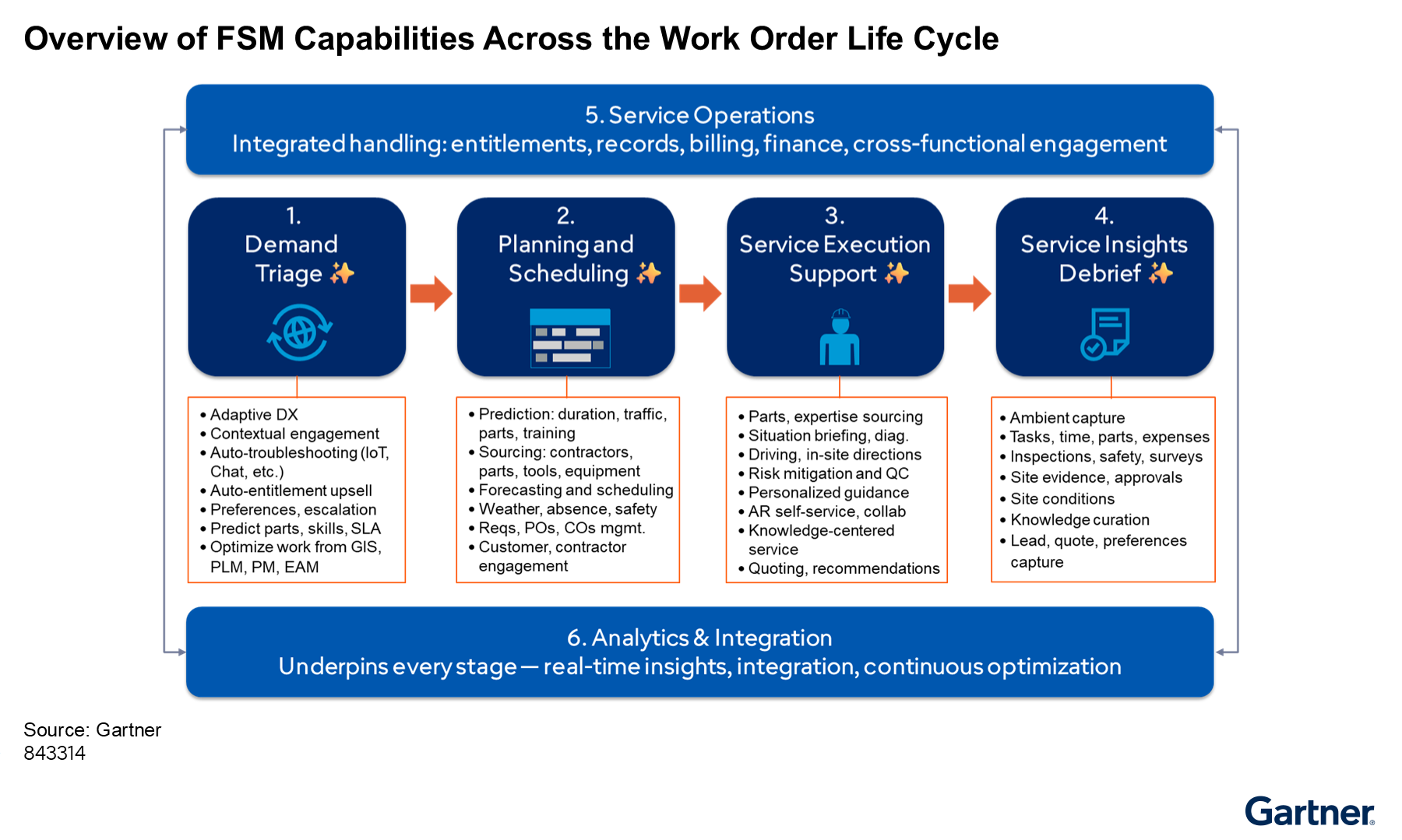
Critical Functions of Field Service Management in the Age of AI
AI is reshaping how service organizations triage demand, plan work, guide technicians, and capture service insights.
Download the Gartner research report to understand the critical FSM capabilities CIOs and service leaders should prioritize as AI becomes central to field service operations.
Improve Field Service Productivity and Product Uptime
Field Decision Intelligence augments worker skills, automates low-value work, and optimizes tasks to enhance efficiency, predict maintenance needs, and improve customer experience.
That's where Service Advisor and Parts Advisor come in. They turn your service manuals, parts catalogs, and repair data into on-demand expertise, accessible anywhere your technicians work. They integrate seamlessly with your existing field service tools to provide AI-assisted resolutions that boost productivity and uptime across your entire operation.
Your Questions About AI-Powered Field Decision Intelligence, Answered
Field Decision Intelligence brings AI-powered decision support into the technician workflow before, during, and after every service visit. For service leaders, the goal is to give every technician the context, guidance, and parts intelligence needed to complete more jobs accurately the first time, without adding more system switching or dependence on a small group of experts.
What is Field Decision Intelligence?
Field Decision Intelligence (FDI) is an AI-powered approach to technician enablement that delivers context-aware recommendations at the moments that determine service outcomes. FDI brings together service knowledge, equipment context, operational data, service history, and AI reasoning to help technicians understand what is wrong, what to do next, which part is required, and how to complete the work correctly. Unlike a simple search or chatbot experience, FDI is focused on better field decisions and measurable outcomes such as higher first-time fix rate, lower mean time to repair, fewer repeat visits, and improved equipment uptime.
How can Field Decision Intelligence improve field service and technical service?
As part of Field Decision Intelligence, Circuitry.ai Service AI Workers help at every stage of field service delivery.
Service Advisors provide technicians immediate, contextual answers from service manuals, bulletins, repair history, diagnostic information, and other approved knowledge. They can provide pre-visit guidance, troubleshooting steps, recommended repairs, and debrief assistance.
Parts Advisors help technicians, dealers, support teams, and customers identify the correct part using product configuration, BOMs, parts catalogs, service history, symptoms, and repair context. They can recommend replacements or supersessions and surface availability when connected to transactional systems. Better parts decisions reduce lookup time, ordering errors, returns, delays, and repeat visits.
Service AI Analysts identify recurring failures or service risks and parts-demand or failure pattern. Service AI Agents create or update work orders, capture outcomes, or initiate downstream actions. Parts AI Agents automate parts quoting, ordering, returns, or related workflows.
The result is faster resolution, higher first-time-fix rates, fewer escalations, reduced truck rolls, and faster onboarding.
How does Field Decision Intelligence improve first-time fix rate?
First-time fix improves when the technician makes a series of correct decisions before and during the visit. Circuitry.ai's Field Decision Intelligence improves that decision chain by capturing better symptoms and history, summarizing what happened before dispatch, identifying likely causes, recommending the right diagnostic path, surfacing the correct repair procedure, and confirming the parts and tools most likely to be required. During the job, the technician can ask follow-up questions and receive guidance based on the exact equipment and service context. After completion, the outcome can be captured and used to improve future recommendations. The result is fewer avoidable return visits caused by missing context, incorrect diagnosis, wrong parts, or inconsistent repair steps.
Why is Field Decision Intelligence becoming a priority for field service leaders?
Field work is getting harder while the supply of experienced technicians is getting tighter. Easier issues are increasingly resolved through self-service or remote support, so the jobs that reach the field tend to be more complex. At the same time, experienced technicians are retiring faster than newer technicians can absorb decades of product and repair knowledge. Circuitry.ai's Field Decision Intelligence helps close that capability gap by making trusted service expertise available at the point of work. FDI gives service leaders a way to increase technician capacity and consistency without relying only on more hiring, more training time, or more escalations to a small group of senior experts.
How should service leaders measure ROI and decide where to start?
Start with a discrete, high-impact field decision where there is a measurable baseline. Good candidates include diagnostic guidance for a high-volume product family, parts identification, technician pre-briefing, or a repair process with a high repeat-visit rate.
Measure business outcomes before and after AI assistance using metrics such as first-time fix rate, mean time to repair, repeat truck rolls, cost per service event, support escalations, parts returns, jobs completed per technician, administrative time, time to proficiency for new technicians, customer effort, and equipment uptime.
Circuitry.ai provides Proof of Value (POV) focused on improvement in the metric that matters, capture technician feedback, and establish the governance needed to scale into broader field service journeys.
How can Field Decision Intelligence help newer technicians perform more consistently?
Field Decision Intelligence makes the reasoning and knowledge of experienced technicians available in the workflow where less-experienced technicians need it. Instead of relying on memory, tribal knowledge, or waiting for an expert callback, a technician can receive step-by-step guidance tailored to the job and equipment. That can shorten onboarding time, reduce variation between technicians, and help newer team members handle a broader range of work with confidence. FDI augments the role of senior experts by scaling their knowledge and allowing them to focus on novel, high-risk, or genuinely difficult cases where human expertise adds the most value.
Can technicians use Field Decision Intelligence by voice, mobile, messaging, or hands-free?
Yes. Field decision support is most useful when it fits the way technicians actually work. Circuitry.ai makes Service Advisor and Parts Advisor available through web and mobile experiences, messaging channels, and voice-based interactions so technicians can ask questions without leaving the job context. This is especially valuable when technicians are wearing gloves, working around equipment, or need to keep their attention on the task. Multilingual and multimodal experiences can also make the same service expertise easier to consume across a distributed workforce.
How does Circuitry.ai ensure AI guidance is accurate, safe, and governed for field service?
Circuitry.ai grounds AI guidance in approved enterprise knowledge, equipment and service history, operational data, and business rules rather than relying on generic AI responses. Recommendations are supported by relevant evidence and evaluated using decision models, confidence thresholds, and governance policies to determine the appropriate level of autonomy.
For high-risk, safety-sensitive, or low-confidence decisions, Circuitry.ai keeps the technician or a qualified subject matter expert in the loop and provides a clear path for escalation. Technicians can review supporting information and provide feedback when guidance is incomplete or incorrect.
That feedback is routed through controlled expert review so corrections to knowledge and decision logic can continuously improve future recommendations. With traceable decisions, supporting evidence, confidence controls, human oversight, and continuous validation, Circuitry.ai helps service organizations scale AI while maintaining accuracy, safety, accountability, and control.
How does Circuitry.ai incorporate technician feedback to continuously improve AI guidance?
Circuitry.ai makes technician feedback a core part of its Service Decision Intelligence platform. Technicians can indicate whether guidance was helpful, incomplete, or incorrect and provide additional context or evidence from the job. This feedback becomes another signal used to evaluate and improve future service decisions.
Circuitry.ai’s AI Analysts continuously analyze the answers provided, technician feedback, decision outcomes, and recurring patterns. AI-powered reasoning and triage help determine whether an issue was caused by missing knowledge, incomplete context, an outdated procedure, conflicting evidence, or a weakness in the underlying decision logic. Exceptions can then be routed to the appropriate subject matter expert for validation and correction.
Approved improvements are incorporated back into the knowledge, reasoning, and decision models used by Service AI Workers. This creates a closed-loop system designed to improve service decisions over time, so every completed job and technician interaction can help increase the accuracy, relevance, and consistency of future guidance.
Do we need a complete and well-structured knowledge base before deploying Circuitry.ai?
No. Circuitry.ai can work with the knowledge you already have, even when it is fragmented across multiple systems, formats, and sources. The platform can ingest service manuals, technical documentation, knowledge articles, parts information, service history, and other enterprise content, then connect that knowledge with the context of the equipment, customer, and service event.
Circuitry.ai can also mine previously untapped knowledge from historical emails, call logs, support cases, technician notes, and past resolutions to identify recurring issues, proven answers, diagnostic patterns, and service expertise that may never have been formally documented.
The platform also supports continuous expert answer capture. When technicians or support experts provide a better answer, clarify a procedure, or resolve a new issue, that expertise can be captured, reviewed, and incorporated into the trusted knowledge used for future service decisions.
This creates a continuously improving knowledge and decision layer. Instead of requiring a large knowledge-cleanup project before you start, Circuitry.ai helps organizations discover, structure, validate, and continuously improve service knowledge as it is used, making more of the organization’s collective expertise available to every technician.