 Customer onboarding
Onboarding Services with Circuitry.ai
Bring your first AI Worker into a live service, parts, or warranty workflow. Your team sets the outcome. Together, we train the worker on your data, test its decisions, and measure the value.
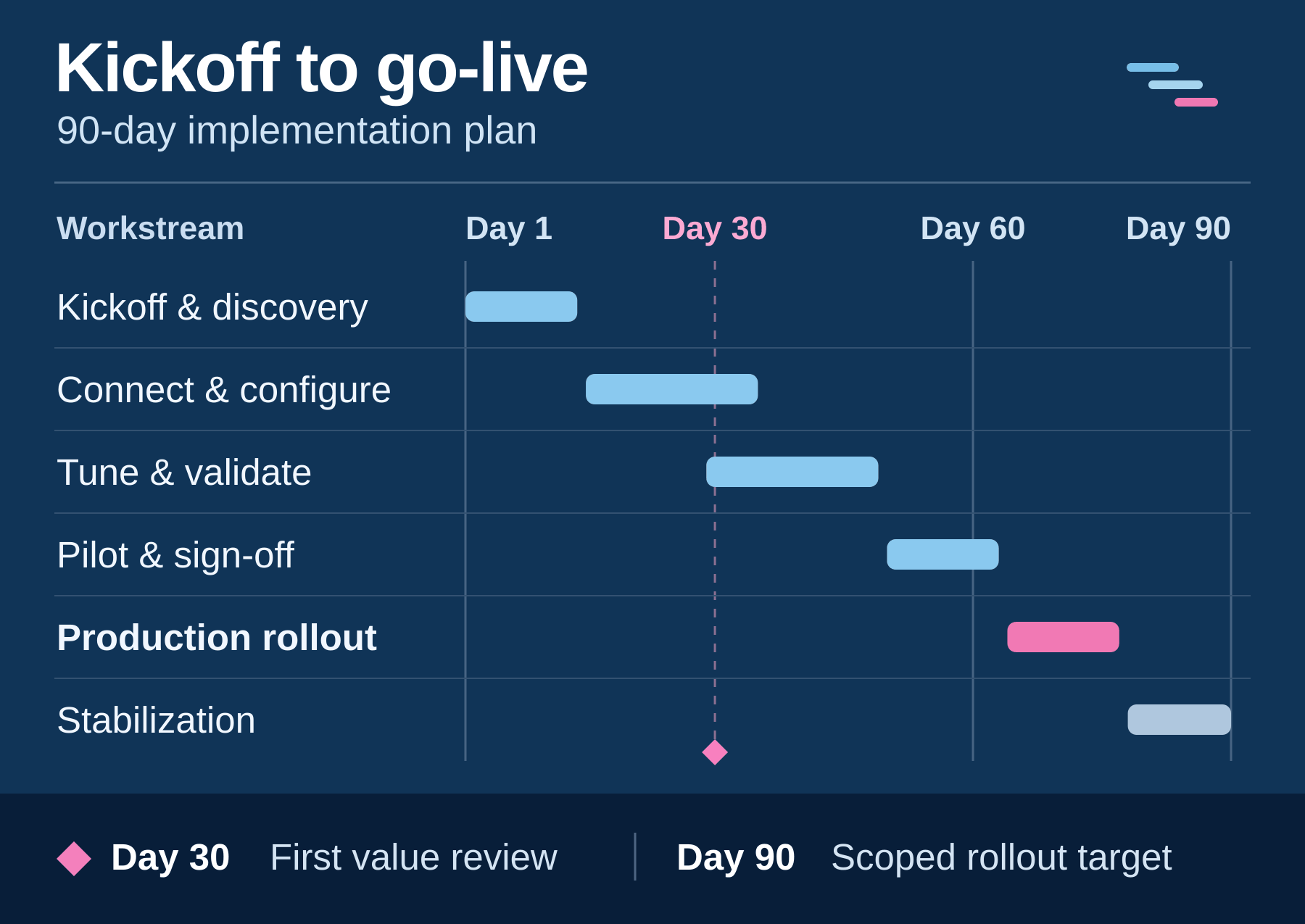
- Day 1
- Sandbox and production access
- By day 30
- First measurable value checkpoint
- By day 90
- Target for the agreed rollout
- 30 days
- Hypercare from go-live
Implementation roadmap
From kickoff to go-live
Work in two-week sprints. Each phase ends with something your team can inspect, test, or approve. Timing depends on data readiness, integration scope, and customer approvals.
Weeks 0–2
Agree on the first decision
Start with one decision that matters to your operation. In sprint planning, your sponsor and our delivery lead agree on scope, owners, and how the team will recognize a better result.
- Give your team sandbox and production access on day one. Live actions wait for approval.
- Map the current workflow, integration points, and the fields needed for the first use case.
- Select representative cases and record a baseline for effort, quality, and cycle time.
What you leave withA signed-off use case, baseline, data map, and sprint backlog.
Weeks 3–7
Put the first worker to the test
Our consultants configure the AI Worker and connect its sandbox pipelines. Your subject-matter experts review its answers and decisions using examples they know.
- Target a first value review by day 30. Compare an initial sample with the baseline and identify time saved or rework avoided.
- Tune knowledge, policy rules, and escalation thresholds as experts explain disagreements.
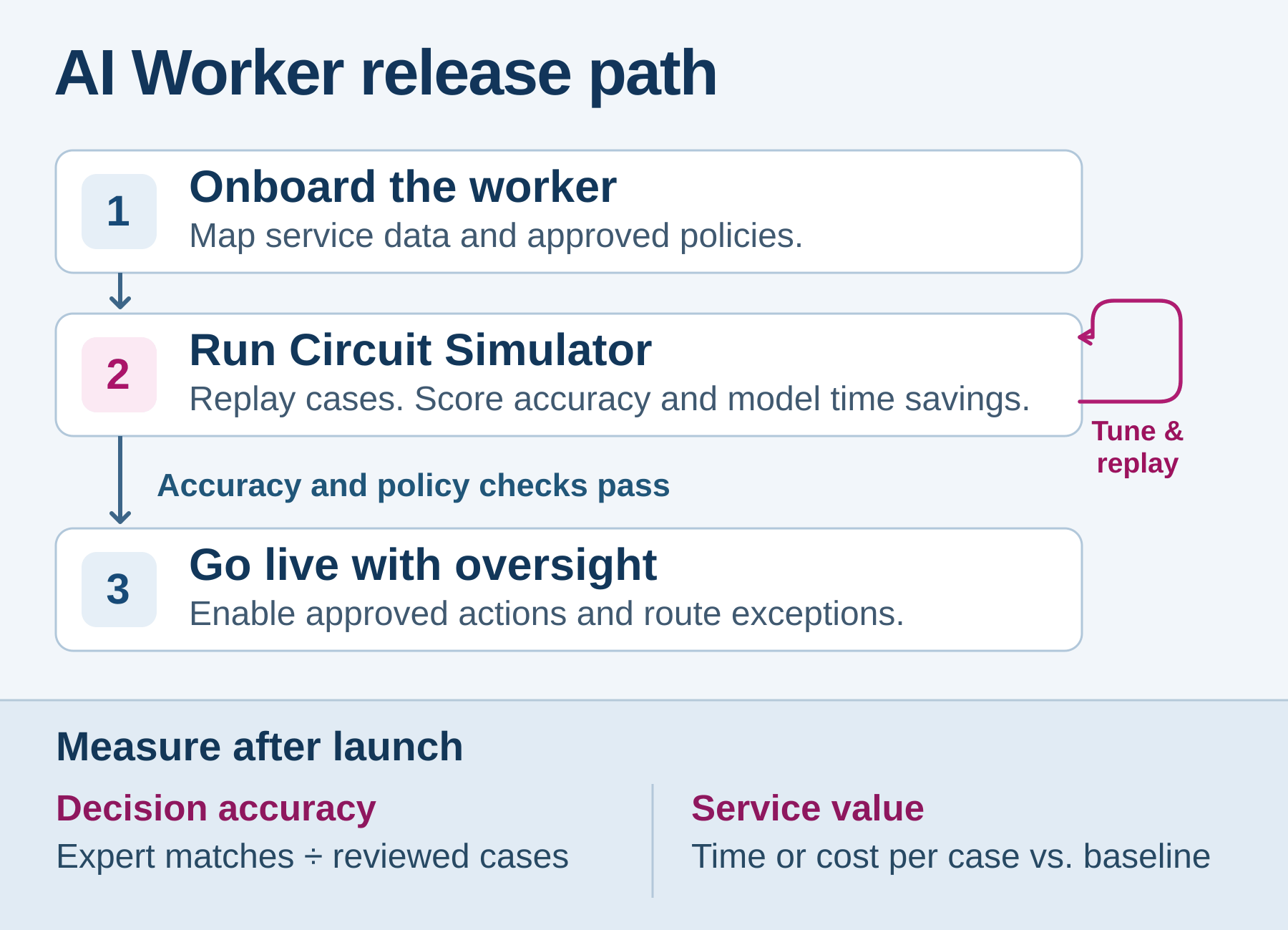
- Run a separate set of cases through Circuit Simulator to check that improvements carry over.
What you leave withA working test pipeline and expert-reviewed results for routine cases and exceptions.
Weeks 8–12
Release the approved scope
Business users test the end-to-end workflow in weeks 8–9. The pilot gives service and IT owners evidence for their go-live decision.
- Start with a shadow pilot. Compare proposed actions with staff decisions. Then enable recommendations for named users and rehearse exceptions and recovery.
- Target production rollout in weeks 10–11 after sign-off. Train trainers, administrators, and users for their roles.
- Use week 12 to stabilize the rollout and prioritize the next use case. Aim for full deployment of the agreed scope by day 90.
What you leave withPilot sign-off, monitored production workflows, and a named owner for every exception.
After go-live
Support the first 30 days live
Hypercare starts on the actual go-live date. Your implementation team stays engaged for 30 days while users put the new workflow into daily use.
- Review live cases, adoption, and overrides with the service owner. Triage issues with product and engineering.
- Hand over the runbook, escalation contacts, known issues, and owners to ongoing support.
- Your Customer Success Manager carries forward the KPI baseline and agrees on the next adoption and value review.
What you leave withA support handoff and a prioritized improvement plan with your Customer Success Manager.
Value realization
How we measure value with TRACK
TRACK connects each implementation decision to a business outcome. Repeat the five steps as you add products, teams, and service journeys.
Explore the TRACK frameworkTarget
Choose a decision with a clear owner and measurable value, such as warranty coverage or the right replacement part.
Review
Map today’s handoffs and exceptions. Establish the baseline from actual cases, handling time, and outcomes.
Assign
Give an Advisor, Analyst, or Agent the knowledge, permissions, and human checkpoints its job requires.
Capture
Measure productivity, outcomes, and efficiency against the baseline. Review exceptions alongside the gains.
Kaizen
Use feedback and overrides to improve the worker. Expand to the next decision when the evidence supports it.
Knowledge & integration
How an AI Worker learns your operation
Start with the records and knowledge needed for one decision. A coverage worker, for example, needs the contract in force, the asset’s repair history, and the policy for the failed part.
Connect the source systems
Use standard APIs or your existing middleware to connect CRM, ERP, field service, warranty, and knowledge systems. Your IT team and preferred systems integrator help define access and ownership.
Map to the universal schema
Our data analysts map customer fields to Circuitry.ai’s universal service schema. Review identifiers, asset-to-part relationships, policy versions, and field quality together.
Load and synchronize
Run the initial migration through predefined ingestion pipelines. Reconcile record counts and rejected records, then schedule incremental updates, retries, and alerts with your data owners.
Train for the assigned decision
Advisors use retrieval-augmented generation to answer from approved documents. Analysts can score historical patterns. Agents combine the evidence with policy rules and approval limits before acting.
Evaluation & autonomy
Test the decision before it goes live
Circuit Simulator replays historical cases in the sandbox. Your experts record the expected outcome for routine cases and rare exceptions. Then they score the worker on cases held back from training.
Explore Circuit Simulator| AI Worker | What your experts test | Example measures |
|---|---|---|
| AdvisorAnswers | Is the answer correct for this asset and grounded in an approved manual or policy? | Expert agreement and citation accuracy. |
| AnalystRecommendations | Does the recommended part or repair match the configuration and expert judgment? | Recommendation accuracy and exception rate. |
| AgentDecisions & actions | Does the agent choose the right action, respect authority limits, and escalate incomplete cases? | Correct-action rate, missed escalations, and overrides. |
Who acts on a claim?
An example of customer-defined policy and confidence thresholds in production.
Within delegated authorityAgent executes the approved action.
Above the approval limitAn adjuster reviews the recommendation.
Missing or conflicting evidenceRequest the missing record or send the case to an expert.
Enterprise delivery
What your implementation includes
Scope and fixed-bid services
The statement of work (SOW) defines the use cases, interfaces, deliverables, acceptance criteria, and fixed services fee. At each two-week sprint review, your sponsor can accept progress and prioritize the backlog. Additional use cases are scoped in phases.
Training for each role
Train-the-trainer sessions give your champions real scenarios to teach. Administrators practice permissions, knowledge updates, and queues. End users practice reviewing evidence, escalating exceptions, and giving feedback. All three training tracks are included in onboarding.
IT, security, and release readiness
With your IT, security, and data teams, agree on access, tenant and data boundaries, retention, audit records, latency, availability, and expected volumes. Before release, test monitoring, incident ownership, and the procedure for returning a workflow to human review.
Delivery roles and partners
Your sponsor owns the outcome. Your coordinator organizes access, business experts lead acceptance testing, and your rollout lead prepares users. Our implementation consultant owns configuration and delivery, data analysts own mapping, and quality analysts coordinate testing. Your preferred systems integrator can work alongside our technology and services partners.
Customer success
Keep measuring after launch
Your Customer Success Manager monitors adoption and value with your service owner. Circuitry.ai analysts review AI Worker accuracy, overrides, and service outcomes against the baseline. Together, you decide what to improve and when to expand.
- ProductivityCases per adjuster, technician time saved
- OutcomesFirst-time fix rate, coverage decision accuracy
- EfficiencyCost per claim, end-to-end resolution time
Which service decision will you start with?
Bring one workflow to a TRACK workshop. We’ll map the decision, identify the data it needs, and agree on a way to measure success.