Power better service outcomes with AI Workers
Circuitry.ai Service AI Workers—Advisors, Analysts, and Agents—augment people and automate work across service, parts, warranty, and support. Together, they power autonomous service journeys that improve decision quality, increase productivity, accelerate resolution, and drive better service margins.


Click below to see Service Advisor in action
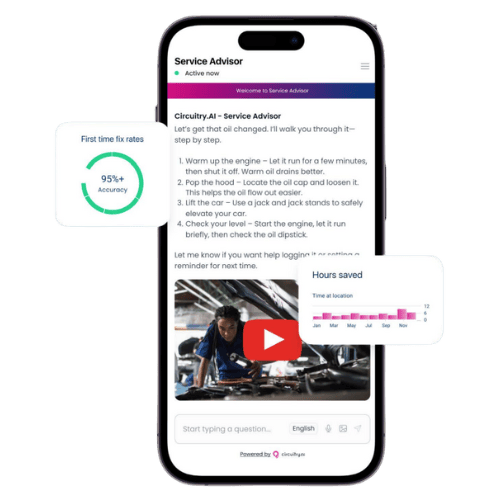
Service Advisor: The right fix. Every time.
AI-powered service resolution
Service Advisor is designed to deliver accurate and relevant answers with AI service resolution using your comprehensive service knowledge base. It's not a path, but a true AI-powered SME in your pocket.
Your service technicians can talk to Service Advisor just like they would an expert co-worker and get the right answers right away.
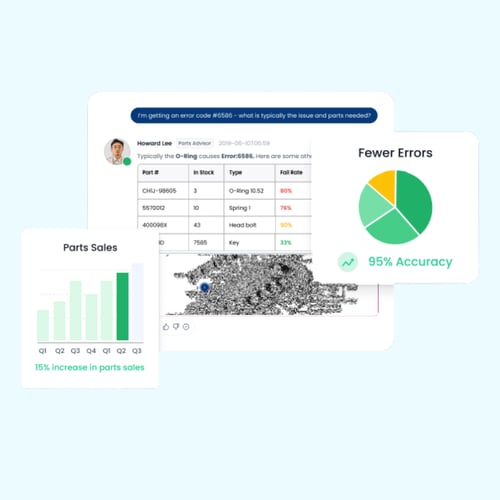
Parts Advisor: The right part. The right time.
AI-powered parts recommendations
Parts Advisor, powered by our Decision Intelligence Platform, addresses delays or errors in parts selection by empowering service technicians with accurate AI parts recommendations.
Click below to see Parts Advisor in action
SERVICE AI WORKERS / ADVISORS
Warranty Advisor
Clear answers. Consistent decisions.
Warranty Advisor turns complex warranty policies, coverage rules, claims, and service contracts into clear, contextual answers. It helps warranty support teams and claims adjusters interpret terms consistently, resolve questions faster, and focus on claims that need their expertise.
It also gives AI agents policy and contract guidance throughout an Autonomous Claims Journey—from intake to payment.
Explore Warranty Advisor→Consistent interpretations
Apply the relevant policies, exclusions, limits, and contract terms to each case.
More productive teams
Reduce manual searches, repetitive inquiries, and lookups for support teams and adjusters.
More efficient claims
Give AI agents contextual guidance to keep authorized claims workflows moving.
Connect to your administration systems through APIs, and extend the same guidance to customers and dealers through Voice Agents, Email Agents, and website or dealer-portal widgets.
Grounded in approved knowledge, with authorized access and human escalation when needed.
SERVICE AI WORKERS / CLAIM AGENTS
Claim Scoring Agent
See what matters in every claim.
Claim Scoring Agent evaluates coverage, parts and labor costs, other charges, the 3 Cs (Complaint, Cause, and Corrective Action), repair profiles, service history, images, video, and other available evidence. It presents criterion-level assessments and a proprietary aggregate score so reviewers can interpret each claim quickly and consistently.
Scoring criteria adapt to the claim type—standard warranty, service contract, or maintenance plan. Multiple AI models interpret text and visual evidence and compare the proposed repair with predictive parts and labor profiles.
Explore Claim Scoring Agent→Faster claim review
Bring relevant evidence and exceptions into one interpretable assessment.
Consistent decisions
Apply claim-type-specific scoring criteria across comparable submissions.
Governed automation
Use scores to route eligible decisions and escalate claims that need expert judgment.
The score highlights what needs attention, supports review and authorized automated decisions, and gives teams data to analyze claim patterns and scoring performance.
An illustrative assessment is shown. Actual criteria, score interpretation, and automation thresholds depend on the program and its configured controls.
Service AI Workers FAQ
Service AI Workers bring specialized AI expertise to the decisions and workflows that define service performance. Learn how Circuitry.ai Advisors, Analysts, and Agents augment your workforce, work across service, parts, warranty, and support, and come together in Autonomous Service Journeys to help close capacity gaps, improve consistency, and protect service margins.
What is a Service AI Worker?
A Service AI Worker is a purpose-built, domain-trained AI role designed to assist, augment, or automate decisions and work across the service lifecycle. Unlike a general-purpose chatbot, a Service AI Worker is trained and grounded in the organization’s service knowledge, operational data, policies, product context, and workflows. It can help service teams find the right fix, identify the right part, make the right warranty or service decision, analyze operational patterns, or execute repeatable work across enterprise systems.
What are the three types of Service AI Workers?
Circuitry.ai organizes Service AI Workers into three complementary roles: Advisors, Analysts, and Agents. Advisors interact with people and provide trusted answers, recommendations, and next-best actions. Analysts evaluate large volumes of service and operational data to score decisions, detect patterns, identify risks, and surface opportunities. Agents execute actions and multi-step workflows across systems. Together, they create an AI workforce that can support a person, improve a decision, and carry the work through to completion.
What business outcomes should we expect from Service AI Workers?
The most important outcomes are aligned with the KPIs service leaders already manage. Depending on the use case, these can include technician and agent productivity, first-time-fix rate, average handling time, resolution time, equipment uptime, SLA performance, claim accuracy, warranty leakage, parts returns, cost-to-service, customer experience, and service margins. Circuitry.ai frames value across Productivity, Outcomes, and Efficiency so AI is measured by business performance.
Why use Service AI Workers instead of a general-purpose AI assistant?
Complex service decisions require domain knowledge, asset and transaction context, approved policies, evidence, workflow integration, explainability, and measurable outcomes. General-purpose AI can help generate or retrieve information, but it does not automatically understand the decision logic or operational consequences behind a repair, part, warranty claim, or service action. Specialized Service AI Workers combine service-domain context with Decision Intelligence and workflow execution so AI can move from answering questions to making better decisions and safely acting on them.
How are Service AI Advisors different from copilots or chatbots?
Circuitry.ai's AI Advisors are designed around specific service decisions rather than generic conversation. They interpret the user’s intent and the context of the asset, customer, repair, claim, part, or contract, then ground recommendations in approved enterprise knowledge and data. A Service Advisor can guide troubleshooting; a Parts Advisor can recommend the correct replacement component; and a Warranty Advisor can interpret coverage or policy. The goal is not simply to generate an answer, but to help the user make a more accurate service decision.
How are Service AI Analysts different from reporting or analytics?
Circuitry.ai’s AI Analysts apply data-driven reasoning across service, parts, warranty, and operational data. They can score claims or repairs, detect anomalies, identify emerging failure patterns, connect evidence across historical cases, monitor performance, and identify opportunities to reduce cost or improve uptime. Analysts turn operational data into decision intelligence so teams can act earlier and more consistently instead of relying only on after-the-fact reporting.
How are Service AI Agents different from the general agentic capabilities?
Circuitry.ai’s AI Agents are the execution layer of the Service AI workforce. They automate repeatable tasks and multi-step processes such as intake and triage, creating or updating cases, generating claims, validating repair information, requesting missing evidence, routing work, communicating status, or triggering actions in CRM, FSM, ERP, warranty, parts, and other systems. E.g. Warranty Agents automate claims processing, returns, and other multi-step tasks, while in support scenarios AI Agents execute actions across CRM, ERP, and knowledge systems. Agents can operate autonomously for low-risk work while escalating exceptions to people when human judgment or approval is required.
How can Service AI Workers help address the service workforce capacity gap?
Service demand, product complexity, installed-base growth, and customer expectations are increasing faster than many organizations can add experienced service talent. Service AI Workers expand effective capacity by making expert knowledge available to every technician, support representative, dealer, adjudicator, and customer; handling repetitive work; and processing high-volume requests without adding equivalent headcount. This allows scarce experts to focus on complex exceptions, customer relationships, and higher-value work.
By embedding decision intelligence, organizations can scale service capacity without adding headcount . Service AI Workers scale capacity by imporving productivity of existing workforce, reducing performance variations and increasing operational efficiencies.
Are Service AI Workers intended to replace service employees?
The primary objective of Service AI Workers is to augment your service workforce and progressively automate the work that is appropriate for AI. Human experts remain essential for complex, ambiguous, high-risk, or relationship-sensitive situations. Circuitry.ai supports a spectrum of autonomy: an Advisor can recommend while the person decides; an Agent can execute with human approval; and trusted, low-risk decisions can be automated end to end. Organizations can define when people remain in control and where AI is allowed to act.
How do Advisors, Analysts, and Agents work together?
Circuitry.ai’s Advisors, Analysts, and Agents are orchestrated into an Autonomous Service Journey. Decision Intelligence acts as the orchestration layer. An Agent may receive and classify a request, an Advisor may interpret the issue and recommend the next best action, an Analyst may score risk or evaluate evidence, and another Agent may execute the approved action in an enterprise system. The journey can repeat these steps as new information arrives. This allows specialized AI Workers to collaborate around a shared outcome instead of operating as disconnected AI tools or applications .