Service Decision Intelligence built for higher equipment uptime, stronger service margins, and greater customer lifetime value.
Turn Fragmented Service Data into Trusted Service Decisions
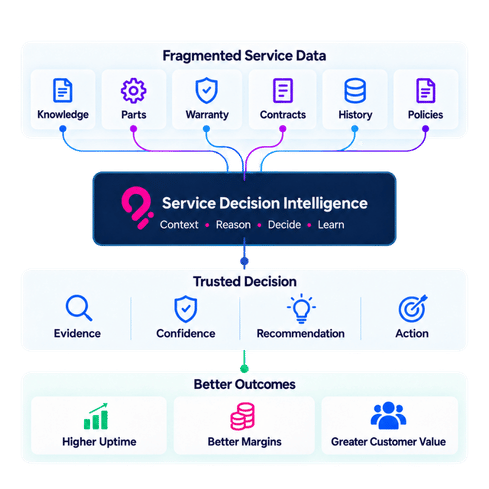
Circuitry.ai turns fragmented service knowledge and operational data into trusted service decisions. We connect and contextualize service manuals, warranty history, parts data, policies, contracts, repair outcomes, and transactional data into a service intelligence layer that understands the equipment, customer, claim, repair, and business context behind every decision.
Our Service Decision Intelligence platform combines domain-specific knowledge, decision models, and AI workers to recommend, score, and automate decisions across the service lifecycle, from diagnosis and parts identification to warranty adjudication, service contract claims, dealer support, and customer communications.
Unlike general-purpose AI, Circuitry.ai is designed for the realities of complex service operations. We ground recommendations in approved enterprise knowledge and data, validate evidence and decision criteria, apply confidence thresholds and business policies, and keep humans in control when decisions require review. Every decision can be traced to its supporting context, governed according to the level of autonomy allowed, and measured against operational and financial outcomes.
The result is AI that does more than generate answers. Circuitry.ai helps service organizations make more accurate decisions, safely automate repeatable work, continuously improve decision quality, and quantify the impact on uptime, service margins, productivity, and customer value.

Why Circuitry.ai is different
Circuitry.ai's differentiation comes from three reinforcing capabilities that turn Service AI from experimentation into trusted business decisions.
Domain depth
Domain depth provides the context for accurate decisions.
Accuracy and autonomy
Decision accuracy builds trust. Trust determines autonomy.
ROI and value
Measurable outcomes prove where greater autonomy delivers business value.
The compounding effect comes from the feedback loop: every decision captures evidence, confidence, action, feedback, and outcome, making future decisions more accurate, more automated, and more valuable.
Domain depth: service expertise encoded into every decision
Circuitry.ai is purpose-built for complex service operations. Our team brings decades of experience designing and deploying service, warranty, parts, and service contract solutions for global manufacturers and service organizations.
We have translated that expertise into the service decision intelligence platform: service-specific knowledge models, decision frameworks, and AI workers that understand how assets, parts, repairs, symptoms, warranties, contracts, and service history relate to each decision.
The result is a Service Decision Intelligence layer that helps organizations make more accurate and consistent decisions, safely automate service work, and improve uptime, service margins, and customer outcomes across the service lifecycle.
Accuracy and autonomy: trusted decisions with governed automation
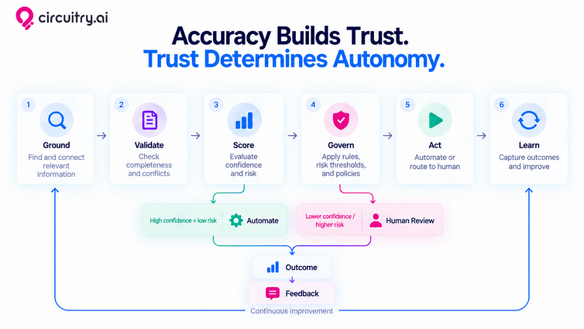
Circuitry.ai is built for service decisions where accuracy matters and the cost of a wrong answer can affect equipment uptime, warranty expense, service margins, or customer experience. Rather than relying on a general-purpose AI response, our Service Decision Intelligence combines approved source evidence, service context, business policies, historical outcomes, and domain-specific decision logic to produce recommendations that can be explained, validated, and acted upon with confidence.
Every decision is evaluated based on the evidence available, the confidence of the recommendation, and the business risk of taking action. Circuitry.ai can validate required inputs, identify conflicting or missing information, apply policy and decision criteria, and provide the evidence and reasoning behind a recommendation before an action is taken.
Autonomy is governed at the decision level. Low-risk, high-confidence decisions can progress from recommendation to automated execution, while decisions with lower confidence, missing evidence, policy exceptions, or greater financial and customer impact remain in human review. Organizations control which decisions AI can recommend, approve, or execute based on their policies and risk tolerance.
Every AI-assisted and automated decision is traceable. Recommendations, evidence, actions, human overrides, and resulting outcomes are captured to create an audit trail and continuously evaluate decision quality. This feedback helps organizations improve models, policies, and automation thresholds over time.
ROI and value: measurable and immediate value
≤ 90 days
Deployment and time to value
SDU
Pricing aligned with outcomes and value
Circuitry.ai is designed to make the business case for Service AI measurable before organizations scale their investment.
Using existing service and historical data, organizations can establish a baseline for how decisions are made today and compare it with AI-assisted outcomes, quantifying opportunities to improve productivity, decision accuracy, resolution rates, cycle times, cost to service, leakage, and service margins.
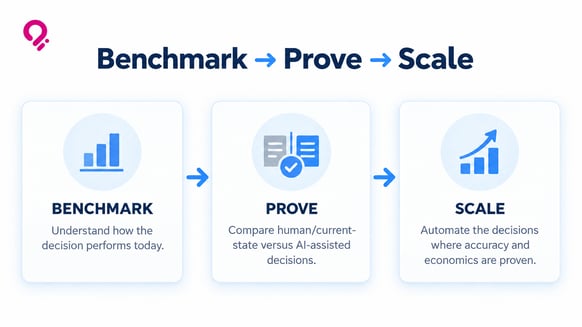
Rather than requiring organizations to build and integrate their own AI capabilities, decision models, governance, and service workflows, Circuitry.ai provides purpose-built Service Decision Intelligence that can be deployed and demonstrate value within 90 days. Organizations can evaluate where AI creates value, which decisions are ready for automation, and the expected financial impact before expanding deployment.
Our Service Decision Unit (SDU) pricing aligns software costs with the volume of service decisions being supported or automated rather than the number of users. As adoption and automation increase, customers can directly connect AI usage to operational outcomes and measurable business return.
The compounding effect: every decision creates a feedback loop
Circuitry.ai captures the context, evidence, recommendation, confidence, action, human override, final outcome, and financial impact associated with each decision.
This feedback creates a governed foundation for evaluating decision quality, identifying knowledge gaps, refining models and decision criteria, and determining where automation thresholds can safely increase.
As accuracy and business performance are proven, organizations can reduce unnecessary human review, expand decision coverage, and increase autonomy across more service journeys.
Circuitry.ai: the right partner for manufacturers and service organizations
Circuitry.ai delivers native Service Decision Intelligence for complex equipment companies by combining deep domain expertise, service lifecycle data, cross-system decision orchestration, and value-based SDU pricing.
Unlike internal builds, admin-system AI, or narrow copilots, Circuitry.ai provides a production-ready decision layer that improves productivity, outcomes, and efficiency across the entire service lifecycle.
|
Capability |
Circuitry.ai |
Build Internally |
General-Purpose AI Vendors |
Service Add-on / Embedded AI |
|
Purpose |
Purpose-built Service Decision Intelligence for service, warranty, parts, claims, and support |
Build the required service AI capabilities from the ground up |
Typically provide general-purpose AI, copilots, agents, or automation platforms |
Extends the existing service system of record with AI for its native workflows |
|
Domain Depth |
Service-specific knowledge models, decision frameworks, workflows, policies, and AI workers are built into the platform |
Internal teams must capture and encode service expertise, data relationships, rules, and workflows |
Domain knowledge typically must be supplied, configured, or developed by the customer |
Broader service knowledge, policies, and decision models require additional products or configuration |
|
Decision Intelligence |
Combines evidence, domain logic, business rules, historical outcomes, and AI to recommend, score, and execute decisions |
Decision logic, models, evaluation, and orchestration must be designed internally |
Often centered on answers, agents, workflows, or task automation rather than service-specific decision models |
Decision scope is generally tied to that application's functions and objects |
|
Accuracy & Trust |
Decisions are grounded in authoritative evidence, validated against criteria, confidence-scored, and evaluated against outcomes |
Customer must build grounding, evaluation datasets, validation, monitoring, and controls |
Accuracy depends on models, grounding, prompting, configuration, and customer implementation |
Grounding, evidence validation, evaluation, and monitoring across external knowledge and systems vary and often require development |
|
Governed Autonomy |
Autonomy is managed at the decision level based on confidence, risk, policy, and business impact; humans remain involved where appropriate |
Customer must design autonomy levels, HITL, exception handling, and governance |
Typically provides agent/workflow controls that must be configured for each business use case |
Cross-application autonomy and decision-level policies must be coordinated across systems |
|
Proving ROI |
Benchmark current decisions, compare human vs. AI-assisted outcomes, and quantify value before scaling |
Business case usually requires separate analytics, pilots, and ROI modeling |
ROI is often demonstrated through productivity or project-level metrics |
Often measured in host-app KPIs. End-to-end service ROI usually needs combined analytics |
|
Service Outcomes |
Connects individual service decisions to uptime, productivity, leakage, cost to serve, service margins, and customer value |
Customer must create measurement framework and instrumentation |
Value measurement varies by platform and implementation |
End-to-end outcomes depend on how FSM, warranty, parts, CRM/ERP, and knowledge systems are connected |
|
Time to Value |
Targeted use cases can be deployed and demonstrate value within 90 days |
Requires development, integration, testing, governance, and ongoing AI expertise |
Platform deployment may be fast, but domain configuration, integration, and validation are still required |
New modules, integrations, data preparation, and validation add time |
|
Cost & Pricing Alignment |
Service Decision Unit (SDU) pricing aligns cost with the volume of decisions supported or automated |
Costs include engineering teams, AI infrastructure, models, integration, governance, and maintenance |
Common models include seats, platform fees, agents, tokens, or consumption |
Costs can accumulate across multiple service platforms |
|
Scaling Across Service |
Reuse the same service intelligence, governance, integrations, decision models, and AI workers across service lifecycle use cases |
Additional use cases often require further development and validation |
Additional use cases generally require agent, workflow, and domain configuration |
Cross-vendor or cross-lifecycle use cases may require multiple AI add-ons plus integration and orchestration |
Proven in production at scale with leading service organizations. Explore our Customer Case Studies to see how Circuitry.ai is delivering measurable outcomes across service, warranty, parts, and support.
Start with one decision. Prove the value. Scale autonomy.
The fastest path to value is to begin with a high-volume or high-cost decision area such as warranty review, parts identification, technician guidance, service contract claims, or support intake. Prove the value, then expand across the service lifecycle with AI workers that learn from every decision.
Ready to make service decisions faster, smarter, and more measurable? Request a demo to see how Circuitry.ai can deliver value to your service operations.
Choosing the Right Service AI Platform
Answers to the questions service leaders, Parts leaders, warranty teams, IT, and AI governance teams ask when comparing Service AI vendors, from accuracy, domain expertise, and integration to governance, autonomy, ROI, and build-versus-buy decisions.
What is Circuitry.ai's core differentiation?
Circuitry.ai is purpose-built to improve and increasingly automate the decisions that drive service operations. Circuitry.ai combines deep service domain intelligence, trusted decision models, governed autonomy, and measurable outcomes to help enterprises make better service decisions, and safely automate more of them over time.
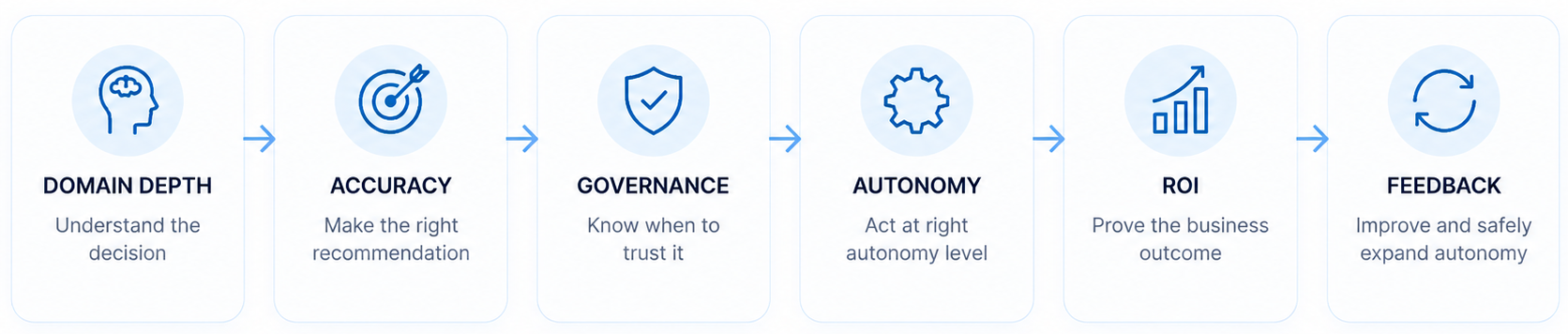
Circuitry.ai differentiates through a connected chain: Domain Depth -> Accuracy -> Trust -> Governed Autonomy -> Measurable Outcomes -> Continuous Improvement. Deep service context enables more accurate decisions. Accuracy builds trust. Trust determines how much autonomy is appropriate. Outcomes prove business value, and the resulting feedback improves future decisions.
How is Service Decision Intelligence different from a chatbot or copilot?
A chatbot or copilot primarily helps a user find information or generate a response. Service Decision Intelligence goes further: it assembles the relevant business context, applies decision criteria, evaluates evidence, scores confidence, incorporates policies and then recommends or executes the appropriate action. The goal is not just to answer a question, but to improve the quality, speed and consistency of the underlying service decision.
How is Circuitry.ai different from AI embedded in an FSM, warranty, parts or CRM application?
Embedded AI is typically optimized for the data and workflows inside a specific application. Service decisions often require context that spans multiple systems - for example service history, parts data, warranty policy, manuals, CRM information, dealer data and financial outcomes. Circuitry.ai is designed as a cross-system service intelligence and decision layer that can work with existing FSM, CRM, ERP, DMS, warranty, parts and knowledge systems.
Circuitry.ai is designed to complement systems of record and systems of workflow. Those applications continue to manage transactions, cases, work orders, claims, parts orders and customer records. Circuitry.ai adds the intelligence layer that helps determine what the best action should be and can return the decision or action to the existing workflow.
Why should we buy Circuitry.ai instead of building Service AI internally?
Building internally can make sense for organizations with substantial AI, data, domain, governance and integration resources. However, the work extends well beyond selecting an LLM. Enterprises must create domain context, retrieval, decision criteria, evaluation frameworks, confidence models, governance, orchestration, observability, feedback loops, integrations and user experiences. Circuitry.ai provides these service-specific capabilities as a platform so teams can focus more of their effort on customer-specific knowledge, policies and business outcomes.
How are Circuitry.ai AI Workers different from generic AI agents?
Generic agents are usually defined by tools and tasks. Circuitry.ai AI Workers add service-domain context, decision criteria, governed autonomy and outcome measurement. The emphasis is on making the right service decision within enterprise controls, not simply completing a sequence of tool calls.
What makes Circuitry.ai different from general-purpose AI?
Most AI tools help generate answers. Circuitry.ai is designed to improve the service decisions that determine uptime, cost, customer experience and service margins - and to automate more of those decisions as accuracy, trust and governance allow.
Circuitry.ai is purpose-built for service decisions. It combines service-domain context, decision models, confidence, governance and outcome measurement so AI can do more than generate an answer. Circuitry.ai's Service AI workers can recommend or execute the right action within enterprise controls.
How should we compare Circuitry.ai with other Service AI vendors?
Important criteria for evaluating Service AI vendors include domain depth, cross-system context, decision accuracy, evidence and explainability, governance, human-in-the-loop controls, ability to scale autonomy, integration, outcome measurement, speed to value, operating economics, and support for multiple service use cases on a common platform.
Circuitry.ai is purpose-built around these criteria through its Service Decision Intelligence platform, combining deep service context, decision models, governed autonomy, AI Workers, and measurable outcomes across service, support, warranty, and parts.
The best way to evaluate the Circuitry.ai advantage is to see it with your own data. Start with a Proof of Value (POV) to measure decision accuracy, quantify business impact, and identify where AI can safely assist or automate your service operations.
What makes Circuitry.ai a lower-risk path to Service AI?
Circuitry.ai reduces the risk of adopting Service AI by helping organizations prove value before they scale. Customers can begin with a focused use case and a Proof of Value (POV) to measure decision accuracy, quantify business impact, and determine where AI can safely assist or automate work before making a broader commitment.
Circuitry.ai also lowers upfront cost and aligns economics to usage through Service Decision Unit (SDU) pricing, so investment scales with the service decisions being processed rather than relying only on large platform or per-user fees.
The platform is supported by a structured approach to adoption and scale. Circuitry.ai uses the POE framework (Productivity, Outcomes, and Efficiency) to define and quantify value and ROI, and the TRACK framework to help customers scale AI in a controlled and effective way.
The Simulator allows organizations to test AI Workers against historical or representative service decisions and evaluate whether they can achieve the desired operational and financial outcomes before full deployment.
Circuitry.ai has proven traction with large enterprise customers across multiple industries operating in complex service environments. The team has also built two industry-leading service and warranty platforms previously, bringing deep experience in service operations, enterprise software, and large-scale deployments.
Finally, Circuitry.ai is designed with enterprise requirements for data security, compliance, reliability, and scalability, with certifications and frameworks including SOC 2, ISO 27001, and alignment with the NIST AI Risk Management Framework.
Risk is further reduced through human-in-the-loop controls, confidence and evidence-based decisioning, selective autonomy, and integration with existing systems rather than requiring wholesale replacement.
Circuitry.ai also focuses on ongoing decision and KPI monitoring after deployment, helping customers track accuracy, adoption, automation levels, business outcomes, and value realization so performance can continuously improve over time.
The result is a higher-value, lower-risk, and more cost-effective path to Service AI—backed by proven technology, proven industry experience, and a practical path to move from evaluation to measurable outcomes and scaled autonomy with confidence.
How do we know circuitry.ai is more accurate? What is measured, and by whom?
Circuitry.ai is designed to deliver 95%+ decision accuracy once the required enterprise knowledge, service data, policies, and decision criteria are incorporated into the AI Workers. In production deployments with enterprise customers, we have seen accuracy reach and exceed this level for well-defined service decisions.
Accuracy is treated as an ongoing operating metric, not a one-time benchmark. Every AI-assisted or automated decision can be traced to the recommendation, supporting evidence, confidence, action taken, human review or override, and resulting service outcome.
Decision quality is measured through a combination of baseline validation, expert review, user feedback, human overrides, and actual service outcomes. Overrides are captured as feedback to identify knowledge gaps, policy issues, decision-model improvements, or confidence thresholds that need adjustment.
For each customer, accuracy is established using their own data and representative service decisions during the baseline or Proof of Value phase, then continuously monitored in production through Circuitry.ai’s evaluation, validation, and observability framework.
Most importantly, accuracy is not measured by Circuitry.ai alone. Customer subject-matter experts and operational teams validate results against their policies, expected decisions, and actual outcomes, creating a transparent and jointly measurable standard for decision quality.
How do we build a defensible business case with circuitry.ai before committing or scaling?
Circuitry.ai helps you build the business case using your own historical service data and decisions, rather than relying on generic ROI assumptions.
We first establish a baseline for how decisions are made today, then use the Simulator and Proof of Value to compare current performance with AI-assisted outcomes. This allows you to quantify potential improvements in productivity, decision accuracy, resolution rates, cycle time, cost to service, leakage, uptime, and service margins before broader deployment.
Circuitry.ai’s TRACK framework provides a structured path for adoption and scaling, while the POE model (Productivity, Outcomes, and Efficiency) translates AI performance into measurable business value. Decision-mapping workshops and baseline analytics determine where the greatest value opportunities exist, and which decisions are best suited for AI assistance or automation.
After deployment, Circuitry.ai continuously monitors decisions, automation levels, and operational KPIs such as first-time-fix rate, average handling time, warranty cost, SLA performance, and product uptime, so realized ROI can be compared with the original business case.
The recommended approach is to start with one high-volume or high-cost decision area, prove the value, and then expand AI Workers and autonomy across the service lifecycle.
This creates a defensible, data-driven business case before you make a larger investment, and a measurable path for scaling Service AI based on proven results.