Warranty technology buyer’s guide
Warranty Decision Intelligence vs. legacy admin
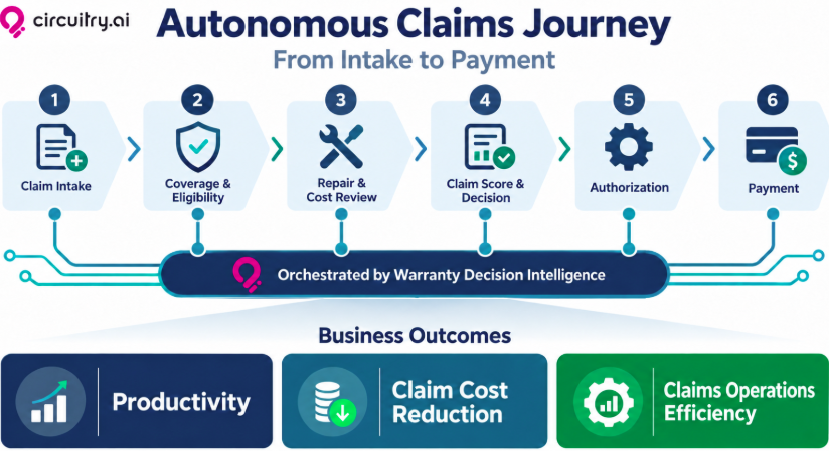
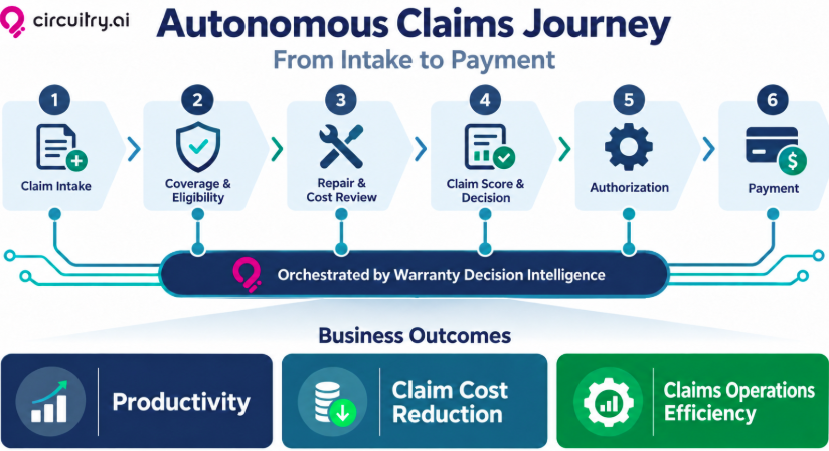
See how Circuitry.ai orchestrates AI Workers from claim intake to payment. Compare the decisions you can automate, the exceptions adjusters handle, and the cost of each approach.
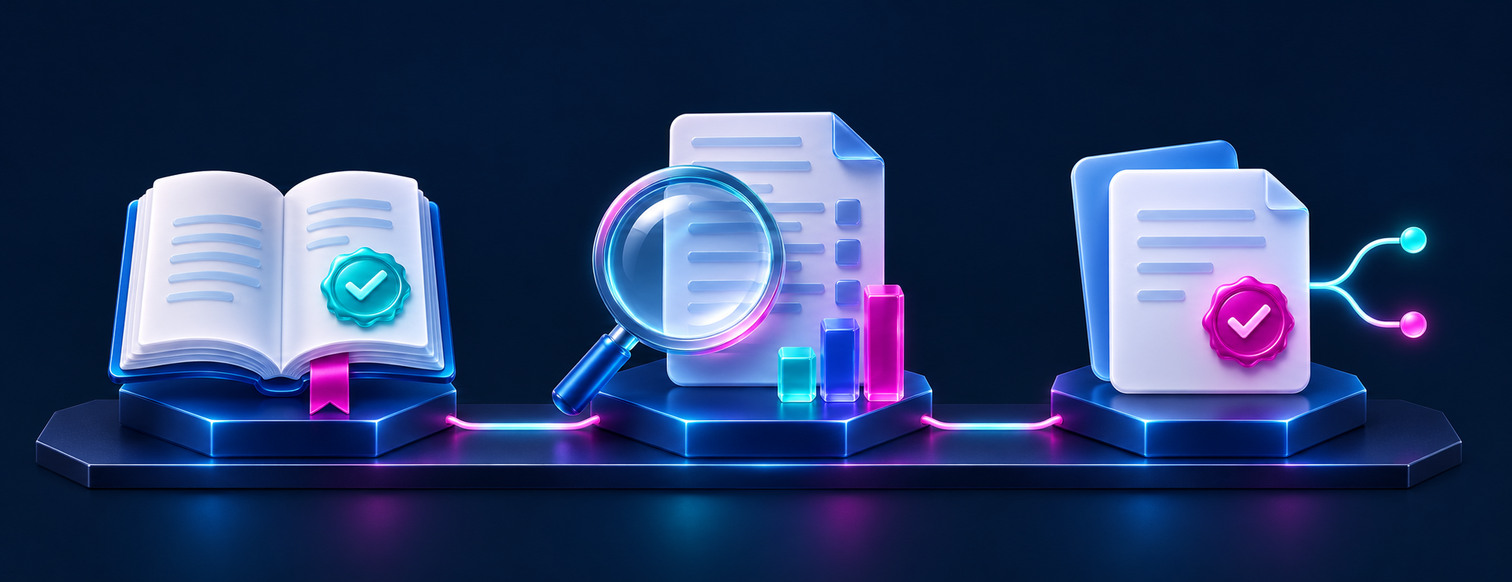
- AdvisorsInterpret coverage
- AnalystsScore claim evidence
- AgentsExecute actions

The Decision Controller applies policy and authority limits.
- Within authorityAdvance to payment
- ExceptionRoute to an adjuster
Platform comparison
What changes when AI reviews a claim?
A warranty administration platform records entitlements, transactions, and approvals. Warranty Decision Intelligence also evaluates the repair evidence and policy, explains what is payable, and acts within the authority your team grants.
Manufacturers and service contract providers buy warranty systems to register assets, administer coverage, control claim costs, recover supplier credits, and turn failure data into corrective action. Use these seven decisions to compare your current process with what each shortlisted vendor can demonstrate today.
| Warranty capability | Typical rules-led workflow | Circuitry.ai approach |
|---|---|---|
| Claim intake | The dealer keys repair-order lines into a form. Required-field rules catch omissions, and an adjuster follows up on incomplete repair notes. | An Intake Agent reads the repair order, captures parts and labor lines, and requests the missing facts before the claim reaches an adjuster. |
| Registration and entitlements | The warranty record stores the registered asset, start date and coverage period. Staff reconcile gaps across dealer and service records. | Warranty Advisor uses the registered serial number or VIN, in-service date, usage and applicable terms to explain whether the asset qualifies for coverage. |
| Repair scope and cost | A price rule can flag an expensive line. A reviewer still has to determine whether the diagnosis supports the replacement. | Service and Parts Advisors connect the complaint, cause and correction to repair guidance. Reviewers can check part fit, permitted alternatives, labor time and price before authorization. |
| Adjudication and payment | Status rules route a claim for approval. The adjuster gathers supporting evidence and checks the invoice before releasing payment. | AI Workers score the evidence, route exceptions and match the final invoice to the authorization. The program sets approval thresholds and payment authority. |
| Service contract programs | Product plans hold coverage schedules and benefit limits. Adjusters look up the contract version and interpret program-specific exceptions. | Warranty Advisor applies the effective terms, exclusions, deductibles and remaining benefits to the requested service and explains the resulting payable amount. |
| Parts returns and supplier recovery | An approved claim can open a return. Teams track the returned part, inspection, supplier claim and credit across separate queues. | Link the dealer claim to the required return, inspection evidence and supplier agreement. Track the recovery case through to credit reconciliation. |
| Quality and warranty analytics | Periodic reports group paid claims by product, dealer or failure code. Analysts investigate changes and pass findings to quality teams. | AI Analysts flag emerging failures and outlier costs, then surface affected units, dealers or suppliers. Track the time from detection to verified corrective action. |
Inside a warranty decision
Follow one repair order.
A dealer requests a complete gearbox for an excavator. Follow the evidence from intake to pre-authorization and see where an adjuster takes over.
A dealer requests a complete gearbox
The repair order describes a grinding noise during travel. The dealer requests a replacement gearbox for an excavator.
- Repair order
- The Intake Agent uses optical character recognition and language analysis to extract the serial number, hours, complaint and requested assembly.
- Evidence received
- The estimate includes parts and labor. A photo shows the outside of the gearbox.
Next actionMatch the serial number to the registered machine and warranty.
The machine falls within the warranty term
Warranty Advisor retrieves the policy effective on the failure date and checks the registration and meter reading.
- Asset record
- The machine is 14 months into service with 620 operating hours. The example policy runs for 24 months or 2,000 hours, whichever comes first.
- Coverage condition
- The policy covers a qualifying defect. The repair order gives a symptom and leaves the cause open.
Next actionCheck the repair evidence against the OEM procedure for this model.
The replacement request needs test evidence
The reviewer sees the complaint, the proposed correction and the gap between them. The example OEM procedure calls for a diagnostic test before assembly replacement.
- Photo review
- Image analysis links the exterior view to the repair file. That view cannot establish the condition of the internal components.
- Procedure check
- The dealer quoted the full assembly. The file contains neither the required test result nor a documented cause supporting that repair.
Next actionRequest the OEM test result and flag the assembly estimate for technical review.
An expert reviews the assembly request
The program routes the request according to the evidence available and the authority required to approve it.
- Review packet
- The adjuster receives the policy, repair order, estimate and exterior image together.
- Dealer update
- The request names the missing OEM test and explains why it is needed.
Check evidence and approval authority
Next actionThe adjuster reviews the dealer’s test result and records the authorized repair and rationale.
Retrieve the applicable contract, service bulletin, or repair procedure and cite the passage behind the answer.
Combine policy checks, claim scoring, anomaly models, and text or image analysis to identify what needs review.
Request evidence, advance approved work, and write decisions to connected systems with a record of each action.
Modernization paths
Add AI where it pays off first.
You can improve a specific decision inside an existing workflow, automate a proven class of claims, or move claims operations to a new system of record. Choose the scope that fits your integration access, team capacity, and risk tolerance.
Augment
Keep the claim in your current system. Give adjusters a policy citation, a repair assessment, and a recommended amount in their workflow.
Start with claim scoring or pre-authorization.Automate
Use Circuit Simulator to compare decisions with expert-reviewed claims. Set limits by program, dollar authority, and evidence quality. Monitor overrides as volume grows.
Start with one eligible, repeatable claim type.Replace
Use Claims Circuit as the claim system of record. Move evidence, decisions, work queues, and claim actions by workload. Reconcile open items before retiring each legacy flow.
Define who owns contracts, payments, and history.
- Read the evidenceDealer and service systems, asset and contract records, repair documents, parts catalogs
- Make the decisionSpecialized AI Workers combine language and predictive models with policy, evidence, and authority limits
- Act and recordReturn the rationale to an adjuster, advance an eligible claim, or send an authorized transaction to ERP
Feedback to evaluation Use overrides, final payment, and audit outcomes to retest policies and automation thresholds.
In production
CARS Protection Plus
Under 3 months
From implementation to go-live
CARS embedded Circuitry.ai decision support in its existing claims administration workflow. Adjusters could use claim scoring and supporting evidence while retaining decision authority. CARS also reported sending thousands of automated authorization notifications in one week.
The business case
What will a better decision be worth?
Compare the total cost of ownership (TCO) and the value you can realize over the same period. Circuitry.ai’s Productivity, Outcomes, and Efficiency framework gives warranty and finance teams three places to look.
Productivity
Measure handling minutes per claim and claims per adjuster. Value released hours using a loaded labor rate and the share of capacity you can redeploy.
Outcomes
Compare validated overpayments avoided, supplier credits collected, and coverage accuracy. Check underpayments, appeals, and rework alongside savings.
Efficiency
Track manual touches, resubmissions, and time to payment. Monetize a removed cost only once, even when it also improves cycle time.
Price the decision volume.
With Service Decision Unit (SDU) pricing, the subscription follows agreed activity such as claims processed. Model annual volume and growth, then request a three-year quote covering setup, integrations, data services, migration, dual running, training, and support.
See SDU pricingTest assumptions in Circuit SimulatorVendor evaluation
Five tests for your shortlist.
Give each vendor the same anonymized claim, a difficult exception, and the effective policy. Score what your warranty and IT teams can verify in the version offered.
Legacy costs often appear after the initial quote. A policy change can require a developer release. A disconnected parts catalog can force an adjuster to rekey prices. A quarterly report can delay action on a recurring failure.
Ask which AI decisions run across your systems today, what a deployment of comparable scope cost, and how many customers on the offered edition can serve as references.
Fit across the warranty lifecycle
Give each vendor an anonymized claim with a coverage exception. Watch a worker read the repair order, cite the policy, route the exception and show how an approved claim can trigger a supplier recovery.
Total cost and expected return
Get a dated go-live plan and three-year quote covering subscription, integration, migration, training and support. Use your volumes and paid-claim history to test the ROI assumptions.
Experience for everyone involved
Let a dealer submit an incomplete claim, an adjuster resolve it and a customer check its status. Count repeated entries and handoffs, then ask a current AI customer how adoption changed in production.
Integration with your systems
Trace a claim from your dealer or service system to CRM, parts pricing and the ERP payment record. Confirm who owns each record and see how a failed write is retried without issuing a second payment.
Product direction and staying power
Ask for a dated warranty and service roadmap, recent releases and referenceable customers on the current version. Check active deployments, renewals, upgrade effort and data export before committing.
Buyer FAQ
Questions warranty leaders ask.
What is the difference between warranty administration and Warranty Decision Intelligence?
Warranty administration maintains registrations, entitlements, claims and payments. Circuitry.ai adds decision support at each step. For example, it can read a repair order, check the applicable coverage, assess parts and labor, and explain why an adjuster should review a line.
Can we add AI to our current warranty management system?
Yes. Start with a defined decision such as pre-authorization or claim scoring. Your current system can remain the claim record while Circuitry.ai returns a recommendation, supporting evidence and a next action through an authorized integration.
Can Circuitry.ai become our claims system of record?
Claims Circuit can hold the native claim record, evidence, decisions and actions. Plan the transition by program or workload. Agree which system owns contracts, asset records, payments and historical claims before migrating live claims.
How does the AI know when to involve an adjuster?
Your program sets policy, financial authority, evidence requirements and confidence thresholds. Test those settings on expert-reviewed claims. Missing documentation, conflicting terms or a request above the authorized amount can send the claim to a named review queue.
How does Service Decision Unit pricing work?
A Service Decision Unit ties the subscription to agreed business activity, such as processing a warranty claim. Ask for a proposal that defines the billable decision, volume tier, overage rate, included work and one-time integration costs.
How do we estimate the return on warranty AI?
Measure reviewer effort, avoidable paid claim costs and process costs for a representative claim population. Price the improvements you can realize, count each benefit once, subtract total costs and divide the net benefit by total costs over the same period.
How long does it take to go live?
CARS Protection Plus reported going live within three months for its existing claims workflow. Your schedule depends on access to policies and data, the number of integrations, user testing and the decisions approved for automation.
What should IT verify before granting automation authority?
Trace one decision through identity and access controls, source permissions, audit records and the write back to the owning system. Agree on data retention, failed-write handling, model-change evaluation and the process for suspending automation.
What should we bring to a warranty software demo?
Bring an anonymized repair order, the applicable contract, an expert decision and a disputed or incomplete claim. Share annual volume and handling time so the team can demonstrate both paths and prepare an ROI estimate and scoped proposal.

Bring a claim to your demo.
Schedule a 30-minute Warranty Decision Intelligence demo. See the AI Workers handle your use case, discuss the ROI at your claim volume, and request a proposal with scope, pricing, and a go-live plan.