End-to-end automation of service workflows across all channels
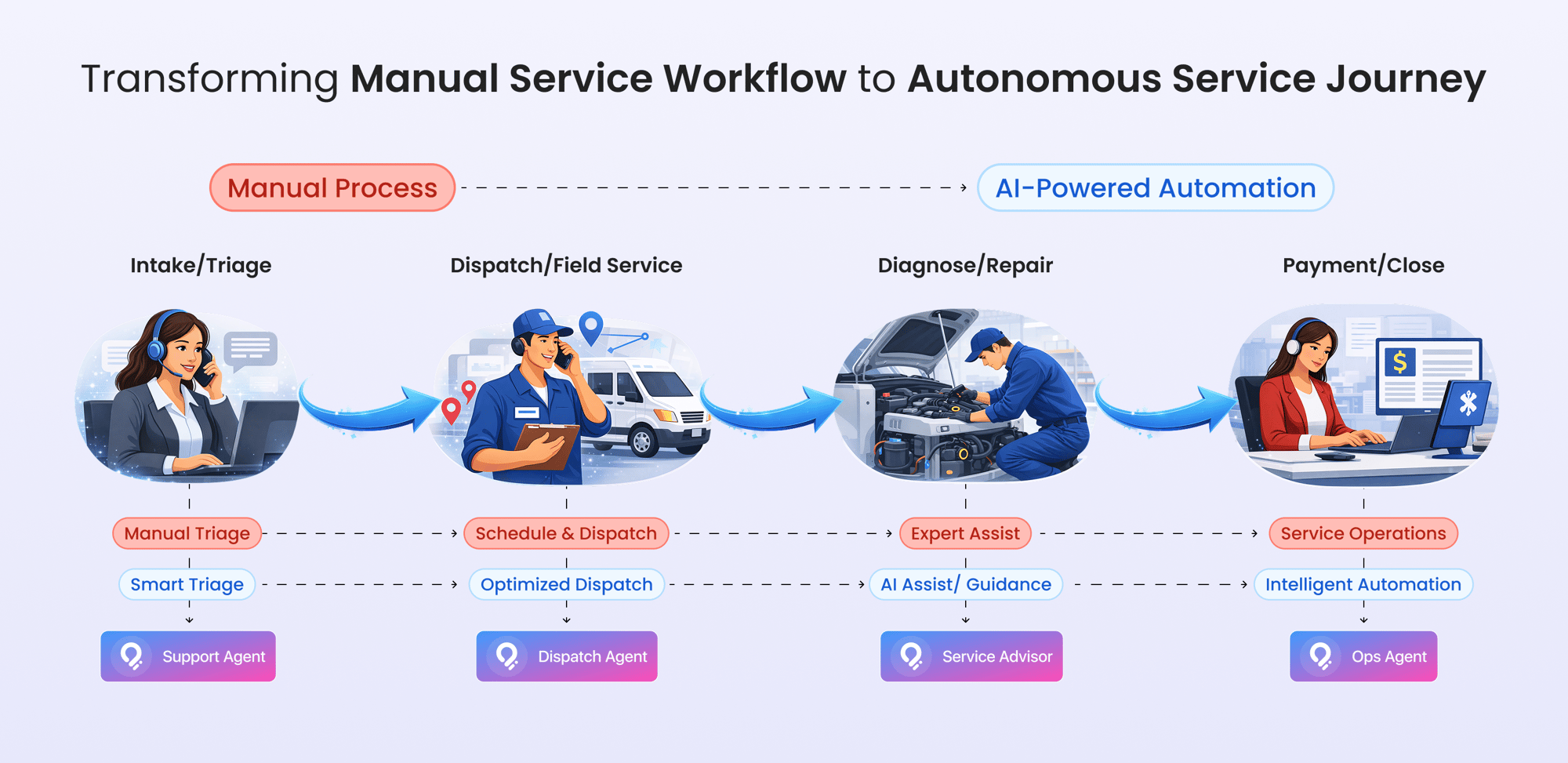
Autonomous Service Journeys orchestrate how service events are received, understood, and resolved across systems, teams, and channels. By deploying Circuitry.ai's Service AI Workers (Advisors, Agents, and Analysts), service operations move from isolated task handling to intelligent, outcome-driven decision orchestration.
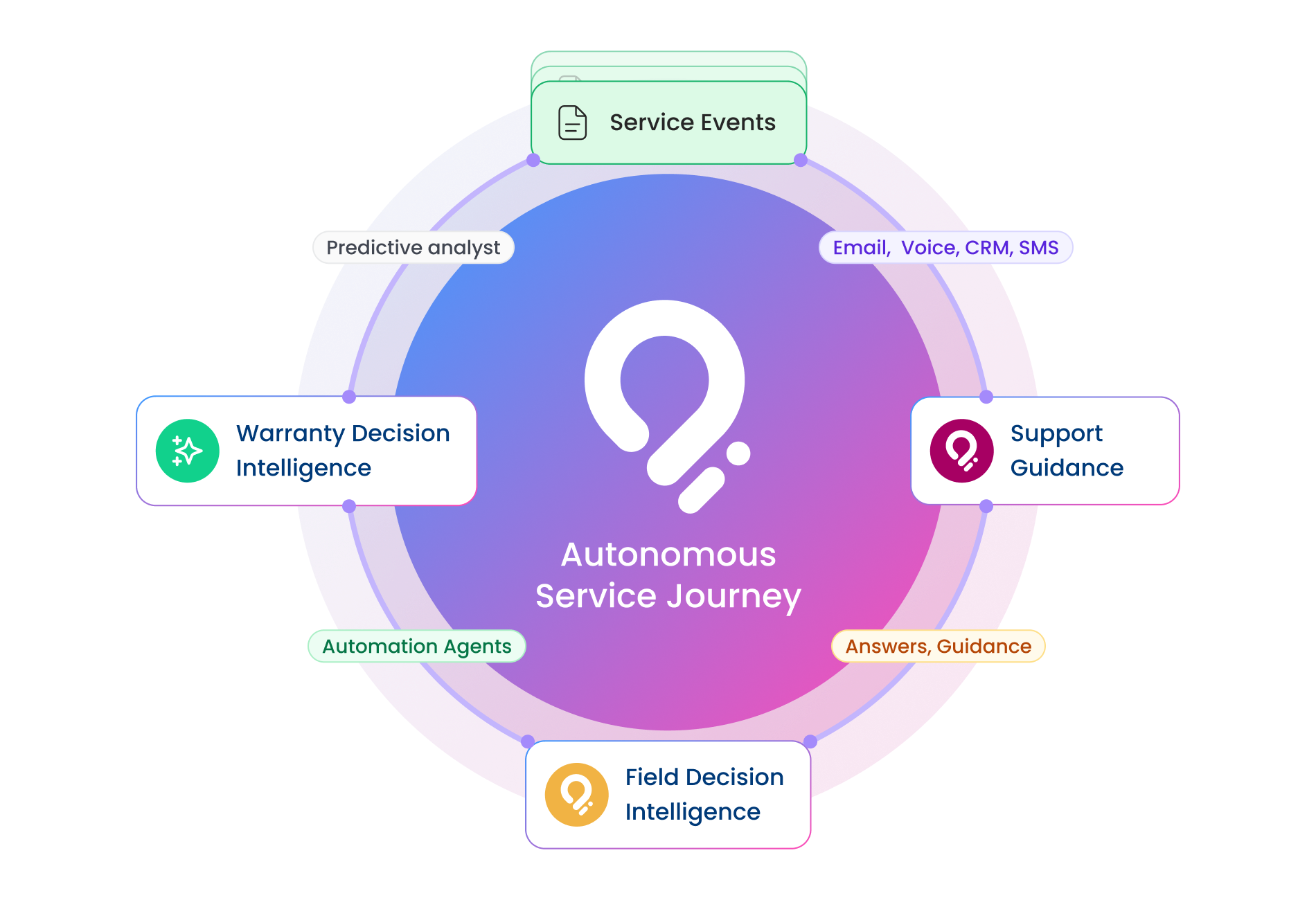
Autonomous Service Journey
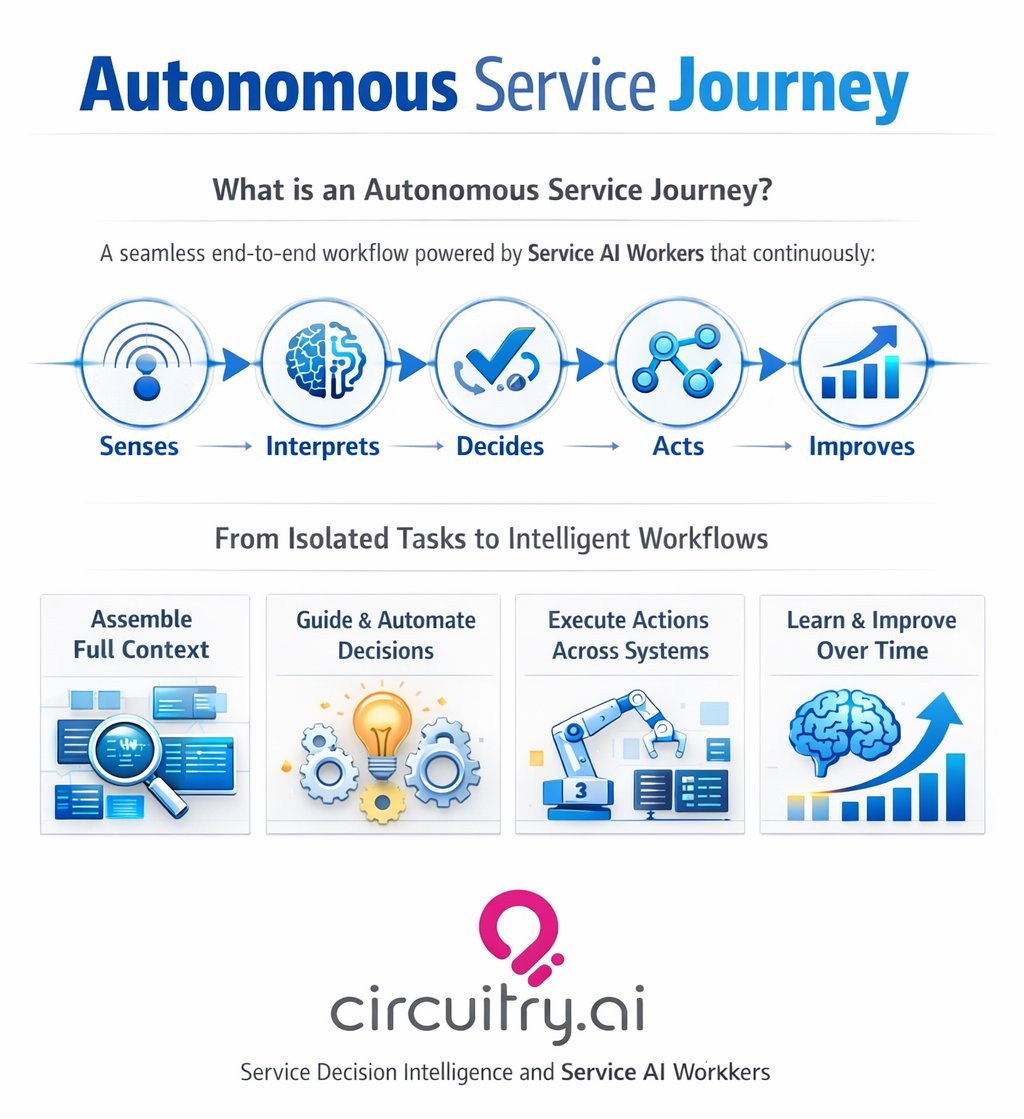
What is an Autonomous Service Journey?
An Autonomous Service Journey is an end-to-end workflow powered by Service AI workers that continuously:
Senses → Interprets → Decides → Acts → Improves
It transforms isolated service tasks into a connected, measurable, and continuously improving service lifecycle.
Instead of reacting to tickets, cases, or claims, your organization operates through intelligent flows that:
- Assemble full context automatically
- Guide or automate decisions
- Execute actions across systems
- Learn from outcomes
- Improve over time
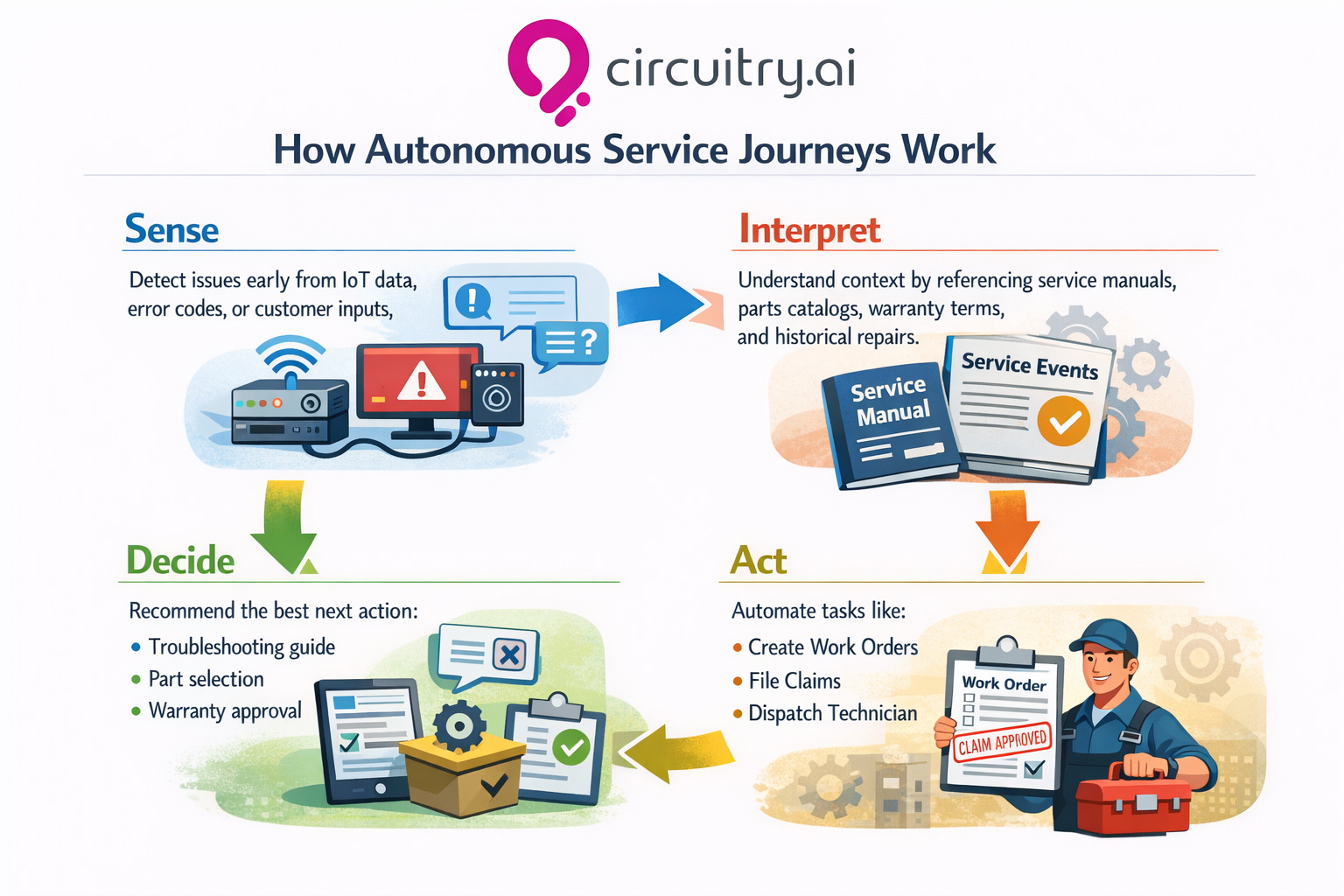
How Autonomous Service Journeys work
- Sense: Detect issues early from IoT data, error codes, or customer inputs.
- Interpret: Understand context by referencing service manuals, parts catalogs, warranty terms, and historical repairs.
- Decide: Recommend the optimal next action, whether it’s troubleshooting guidance, part selection, or warranty claim approval.
- Act: Automate tasks like generating a work order, filing a claim, or dispatching a technician with the right parts.
Powered by Service AI workers and Decision Intelligence
Autonomous Service Journeys are powered by Service AI workers:
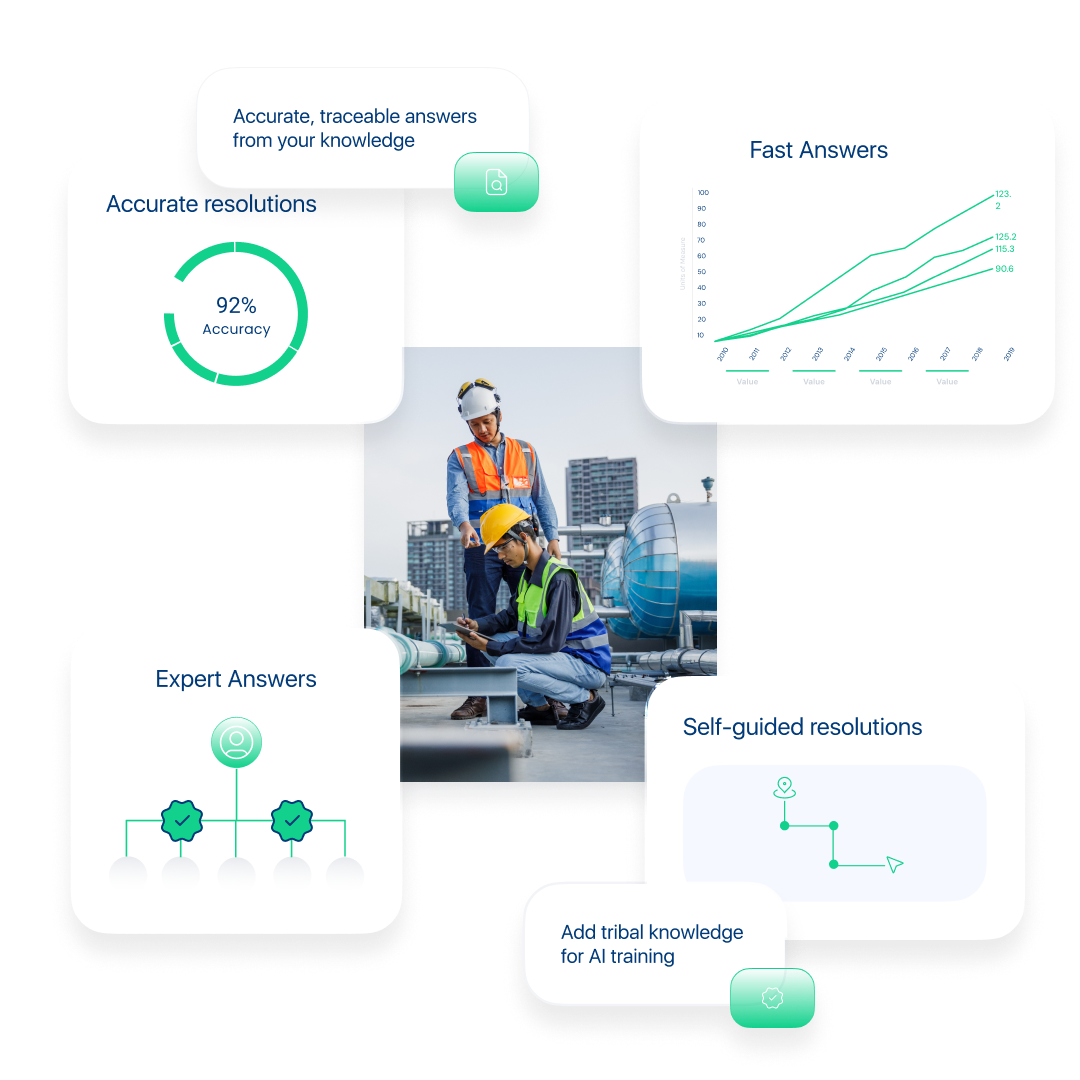
- AI Advisors guide decisions and recommend next best actions
- AI Agents execute workflows across systems
- AI Analysts monitor performance and identify optimization opportunities
All coordinated through a Decision Intelligence layer that connects:
- CRM
- ERP
- FMs
- Warranty systems
- Parts systems
Designed for manufacturers
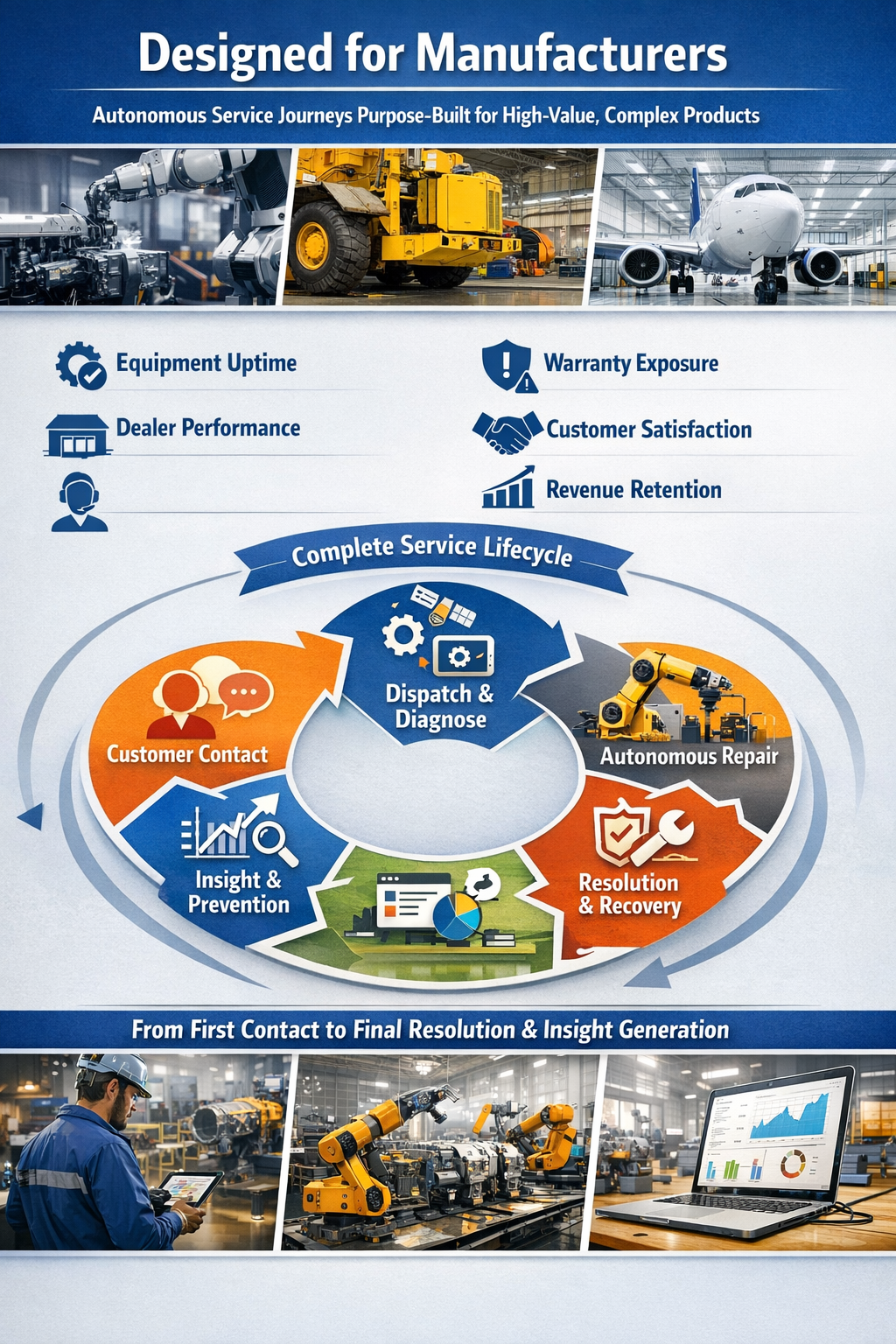
Autonomous Service Journeys are purpose-built for manufacturers of complex, high-value products, where service decisions impact:
- Equipment uptime
- Warranty exposure
- Dealer performance
- Customer satisfaction
- Revenue retention
Autonomous Service Journeys cover the entire service lifecycle, from initial customer contact to final resolution, recovery, and insight generation.
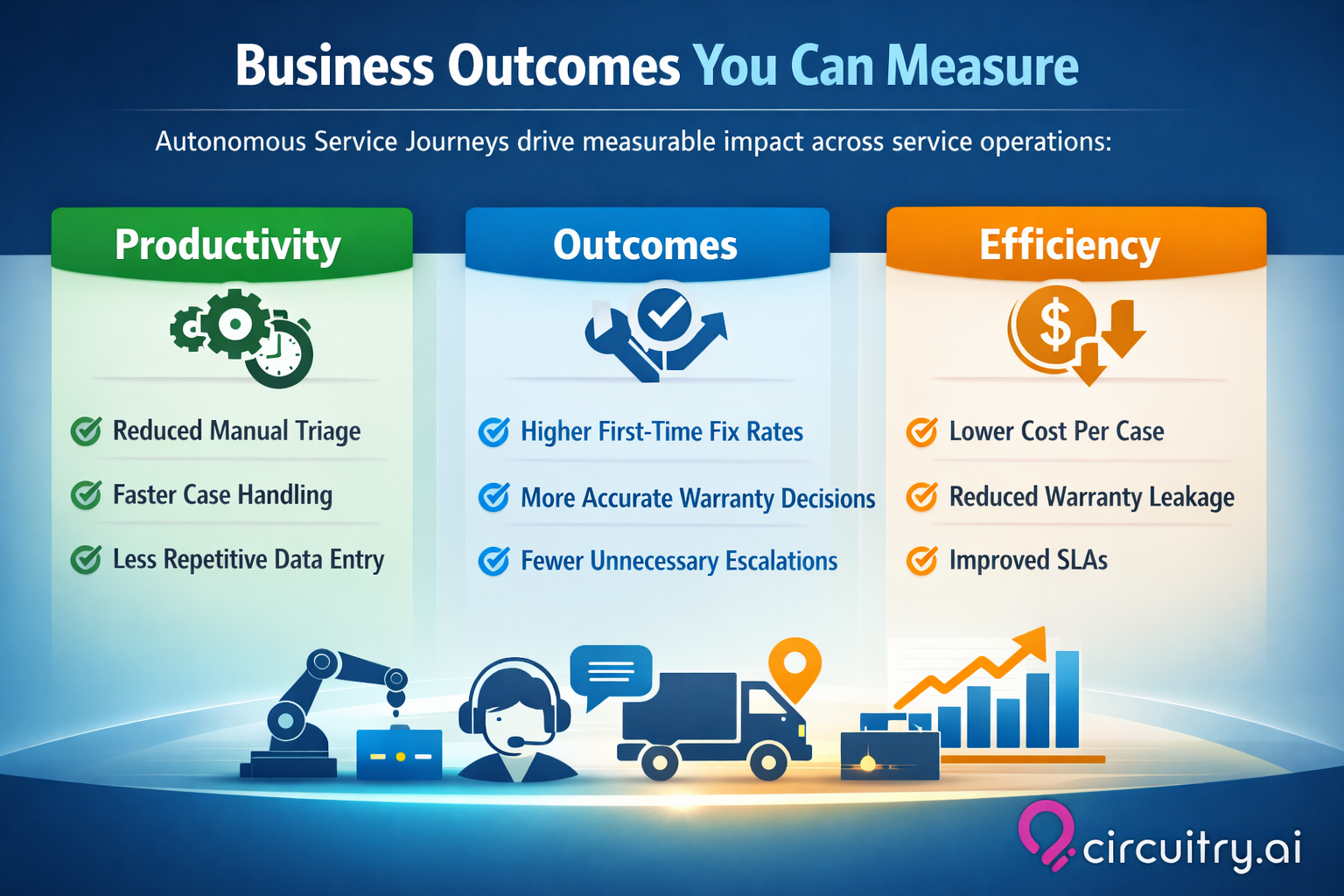
Business outcomes you can measure
Autonomous Service Journeys drive measurable impact across service operations:
Productivity
- Reduced manual triage
- Faster case handling
- Less repetitive data entry
Outcomes
- Higher first-time fix rates
- More accurate warranty decisions
- Fewer unnecessary escalations
Efficiency
- Lower cost per case
- Reduced warranty leakage
- Improved SLAs
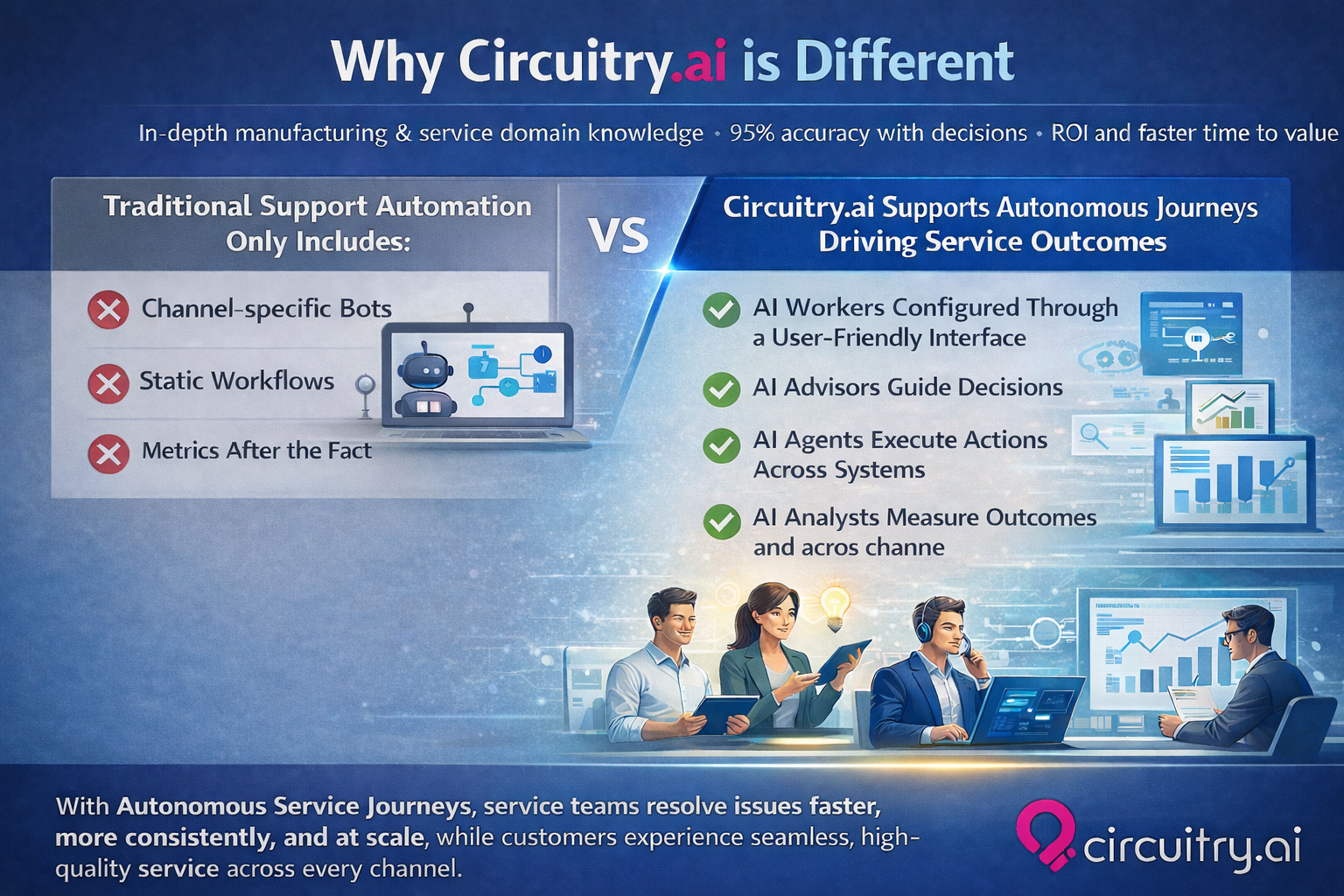
Why Circuitry.ai is different
Traditional Support Automation only includes:
- Channel-specific bots
- Static workflows
- Metrics after the fact
Circuitry.ai Support Autonomous Journey drives service outcomes with:
- AI workers configured through a user-friendly interface
- AI Advisors guide decisions
- AI Agents execute actions across systems
- Analysts measure outcomes and close gaps
With Autonomous Service Journeys, service teams resolve issues faster, more consistently, and at scale, while customers experience seamless, high-quality service across every channel.
How Circuitry.ai powers Autonomous Support Journeys
By combining AI Advisors that guide decisions, Agents that execute actions across CRM, ERP, FSM, warranty, parts, and knowledge systems, and Analysts that continuously monitor and refine performance, Circuitry.ai orchestrates end-to-end Autonomous Service Journeys without disrupting your existing platforms. Our volume-based pricing model aligns with the number of support cases processed, allowing organizations to start small, prove ROI quickly, and scale automation predictably as demand grows.
Ready to see how Autonomous Support Journeys can transform your service operations? Schedule a demo with Circuitry.ai to explore real workflows, measurable outcomes, and pricing tailored to your case volume.
How Autonomous Service Journeys Work and Deliver Value
What is an Autonomous Service Journey?
An Autonomous Service Journey is an end-to-end service flow that connects the decisions, people, AI Workers, data, and systems required to move a service event from request to resolution. The journey continuously senses what is happening, interprets the available context, decides what should happen next, acts through connected systems, and learns from the result.
For example, a journey can receive a customer request, identify the product and asset, assemble service history, determine the likely issue, recommend the repair and parts, evaluate warranty coverage, create or update a work order or claim, communicate status, route exceptions, and record the final outcome.
What service problem does an Autonomous Service Journey solve?
Most service processes are divided across channels, teams, and systems. A customer request may become a support case, work order, parts search, warranty decision, dealer interaction, and follow-up communication. Each handoff can lose context, add delay, create rework, or produce a different decision.
An Autonomous Service Journey carries the relevant context across those steps and coordinates them around a shared outcome, such as faster resolution, higher first-time-fix rates, greater equipment uptime, a compliant claim decision, or lower cost to serve.
How is the ROI of an Autonomous Service Journey measured?
Circuitry.ai starts with the decisions that drive measurable operational or financial impact. The organization establishes a current-state baseline and compares it with AI-assisted and automated performance. Metrics can include decision volume, handling time, touches per case, escalation rate, first-time-fix rate, repeat visits, resolution time, automation rate, claim accuracy, leakage, parts returns, cost to serve, SLA performance, uptime, customer experience, and service margin.
Because each decision can capture its context, action, and outcome, value can be attributed to a specific AI Worker, decision, process, or journey. This makes it possible to determine where more autonomy creates value and where human review should remain.
Why use Circuitry.ai instead of building autonomous service orchestration internally?
Building autonomous service orchestration requires much more than selecting a language model or agent framework. Organizations must develop service-domain context, retrieval capabilities, data relationships, decision criteria, evaluation datasets, confidence models, approval and exception logic, integrations, security controls, auditability, feedback loops, and user experiences for every journey.
Circuitry.ai provides a proven, purpose-built platform for complex service operations, with ready-to-deploy AI Workers and unique Service Decision Intelligence models. These capabilities combine service knowledge, decision logic, governed autonomy, cross-system orchestration, and outcome measurement without requiring customers to build each component internally.
Customers can begin with a focused, high-value service decision, limit their upfront investment, integrate with existing systems, and prove the operational and financial value before expanding. This reduces implementation risk, accelerates time to value, and allows the same AI Workers, decision models, integrations, intelligence, and governance to be reused across additional service journeys.
Instead of investing time and resources in building and maintaining the underlying AI technology, customers can focus on improving service business outcomes, equipment uptime, service margins, workforce productivity, and customer experience.
How are Service AI Workers orchestrated within a journey?
Circuitry.ai uses Service Decision Intelligence to coordinate specialized Service AI Workers according to the current state of the service event, the decision required, the available evidence, and the authorized level of autonomy.
An Agent may receive and classify a request. An Advisor may interpret the issue and recommend the next best action. An Analyst may score the decision, evaluate evidence, or identify risk. Another Agent may execute the approved action in a connected system. A person reviews the decision when policy, confidence, risk, or business impact requires human judgment. The orchestration can repeat as new information arrives until the desired outcome is reached.
How do the other Circuitry.ai capabilities fit into an Autonomous Service Journey?
|
Circuitry.ai Capability |
Role in the Journey |
|
Data Fabric and Connectors |
Bring service knowledge, operational data, and transactions together from CRM, ERP, FSM, DMS, warranty, parts, contact center, email, voice, and other environments. |
|
Service Knowledge Graph |
Connects service knowledge resources, parts BOM, and service lifecycle data by modeling the rich relationships among products, assets, symptoms, fault codes, repairs, parts, policies, contracts, people, and outcomes. |
|
Service Decision Intelligence |
Provide the shared intelligence layer that senses context, recommends or scores decisions, governs actions, and captures results. |
|
Decision Models and Decision Circuits |
Define the evidence, criteria, rules, confidence thresholds, approvals, exceptions, and next actions for a specific service decision. |
|
Service AI Workers |
Provide specialized Advisors, Analysts, and Agents that guide decisions, evaluate data, and execute approved work. |
|
Human-in-the-Loop Governance |
Keep people in control through review queues, approval policies, explanations, escalation logic, role-based access, and audit trails. |
|
Outcome Analytics and Feedback |
Measure decision quality, adoption, automation, operational KPIs, and financial impact, then use feedback and outcomes to improve future decisions. |
|
Service Solutions |
Apply the common platform to field service, technical support, parts, warranty, service contracts, claims, dealer support, and quality improvement. |
|
Simulator, TRACK, and POE |
Test decisions on historical or representative data, establish a baseline, prove value, and scale using Productivity, Outcomes, and Efficiency measures. |
|
Service Decision Unit Pricing |
Align recurring economics with the volume and value of service decisions processed as the journey expands. |
How is an Autonomous Service Journey different from a chatbot, copilot, RPA, or static workflow?
A chatbot or copilot primarily helps a user retrieve information or generate a response. RPA and static workflows execute predefined steps. An Autonomous Service Journey combines those useful capabilities with service-specific decision intelligence. It assembles cross-system context, evaluates evidence, applies policies and decision criteria, scores confidence and risk, determines the appropriate level of autonomy, coordinates specialized AI Workers, executes approved actions, and measures whether the decision achieved the intended outcome.
The autonomous service journey can adapt when new information arrives or an exception occurs instead of following one fixed path. Its objective is not only to complete a task, but to improve the quality, speed, consistency, and business result of the service decision.
How much autonomy can an Autonomous Service Journey have?
Circuitry.ai supports multiple levels of autonomy for each service decision. An AI Worker can provide guidance while a person makes the decision, prepare an action for approval, execute within defined limits, or automate an eligible decision from end to end. Customers determine which decision categories can receive greater autonomy and set the confidence thresholds, evidence requirements, financial or risk limits, approval rules, and governance policies that control how AI is allowed to act.
Low-confidence decisions, missing or conflicting evidence, policy exceptions, high-value transactions, safety-sensitive situations, and unusual cases can be routed to an expert through Human in the loop review. The expert receives the relevant context, evidence, recommendation, and reasoning needed to make or approve the decision. As decision accuracy, trust, and business outcomes are demonstrated, customers can selectively increase autonomy for appropriate decision categories.
Circuitry.ai provides analytics to monitor automation levels, decision accuracy, approvals, overrides, escalations, exceptions, and business outcomes. Analysts also decompose each journey into its individual decisions, showing which decisions are guided, Human in the loop, or automated. This helps customers manage autonomy at a detailed level, identify where additional automation is appropriate, and maintain governance as autonomy increases.
How can we prove the business case for Autonomous Service Journey before scaling?
Begin with one high-volume or high-cost decision area, such as support intake, technician guidance, parts identification, warranty review, or service-contract claims.
Circuitry.ai can use historical or representative decisions in the Circuit Simulator to evaluate accuracy, automation potential, and expected operational and financial impact before a broader deployment.
The TRACK approach moves from capturing the current process and benchmarking performance to proving value and scaling.
POE measures value through Productivity, Outcomes, and Efficiency, while Service Decision Unit pricing aligns ongoing cost with the volume and value of decisions processed.
How do we get started with an Autonomous Service Journey?
Start with a decision-mapping working session focused on one service event. Identify the decisions and handoffs that create the most delay, cost, inconsistency, or customer impact; define the target KPIs; determine the knowledge and systems required; and set the initial human-review and automation boundaries.
A focused deployment is designed to demonstrate time to value within 90 days. Starting with a bounded decision and historical or representative data can shorten the path to a measurable result.
Circuitry.ai can then test the selected decisions with the Simulator or a focused Proof of Value, establish the baseline, configure the required AI Workers and Decision Circuits, and measure the results before the journey is expanded.
The organization can then connect additional systems, add AI Workers, and expand autonomy as accuracy and value are proven.