For warranty and service contract providers, claims operations are where cost, complexity, and customer experience converge. AI can help solve the biggest challenges in this process by reducing manual effort, improving decision accuracy, accelerating adjudication, and giving claims teams the context they need to make faster, more consistent decisions.

In the MAPconnected webinar Smarter Warranty Decisions: How AI Drives Claims Accuracy & Reduces Costs, Lance LaCoe, President of CARS Protection Plus, discussed how CARS deployed Circuitry.ai’s AI-powered Warranty Decision Intelligence to improve adjudication accuracy, reduce claims costs, and support growth without disrupting its existing workflow.
Watch the full webinar on demand here.
Here are five practical takeaways from the conversation for warranty leaders evaluating AI in their own operations.
Takeaway 1. AI can layer onto existing warranty systems without disrupting workflows
The most common objection that warranty operations leaders raise about AI adoption is the cost and complexity of getting it in place.
CARS Protection Plus has run on PCMI as their warranty admin system since 2017, and that hasn't changed. When Lance and his team went looking for an AI partner, their criteria were clear, as he noted:
“We needed somebody to help us eliminate human error, speed up the process, and we needed something that was really going to help us manage the incredible scaling of our business. We ultimately selected Circuitry.ai because they really fit everything that we were doing right now, but they also offered the best pathway for what we wanted to do in the future.”
Josh was direct on this point: there are no rules engines to rebuild, no requirement to pull in IT resources for the integration to function, and no changes to how the admin system operates. CARS' claim adjudicators still work inside PCMI, while the Warranty Decision Intelligence layer surfaces claim scores, coverage guidance, and automation on top of that workflow.
What Lance observed surprised him: with Circuitry.ai’s Warranty Decision Intelligence, CARS is now getting more value out of PCMI. Pop-up notes and dealer-specific rules that adjusters were expected to read and apply manually are now ingested by the platform and incorporated into claim scoring automatically. This means adjusters can spend more time in PCMI doing the work that moves claims forward.
Takeaway 2. Improved adjudication accuracy is what drives measurable ROI
Lance was direct about what drove the business case: accuracy first, with speed as the natural result of achieving it consistently.
His ROI model was built on a targeted 2–3% reduction in total claims spend, driven by better contract compliance and more consistent adjudication. On tens of millions of dollars in annual claims, that's a meaningful number, and Lance noted that CARS is on track to hit it within the first year of deployment:
“We've already seen significant improvement in meeting our KPIs, making sure that we can comply with our service level that we provide out to our shops, but also just making sure that we're providing those timely answers to questions. Not only the shops but also the customers. So that value proposition and the customer experiences have improved significantly through Circuitry.ai.”
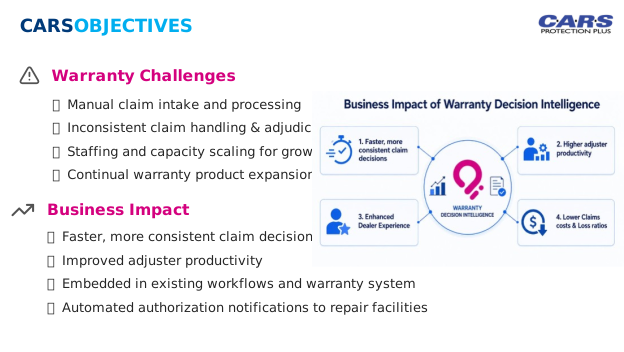
The underlying logic holds across any warranty organization: when adjusters are working across multiple product families, dealer-specific rules, and lender-approved contract variations, the opportunity for error is constant. Improving accuracy on those decisions is what reduces leakage, protects the loss ratio, and justifies the investment.
Josh framed what accuracy means in practice: "Our objective when we started Circuitry.ai is to ensure that AI is never treated like a black box. If an agent is making a decision, all aspects of that decision, all of the reference material that went into that decision, are available to you.”
Takeaway 3. AI should support the way your repair network actually works
One of the limitations Lance encountered when evaluating competing systems was a rigid requirement for electronic claim intake. If a repair facility wanted to submit a claim, it had to come in through a web portal or electronic form. For a VSC provider like CARS Protection Plus, which serves thousands of independent repair shops that simply prefer to pick up the phone, that's not a workable model.
Circuitry.ai's architecture handles both. When a shop calls in, an adjuster takes the claim through the standard intake process, enters the details, and from that point, the claim moves through the same scoring and adjudication workflow as one submitted electronically by a franchise dealer. The intake method doesn't constrain the automation downstream.
Lance described this as one of the platform's most practically valuable characteristics, the ability to customize how the funnel is entered without compromising what happens inside it.
For TPAs and VSC providers managing broad, mixed repair networks, that flexibility is important. An AI deployment that only works for your most digitally sophisticated service partners isn't a full solution; it's a partial one.
Takeaway 4. You can automate the full claim lifecycle, starting at any stage
The Autonomous Warranty Journey that Circuitry.ai enables covers the full claim funnel: intelligent intake, claim scoring, adjudication, invoice matching, and payment. Each stage has AI Agents ready to operate, and the system routes exceptions to human review while processing compliant claims end-to-end without manual intervention.
The speed gains across that funnel are significant. As Josh mentioned: “For a claim score, we're under the 60-second mark…. Same thing for an adjustment, 30 seconds on average. …When you think about trying to do an adjustment on a claim manually, 10 minutes or 18 minutes, depending on your line of business, if we can do that in seconds versus minutes, that's quite an increase in performance optimization.”
That flexibility extends to where you start. Some customers begin with invoice matching because that's where manual labor is most concentrated. Others start with the warranty advisor. CARS began with the advisor and notification agent, then layered in claim scoring. There's no single right entry point; the platform is designed to deliver value wherever you begin and compound it as you expand.
Takeaway 5. Adoption goes smoothly when the claims team is a partner from day one
Change management is where many technology deployments lose momentum. CARS ran it differently. Claims leadership was involved in vendor selection alongside the executive team, rather than being informed after the fact. That early partnership shaped how the rollout was received and laid the groundwork for a team already invested in the outcome.
As Lance put it: “What we've been able to do through Circuitry.ai is provide them and roll out a model where the AI tools have actually learned on all of our products, where it's learned on all of the notes that we've attached to the dealers where it understands the shops. So now we give them what they were already seeking, but we give it to them with all the right information already baked into it.”
For warranty operations leaders worried about adjuster resistance, the CARS experience offers a practical reframe: if your claims team isn't brought in early, you'll spend the back half of your deployment winning over the people who matter most to its success.
See Warranty Decision Intelligence in action
The CARS Protection Plus deployment shows that AI adoption in warranty operations does not have to mean replacing core systems or forcing teams into entirely new workflows. The biggest gains come from improving decision accuracy, supporting the realities of your repair network, and bringing claims teams into the process early so adoption happens with them.
If you’re exploring how to reduce claims leakage, improve consistency, and move toward a more autonomous warranty operation, request a demo to see how Circuitry.ai applies AI to real-world warranty workflows.