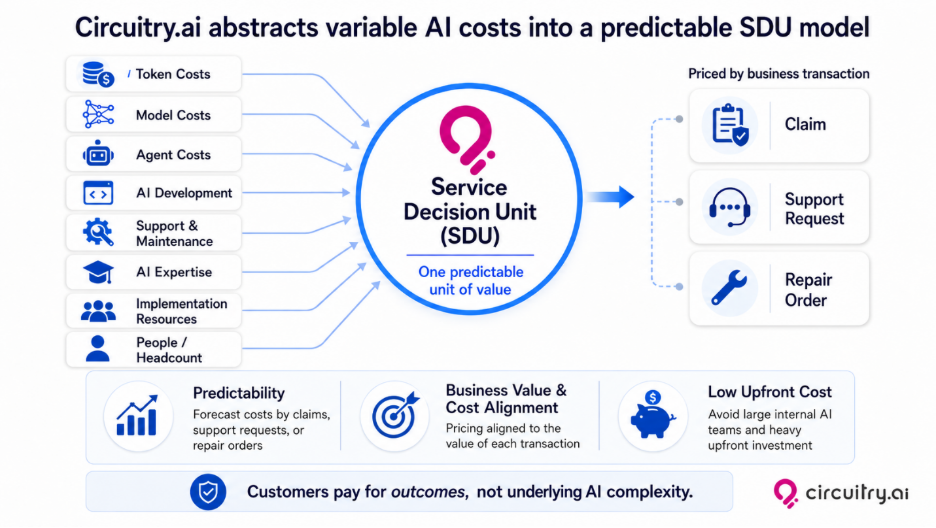
AI is transforming warranty, service, support, and repair operations. But for many companies, one major question remains: how do we budget for AI when the underlying costs are constantly changing?
Token and model costs change. Agent workflows vary in complexity. Some claims require a simple policy check, while others require coverage validation, repair history analysis, image review, fraud signals, labor verification, and human-in-the-loop routing.
If AI pricing is based only on technical consumption, customers are left trying to predict variables they don’t control. Circuitry.ai takes a different approach.
At Circuitry.ai, we price our solutions around Service Decision Units, or SDUs. An SDU is tied to a real business transaction, such as a support request, repair order, parts order, or claim. This gives customers a predictable, business-aligned way to adopt AI across service, warranty, parts, and support operations.
AI pricing should be simple, predictable, and value-based
Service and warranty leaders need pricing that is simple to understand, predictable to budget, and aligned with measurable ROI. That’s the purpose of Circuitry.ai’s Service Decision Unit pricing.
By pricing around claims, support requests, and repair orders, Circuitry.ai gives customers a practical way to scale AI across service operations. Customers gain predictability despite changing token costs, agent costs, and model costs. Circuitry.ai manages the technical optimization needed to deliver accuracy and automation efficiently.
The result is a pricing model that supports better adoption, stronger ROI, and a clearer path to autonomous service operations.
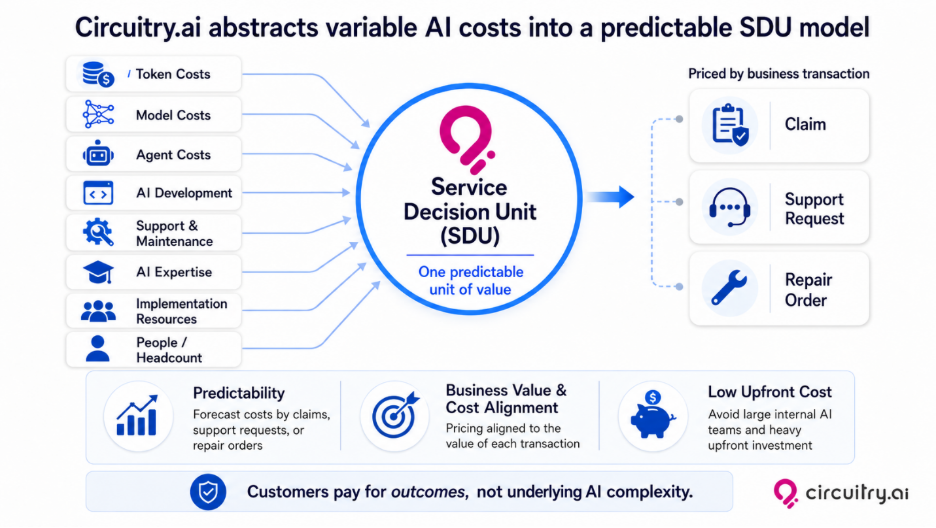
From technical consumption to business outcomes
Traditional AI pricing models often expose customers to the complexity of the technology stack. Pricing may depend on tokens consumed, model calls, number of agents invoked, or compute usage. While these metrics are useful for infrastructure teams, they aren’t how service and warranty leaders measure value.
- A warranty leader thinks in terms of claims processed, decisions automated, review time reduced, leakage prevented, and customer experience improved.
- A support leader thinks in terms of requests resolved, call deflection, faster answers, fewer escalations, and higher first-contact resolution.
- A service leader thinks in terms of repair orders completed, truck rolls avoided, parts accuracy improved, technician productivity, and SLA performance.
That’s why Circuitry.ai uses SDU-based pricing. It connects cost directly to the business activity being improved. For example:
- A warranty claim processed by Warranty Decision Intelligence is priced as a claim-based SDU.
- A customer or technician support interaction handled by a Service AI Advisor is priced as a support-request SDU.
- A repair order enriched, analyzed, or automated by AI is priced as a repair-order SDU.
Each of the business transactions affects productivity, cost, customer experience, compliance, service quality, and revenue.
This makes the economics simple: as customers process more business transactions, they pay in proportion to the value being created.
Turning the biggest variable cost into predictable SDUs
The largest and most unpredictable cost for most companies adopting AI is often the people required to build, manage, support, and improve AI solutions.
Companies that try to internally build service, warranty, claims, or support AI often need a broad set of specialized resources, including AI engineers, data scientists, integration developers, product managers, QA teams, security experts, and service domain experts. They also need people who understand claims policies, repair procedures, service contracts, parts catalogs, diagnostics, dealer operations, and field service workflows.
That creates a major challenge. Even before the AI solution delivers measurable business value, the company is already carrying the cost of internal development, implementation, support, model tuning, monitoring, testing, governance, and ongoing maintenance.
Circuitry.ai’s SDU model changes this equation. Instead of asking customers to fund and manage a large internal AI team, Circuitry.ai converts that complexity into a predictable, business-aligned usage model.
Download our whitepaper on Build vs Buy decision for Service AI.
The cost of building AI in-house
Internal AI initiatives can be powerful, but they’re often expensive because the customer owns every layer of the operating model.
The company must build the solution, integrate systems, train and evaluate models, maintain knowledge sources, monitor accuracy, manage compliance, improve workflows, support users, and keep pace with rapidly changing AI technology.
In service and warranty operations, they also need deep domain expertise to ensure the AI understands policies, repair logic, claims exceptions, labor validation, parts identification, and escalation rules.
That requires ongoing investment and the continuing cost of people, process, and platform support.
Circuitry.ai takes on much of this burden. We focus on optimizing across models, decision intelligence methods, agent workflows, retrieval strategies, automation patterns, and domain-specific service knowledge. Customers benefit from those innovations without needing to build and maintain the full AI operating team themselves.
Moving beyond traditional SaaS user based pricing models
Many enterprise software and SaaS models still rely on pricing structures that grow based on the number of people involved. Customers may pay more for admin users, premium support tiers, implementation resources, managed services, customer success packages, or maintenance fees.
In many cases, the more help a customer needs, the more they pay. Customers want outcomes, but they end up paying for access, support hours, service packages, or the number of people required to keep the system running.
Circuitry.ai’s SDU model is different. We align pricing to business activity and business value, not the number of people required behind the scenes.
Aligned incentives between Circuitry.ai and customers
SDU pricing also aligns Circuitry.ai’s incentives with customer success. If customers are paying for business transactions, Circuitry.ai is motivated to make each transaction more accurate, efficient, and valuable. We aren’t rewarded for generating more tokens or invoking more models. We are rewarded when customers trust Circuitry.ai to support or automate more of their service and warranty operations.
Our focus is on improving decision quality, automation rates, productivity, and measurable business impact. That’s why Circuitry.ai invests in innovations that reduce cost while improving accuracy. Better model orchestration, better knowledge retrieval, better data fabric, better Decision Intelligence, and better agent workflows all contribute to a stronger customer outcome.
The customer gets predictable pricing while Circuitry.ai takes responsibility for optimizing the technology behind the scenes.
Circuitry.ai optimizes the AI stack, and customers get the business value
Behind each SDU, Circuitry.ai continuously optimizes across models, data pipelines, retrieval methods, agent workflows, and decision logic. Our goal is to deliver the highest possible accuracy, automation, and business impact at the lowest sustainable cost per transaction.
That means we don’t treat every question, claim, or repair order the same way. Some decisions may require a powerful reasoning model. Others may be handled by smaller, faster, specialized models.
Some workflows may rely on retrieval from policies, service manuals, repair histories, parts catalogs, or prior claims. Others may use structured rules, predictive models, knowledge graphs, or agent orchestration.
Circuitry.ai focuses on selecting the right combination of capabilities for the job. This includes:
- Model routing to match the right model to the complexity of the decision.
- Retrieval optimization to reduce unnecessary processing while improving answer quality.
- Knowledge indexing and caching to avoid repeated work and improve response speed.
- Decision Intelligence models that combine generative AI, predictive AI, rules, policies, and business context.
- Agent workflow optimization to automate only the steps that create value and avoid unnecessary model calls.
- Accuracy monitoring and feedback loops to improve performance over time.
Built for scale across service journeys
Service and warranty operations are complex. A single customer journey may touch product registration, entitlement, troubleshooting, parts identification, service dispatch, repair order review, warranty claim processing, payment, quality analytics, and customer follow-up.
Each step may involve different systems, data sources, policies, people, and decisions.
Circuitry.ai’s SDU model is designed to handle complexity without making pricing complicated. Whether the unit of value is a claim, a support request, or a repair order, the principle is the same: price the AI around the business decision or transaction being improved.
This lets customers start with a focused use case and expand over time. A company may begin with claims pre-approval, then add AI-assisted claim review, then automate support requests, then enrich repair orders, then use the same decision intelligence foundation to improve quality, parts, and service contract performance.
As adoption grows, the pricing remains connected to operational volume and business value. When the cost per SDU is low and predictable, customers can scale adoption with confidence.
Learn more about Circuitry.ai’s TRACK Framework, a five-step approach to deploying Service AI with purpose, proving ROI, and scaling service with confidence.
Low cost per transaction improves ROI
By keeping pricing tied to a low cost per business transaction, Circuitry.ai makes it easier for customers to measure ROI in practical terms.
When pricing is aligned to these business transactions, customers can directly compare the cost of an SDU to the value created per claim, support request, or repair order.
For example, if manual claim review costs an estimated $13 per claim and the Circuitry.ai SDU price is only $2 per claim, companies can reduce review costs by $11 per claim. That’s approximately 85% cost reduction or 6.5x lower unit cost, by automating claims with AI-powered Warranty Decision Intelligence.
Try our Annual Savings Calculators to identify the value based on the number of business transactions.
Circuitry.ai as your Service Decision Intelligence partner
Circuitry.ai’s SDU pricing model converts the biggest variable cost in enterprise AI, people, expertise, support, and ongoing optimization, into a predictable cost per business transaction.
Instead of building and maintaining large internal AI teams or paying for premium support and services, customers pay for the decisions and workflows that create value: claims, support requests, and repair orders.
This makes AI easier to budget, easier to scale, and easier to justify with measurable ROI. Circuitry.ai manages the complexity of models, agents, tokens, workflows, and AI expertise so customers can focus on outcomes: faster decisions, lower costs, higher accuracy, better automation, and improved service performance.
Circuitry.ai helps service, warranty, and support organizations move from AI experimentation to business-scale automation, with pricing aligned to the decisions that matter.
Schedule a live demo now to learn how you can automate service, support, and warranty journeys.