Service Decision Intelligence: From Answers to Autonomous Service Journeys
Mission-critical service runs on trusted decisions. See how Circuitry.ai's autonomous service journeys turn AI answers into action that protects...
Every AI data center runs on power, cooling, and networking equipment that can't fail. See how Service Decision Intelligence keeps it running.
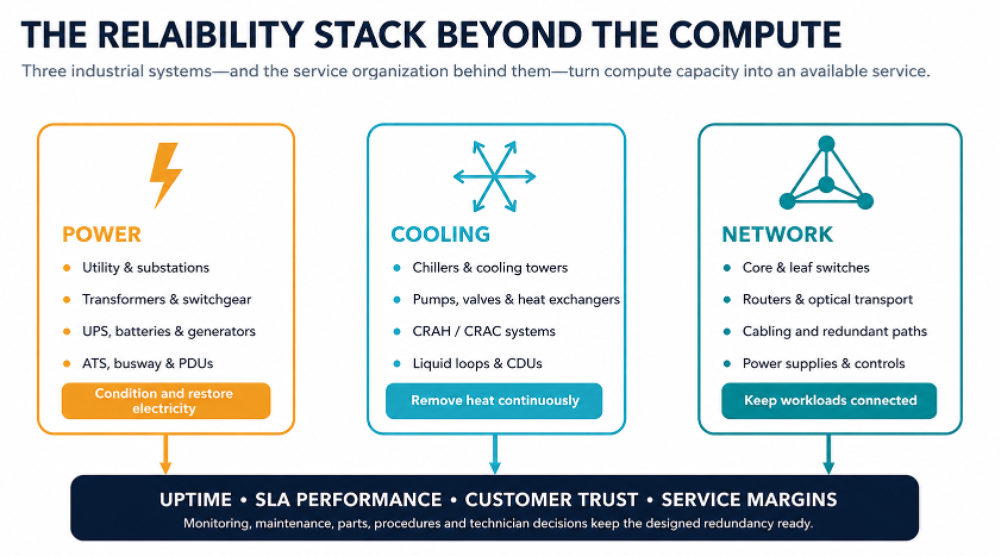
AI is driving one of the largest infrastructure investment cycles in history, with hundreds of billions of dollars flowing into new data centers. Most of that attention goes to GPUs and compute infrastructure. But these facilities run on power, cooling, and networking equipment that must work every time. Even a brief interruption means real financial losses and broken SLAs.
Ironically, the same AI boom that’s fueling this demand also provides the solution. By augmenting service organizations with AI-powered Decision Intelligence, equipment manufacturers and service providers can scale support globally, improve uptime, accelerate response and resolution times, and meet increasingly stringent SLA commitments without scaling their service workforce.
Circuitry.ai’s Service Decision Intelligence is the AI-powered layer that connects equipment context, service knowledge, telemetry, contracts, parts, and workflows to recommend or automate the next best service action.
Short on time? Jump to the sections that interest you the most.
In this article
Why now: AI infrastructure is outpacing traditional service models
AI workloads are denser, less forgiving, and more dependent on uninterrupted performance. Service labor remains constrained while installed bases are expanding, and the expertise needed to maintain specialized infrastructure isn’t scaling as quickly as demand.
At the same time, service contracts and SLA commitments are becoming more demanding, turning every delayed diagnosis, unnecessary dispatch, wrong-part shipment, or preventable escalation into a direct risk to uptime, margin, and customer trust.
Uptime Institute’s 2025 outage analysis reports that power remains the leading cause of serious and severe data center outages, while outages associated with IT and networking are increasing.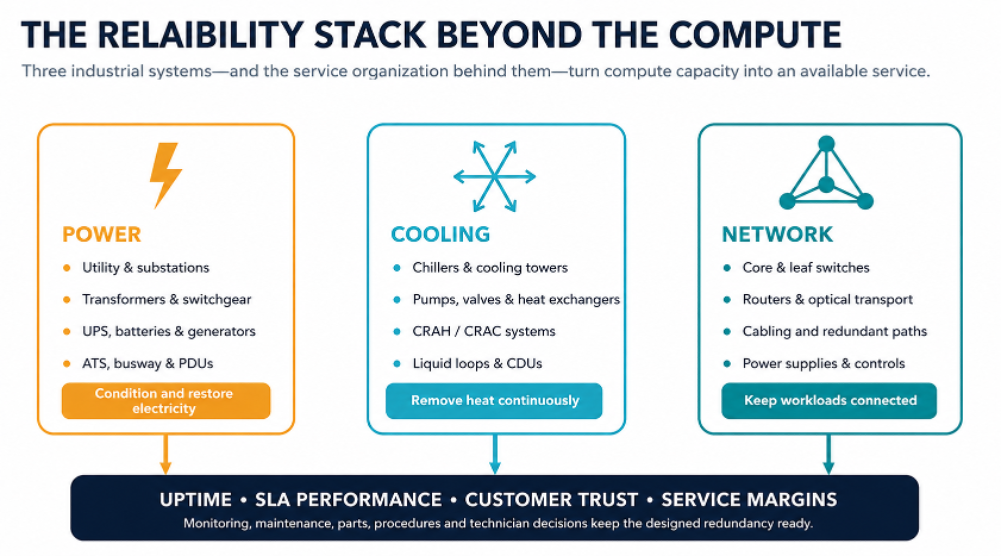
Redundancy is designed into data centers, but redundancy only protects the service when the standby path is actually ready. That’s why the service organization is part of the reliability architecture. Inspection quality, preventive and condition-based maintenance, remote triage, parts availability, and complete debriefs all determine whether the physical infrastructure meets its intended resilience.
Compute platforms get refreshed multiple times over; the power, cooling, and networking equipment underneath them usually doesn't.
Across a decade-plus lifecycle, sites accumulate different models, firmware versions, parts supersessions, maintenance histories, and operating procedures. Meanwhile, experienced technicians retire, service teams change, and knowledge becomes fragmented across manuals, ticket notes, and engineering files.
The long lifecycle makes every service decision contextual. The right answer depends on the specific asset, its configuration, service history, the site’s criticality, current operating state, the applicable contract, and the time remaining before an SLA is at risk.
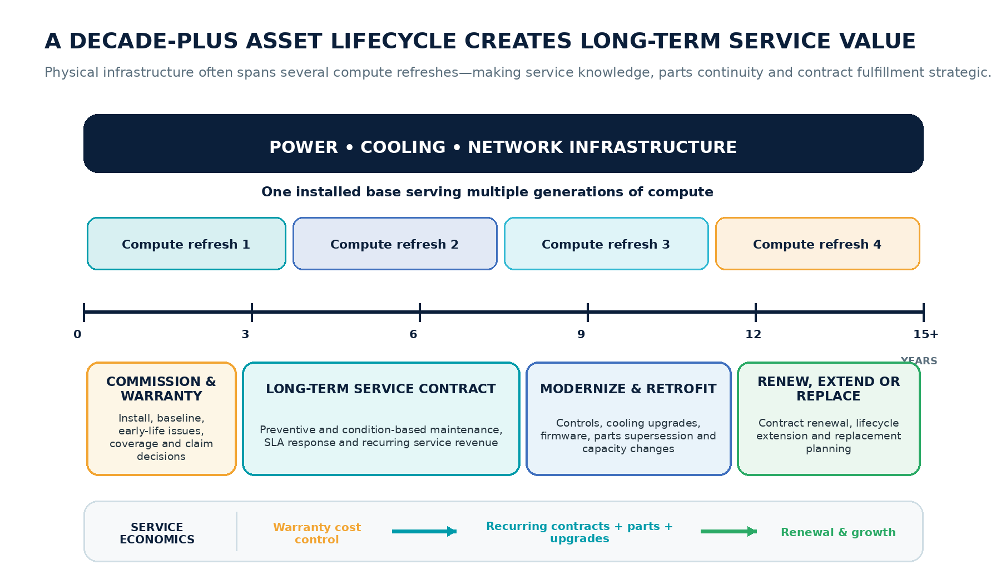
After the original warranty period, data center operators rely on long-term maintenance and service agreements for critical equipment. For equipment manufacturers and service providers, the installed base can generate recurring revenue through planned maintenance, parts, lifecycle extensions, and contract renewals.
But the economics only work when the provider fulfills the promised service without overservicing. Margin can disappear through unnecessary truck rolls, slow entitlement checks, excessive escalations, incomplete work-order data, and preventable SLA failures.
The strategic opportunity is to improve both sides of the equation: deliver faster and more reliable service to protect uptime, while reducing the avoidable effort required to fulfill each contract. This is where Service Decision Intelligence becomes essential.
Field service management, enterprise asset management, CRM, and work-order platforms remain essential systems of record.
What they don’t answer is the highest-value question at the moment: What should happen next?
Decision Intelligence adds this missing layer by combining asset context, service knowledge, predictive signals, policies, parts, and workflow state to recommend or automate the next-best service decision. It works alongside the FSM system, using it to execute and record work without requiring a rip-and-replace transformation.
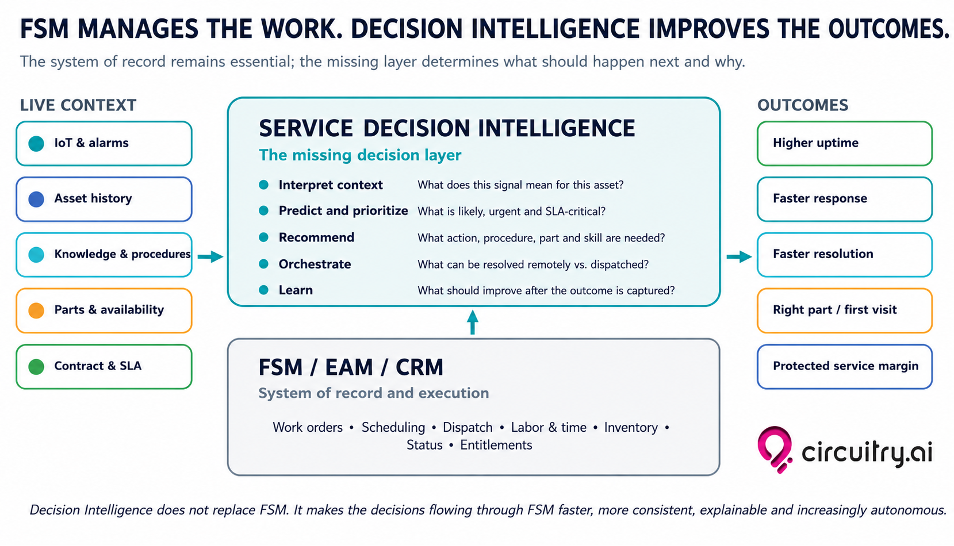
Circuitry.ai’s AI-powered Service Decision Intelligence platform connects service knowledge, asset and IoT data, work history, parts information, contracts, SLAs, and live workflow context to help service teams make faster, more consistent, and explainable decisions.
Service AI Workers support different moments in the journey.
Service Decision Intelligence becomes a trusted decision layer inside the channels and systems service teams already use, such as FSM, CRM, EAM, browser, mobile, voice, email, and messaging, so the next best action is available at the point of work.
A sensor can report temperature, vibration, flow rate, and many other signals. It can also create thousands of alerts that still require a human to determine relevance.
Monitoring identifies the anomaly. Decision Intelligence then compares it with the asset configuration, recent maintenance, operating load, prior incidents, site criticality, and contract terms. It can rank likely causes, recommend safe remote checks, determine whether the issue is trending toward an SLA risk, and, if dispatch is required, attach the correct procedure, skill requirement, and probable parts kit to the work order.
After resolution, the completed work order, technician notes, replaced parts, and sensor normalization become feedback. The next similar event can be identified and resolved faster.
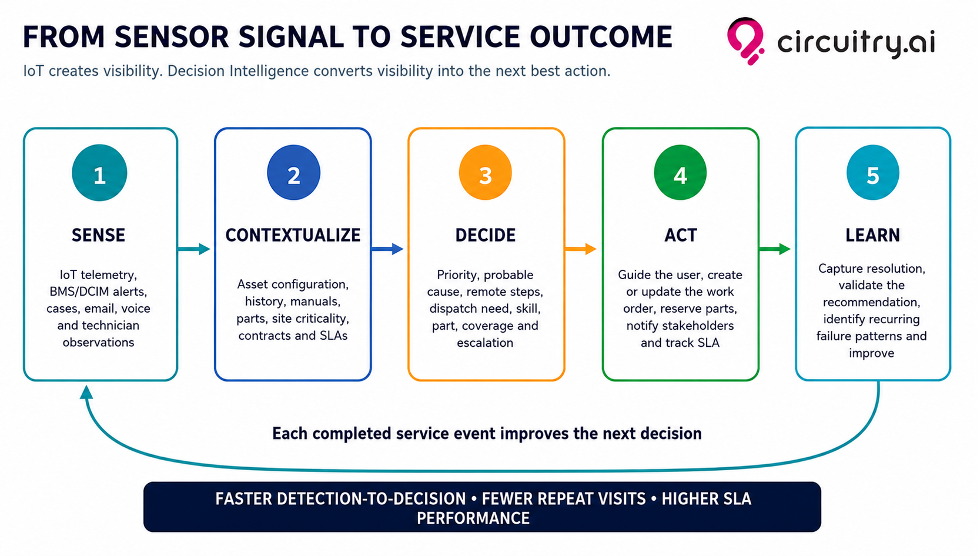
AI changes the operating model by compressing decision time, distributing expert knowledge, automating coordination, and helping less-experienced personnel perform with greater consistency. The service leader’s role evolves from managing workforce activity to managing install-base performance and lifecycle economics.
The priorities remain practical: improve uptime, shorten response and resolution time, increase first-time-fix performance, improve parts accuracy, fulfill contracts consistently, retain service knowledge, and grow service revenue at healthier margins.
Circuitry.ai will join Hypertec at the upcoming Field Service Next East 2026 conference in Orlando for a case study on how AI is reshaping service and support operations and helping automate support at scale. Ashok Kartham, Founder and CEO of Circuitry.ai, will be joined by Ramzi El-Achkar, Director of Hardware Support at Hypertec.
The next wave of data center investment will need the supporting physical infrastructure to remain available through changing loads, equipment generations, service teams, and contract obligations.
The providers that connect sensor signals, service knowledge, parts, contracts, systems of record, and human expertise into a closed-loop decision system will be better positioned to protect uptime, fulfill SLAs, and build profitable recurring service businesses.
Schedule a demo to see how Circuitry.ai helps service organizations convert equipment signals, service knowledge, parts, contracts, and workflows into faster decisions, stronger SLA performance, and more profitable service delivery.
Mission-critical service runs on trusted decisions. See how Circuitry.ai's autonomous service journeys turn AI answers into action that protects...
Discover how Service AI workers can solve the skilled labor shortage in service industries, boosting efficiency and reducing costs.
Discover how AI Service Advisor can revolutionize service teams in field service, dealerships, contact centers, and customer self-service.