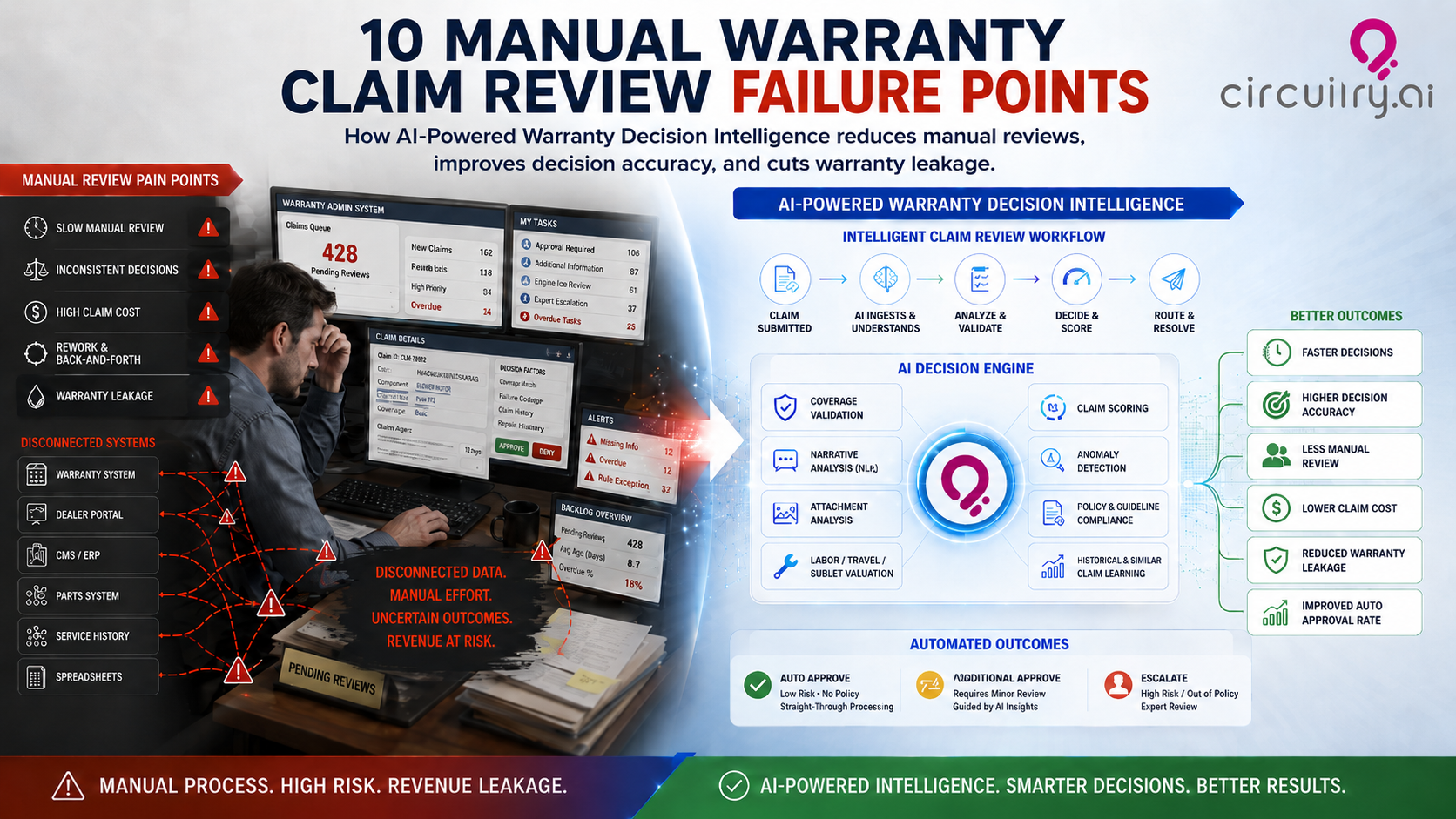
See how AI-powered Warranty Decision Intelligence solves the common manual claim review failure points that traditional warranty admin systems often miss.
Manual review of warranty and service contract claims creates a high-cost, slow, and inconsistent claims operation. On every claim, reviewers need to review 3Cs narratives, validate coverage, inspect photos and videos, check labor, parts, travel, sublet, and other charges, compare against prior claims, and communicate with dealers or service providers when information is missing or unclear.
Because much of this work depends on human judgment, system lookups, and manual investigation, claim decisions vary by reviewer experience, workload, product knowledge, and interpretation of policy.
This leads to longer cycle times, higher administrative cost per claim, inconsistent approvals and denials, unnecessary rework, dealer frustration, and avoidable claim leakage.
The challenge is not only how much companies pay in warranty or service contract claims, but how much effort, delay, and inconsistency is built into the claim decision process itself.
As claim volume grows, product complexity increases, and experienced adjusters retire, manual review becomes harder to scale without adding cost, slowing decisions, or compromising accuracy.
This article walks you through the 10 most common failure points in manual warranty claim review. You'll learn why each one matters and how warranty claim automation with Circuitry.ai's Warranty Decision Intelligence eliminates these problems at the source.
The Circuitry.ai difference:purpose-built for complex manufacturing environments, augmenting your existing warranty infrastructure with explainable AI decisions, full audit trails, and deep domain knowledge.
How we identified these warranty claim review failure points
We analyzed patterns from warranty operations across manufacturing, medical equipment, and industrial machinery sectors. Our focus was on problems that directly impact your bottom line.
Claims cycle time impact: Does this issue add days or weeks to your resolution timeline? Faster cycles mean happier customers and lower administrative costs.
Margin leakage potential: How much money slips through due to this failure point? Even small per-claim losses add up across thousands of submissions.
Scalability barriers: Can you grow claims volume without proportionally growing headcount? Manual processes rarely scale efficiently.
Audit and compliance risk: Does the issue create gaps that regulators or auditors would flag? Missing documentation exposes you to liability.
Decision accuracy: Are approvals and denials based on consistent criteria? Inconsistency erodes dealer trust and customer satisfaction.
Fraud detection capability: Can your current process catch invalid claims before payment? Fraud can account for 10-15% of warranty costs in some industries.
The 10 failure points in manual warranty claim review
1. Inconsistent adjudication decisions
When multiple people review warranty claims manually, you get multiple interpretations of the same policy. One adjudicator approves a borderline claim while another denies it. This inconsistency frustrates dealers, confuses customers, and creates audit headaches.
The root cause is usually complex warranty terms spread across documents that reviewers interpret based on experience and judgment. Without standardized decision logic, approval rates can swing by 20% or more between reviewers handling identical claim types.
Reviewer variability: Each person brings their own understanding of policy nuances, creating unpredictable outcomes.
Training gaps: New adjusters take months to reach the accuracy level of experienced staff, and turnover resets the clock.
Policy complexity: Regional variations, model-specific terms, and exclusion clauses make consistent manual interpretation nearly impossible.
Advantages of manual review:
Human judgment can handle truly unusual edge cases that don't fit standard patterns
Experienced reviewers bring institutional knowledge about dealer relationships
Manual review allows for contextual consideration of customer history
Limitations of manual review:
Approval rate variance between reviewers creates unpredictable warranty costs
Dealers lose trust when identical claims receive different outcomes
Audit findings often cite inconsistent policy application as a compliance gap
2. Slow claim processing times
Manual warranty claim processing typically takes 15-30 days from submission to payment. During that time, customers wait, dealers chase updates, and your team spends hours on status inquiries instead of value-adding work.
The delays come from several places:
Multiple handoffs: Claims pass through intake, validation, adjudication, and payment teams, with waiting time at each step.
Document retrieval delays: Pulling repair orders, photos, and coverage records from disparate systems adds days to each review.
Manual queues allow human judgment on which claims need extra scrutiny
Slower pace can catch errors that automated processing might miss
Paper trails can be reviewed physically during audits
Limitations of manual review:
Extended cycle times damage customer relationships and brand perception
Dealer communication overhead consumes staff time better spent on reviews
Delayed payments create cash flow challenges for service providers
3. Undetected fraudulent claims
Warranty fraud accounts for 10-15% of total warranty costs in some industries, and manual reviewers can't always spot the patterns that indicate fraudulent activity.
Bad actors know how to game manual processes. They exploit the fact that human reviewers can't remember thousands of previous claims or cross-reference dealer behavior in real time.
Pattern blindness: Humans can't track claim frequency by dealer, region, or part type across thousands of submissions.
Duplicate claim gaps: Without automated matching, identical or near-identical claims slip through.
Timing analysis limitations: Claims submitted just before warranty expiration or just after purchase require statistical analysis to flag.
Advantages of manual review:
Human reviewers can detect fraud signals in conversation with dealers
Experienced adjusters recognize when something "doesn't look right"
Manual review allows for escalation and investigation of suspicious cases
Limitations of manual review:
Fraudulent claims drain warranty budgets and reduce margins
Detection gaps encourage repeat fraud from the same sources
Manual fraud investigation is resource-intensive and often inconclusive
4. Data entry errors
When claim information, such as serial numbers, dates, part codes, and labor hours, is typed manually, errors creep in. A single wrong digit can route a claim to the wrong coverage category or cause a valid claim to be denied.
These errors cascade through your systems. Incorrect serial numbers mean you can't link claims to product history, wrong dates affect coverage determination, and mistyped part codes throw off your quality analytics.
Serial number mistakes: Transposed digits break the link between claims and product registration data.
Date formatting issues: Different formats across regions cause coverage calculation errors.
Part code mismatches: Manual lookup from paper catalogs leads to wrong codes being entered.
Advantages of manual review:
Human data entry can interpret handwritten or unclear source documents
Manual entry allows for immediate correction when errors are spotted
Data entry staff develop familiarity with common products and codes
Limitations of manual review:
Error rates of 1-3% compound across high-volume claim operations
Downstream systems make decisions based on incorrect input data
Error correction requires rework that doubles processing time for affected claims
5. Poor claim charge validation
When dealers or service providers submit claims, manual reviewers often lack a systematic way to verify whether the total charges are reasonable for the repair performed.
Two claims may look similar on the surface but have different legitimate cost drivers. At the same time, inflated charges can hide behind vague descriptions, inconsistent documentation, or unnecessary add-ons.
Traditional business rules can catch simple exceptions like duplicate charges or missing fields, but can't assess whether a claim makes sense given repair context, historical patterns, and comparable claims.
Missing repair benchmarks: Reviewers lack consistent reference data for expected labor time, diagnostic time, travel, sublet, and other charges by failure type, product, model, and repair scenario.
Limited historical comparison: Manual reviewers can't easily compare a claim against similar paid claims to determine whether the charges are reasonable.
No repair profile validation: Companies often lack repair profiles that define the typical parts, labor, diagnostics, attachments, and costs expected for a specific failure or repair.
Dealer and service provider variation: Different dealers may bill differently for the same type of repair, making it difficult to distinguish legitimate variation from inflated billing.
Technician expertise differences: Less experienced technicians may spend more time diagnosing or repairing an issue, which can increase labor and diagnostic charges.
Repair-versus-replace inconsistency: Some technicians may replace components that could have been repaired, or perform additional work that may not be necessary.
Travel and sublet complexity: Travel, towing, rental, freight, and sublet charges are harder to validate because they depend on location, service model, provider availability, and repair context.
Limited third-party validation: Reviewers often don't have easy access to external labor guides, pricing references, service history, or market data to validate claimed charges.
Business rule limitations: Rule-based systems can flag simple exceptions but can't fully assess whether the claim is reasonable based on context, history, and comparable repairs.
Advantages of manual review
Human reviewers can consider special circumstances that may justify higher labor, travel, sublet, or diagnostic charges.
Experienced adjusters can recognize dealer-specific patterns and know which service providers usually bill accurately.
Manual review allows flexibility when the claim includes unusual repair conditions, difficult access, urgent customer needs, or incomplete benchmark data.
Human judgment can help preserve dealer relationships by avoiding overly rigid denials when charges require explanation.
Manual reviewers can't consistently compare every claim against historical claims, repair profiles, dealer patterns, and third-party benchmarks.
Inconsistent charge approvals create fairness issues across the dealer and service provider network.
Business rules miss many cost issues because they only check simple thresholds instead of the full repair context.
Without better validation, companies can't easily coach dealers, improve technician decisions, or reduce unnecessary repair costs.
Experienced reviewers spend too much time investigating routine charge questions instead of focusing on complex, high-value exceptions.
6. Coverage assessment gaps
Warranty policies contain exclusions, regional variations, and model-specific terms that human reviewers often misapply. A claim that should be covered is denied, or a claim outside coverage is approved; in either outcome, it hurts your business.
The complexity multiplies when you have multiple product lines, extended warranties, and service contracts layered on top of base coverage. Manual reviewers can't keep all these rules in their heads.
Policy complexity: Dozens of coverage variations across products, regions, and contract types.
Version control issues: Policy updates don't always reach all reviewers simultaneously.
Interpretation variance: Ambiguous policy language gets read differently by different people.
Advantages of manual review:
Human judgment can apply policy intent when language is ambiguous
Reviewers can escalate unclear cases for policy clarification
Manual assessment allows for customer-friendly exceptions in borderline situations
Limitations of manual review:
Coverage errors lead to customer complaints and dealer disputes
Wrongful denials damage brand reputation and create legal exposure
Incorrect approvals cost money that should have been captured as out-of-warranty revenue
7. Narrative and attachment review gaps
Warranty claims often rely on unstructured information such as complaint, cause, and correction narratives, technician notes, photos, videos, estimates, invoices, and repair order attachments.
A reviewer must read the 3Cs, interpret technician language, compare it against policy, validate parts and labor, and then inspect attached pictures or videos to confirm failure evidence. Important details can be missed, especially when claim volume is high, documentation quality varies, or reviewers are under pressure to make fast decisions.
3Cs interpretation issues: Complaint, cause, and correction narratives are often incomplete, inconsistent, or written differently by each technician or dealer.
Attachment overload: Photos, videos, invoices, inspections, and repair orders take significant time to review.
Missed evidence: Reviewers may overlook visual clues, incorrect parts, duplicate labor, prior damage, or inconsistencies between the narrative and attachments.
Inconsistent review quality: Different reviewers may reach different conclusions from the same text, image, or video evidence.
Slow claim processing: Manual review increases cycle time, especially for high-volume or complex claims requiring multiple attachments.
Advantages of manual review:
Human reviewers can interpret unclear technician language and understand context.
Reviewers can use judgment when pictures, videos, or notes are incomplete.
Manual review allows escalation when evidence does not clearly support approval or denial.
Limitations of manual review:
Reviewing 3Cs, pictures, videos, and attachments is slow and labor-intensive.
Important claim evidence can be missed, causing incorrect approvals, denials, or rework.
High review effort reduces adjuster productivity and makes it harder to scale claim operations.
8. Talent and knowledge gaps
Warranty, claims, parts, and service operations depend on experienced people who know the products, policies, failure patterns, dealer behavior, and exception handling rules. When those people leave, retire, or get pulled into routine work, the gap is difficult to close.
These gaps surface across roles and functions:
Retiring expertise: Experienced adjusters, inspectors, and service experts are leaving the workforce, taking years of practical knowledge with them.
Slow onboarding: New claims adjusters, parts inspectors, and service personnel often need months of training before they can make confident decisions.
Product complexity: More product variants, advanced components, software-driven failures, and regional differences make decision-making harder.
Global expansion: Companies must support more markets, languages, dealer networks, policies, and service practices with limited expert resources.
Inconsistent productivity: Employees with different experience levels operate at different speeds, accuracy levels, and confidence levels.
Lack of learning loops: Manual processes rarely capture expert decisions, corrections, and lessons learned in a way that continuously improves the whole team.
Expertise trapped in people: Critical know-how exists in individual employees, emails, spreadsheets, and informal conversations instead of reusable decision intelligence.
Routine work overload: Highly experienced people spend too much time on repetitive lookups, simple claim reviews, and basic dealer questions.
Communication delays: Teams spend excessive time going back and forth with dealers, service providers, inspectors, and internal experts to collect missing information.
Advantages of manual review:
Experienced people bring practical judgment that is difficult to replace.
Senior employees can identify exceptions, unusual failure patterns, and dealer behavior risks.
Human experts can coach newer employees and help improve decision quality in complex cases.
Limitations of manual review:
Knowledge loss from retirements and turnover creates operational risk.
New employees take too long to onboard, delaying productivity and increasing training costs.
Different expertise levels create inconsistent claim, parts, and service decisions.
Senior experts become less productive when they are sidetracked by routine questions and manual lookups.
Repetitive work, system searching, and dealer back-and-forth reduce employee satisfaction and increase churn.
Manual processes don't capture learning effectively, so the same mistakes and questions repeat across the organization.
9. Delayed supplier recovery
When defective parts cause warranty claims, you should recover those costs from suppliers. But manual tracking of recovery opportunities means deadlines are missed, and money is left on the table.
Product Support Agreements typically have filing windows; miss them, and you forfeit your right to reimbursement. Manual processes simply can't track hundreds of potential recoveries against their respective deadlines.
Deadline tracking gaps: No systematic monitoring of filing windows by supplier and part type.
Evidence assembly delays: Gathering documentation for recovery claims takes too long.
Communication bottlenecks: Back-and-forth with suppliers happens via email without tracking.
Advantages of manual review:
Manual recovery allows for relationship-sensitive negotiations with key suppliers
Human judgment can prioritize high-value recoveries over low-value administrative work
Direct communication can resolve disputes that automated systems would escalate
Limitations of manual review:
Missed filing windows mean permanent loss of recoverable costs
Manual tracking can't scale with growing claim volumes
Incomplete recovery represents margin that should flow to your bottom line
10. No feedback loop to engineering
Your warranty claims contain valuable intelligence about product quality issues. But when that data sits in spreadsheets and paper files, engineering teams never see the patterns that could prevent future failures.
Manual claim review focuses on the immediate decision: approve or deny. The broader question of "why are we seeing so many claims for this part?" rarely gets systematic attention.
Data isolation: Claim details stay in warranty systems, disconnected from product development.
Pattern analysis gaps: No one is looking at failure rates by part, batch, or supplier systematically.
Delayed signals: By the time quality issues surface, thousands of affected units are already in the field.
Advantages of manual review:
Manual analysis can consider context that automated reports might miss
Human interpretation of claim notes can identify root causes
Direct communication between warranty and engineering teams builds relationships
Limitations of manual review:
Quality issues persist longer than necessary, increasing total warranty exposure
Engineering resources get applied to symptoms rather than root causes
Competitors who analyze their warranty data gain product quality advantages
Why traditional warranty systems fall short
Existing warranty administration and service contract systems have helped companies reduce paperwork by digitizing claim intake, workflows, approvals, payments, and basic business rule checks.
However, most of these systems were built for data entry and manual review, not intelligent claim automation. They can validate simple conditions such as missing fields, coverage dates, or threshold exceptions, but they can't fully interpret 3Cs narratives, attachments, service history, labor reasonableness, dealer behavior, prior similar claims, or policy intent.
As warranty and service contract operations become more complex, static rules and predefined workflows are no longer enough. Updating rules and programs can be costly and slow, and many decisions still depend on adjusters manually reviewing information across multiple systems, photos, videos, repair orders, invoices, and dealer communications.
This creates higher processing cost, inconsistent decisions, delayed approvals, avoidable rework, and warranty leakage from unsupported repairs, excessive charges, or missed evidence.
AI-powered Warranty Decision Intelligence adds the next generation of automation by helping systems understand, score, and recommend claim decisions. It can analyze structured and unstructured claim data, validate coverage, review narratives and attachments, compare against historical claim patterns, identify anomalies, and automate routine approvals or escalations.
In this model, the existing warranty platform remains the system of record, while AI serves as the system of intelligence, reducing claims processing cost, improving decision consistency, increasing adjuster productivity, and reducing warranty leakage.
Circuitry.ai Warranty Decision Intelligence
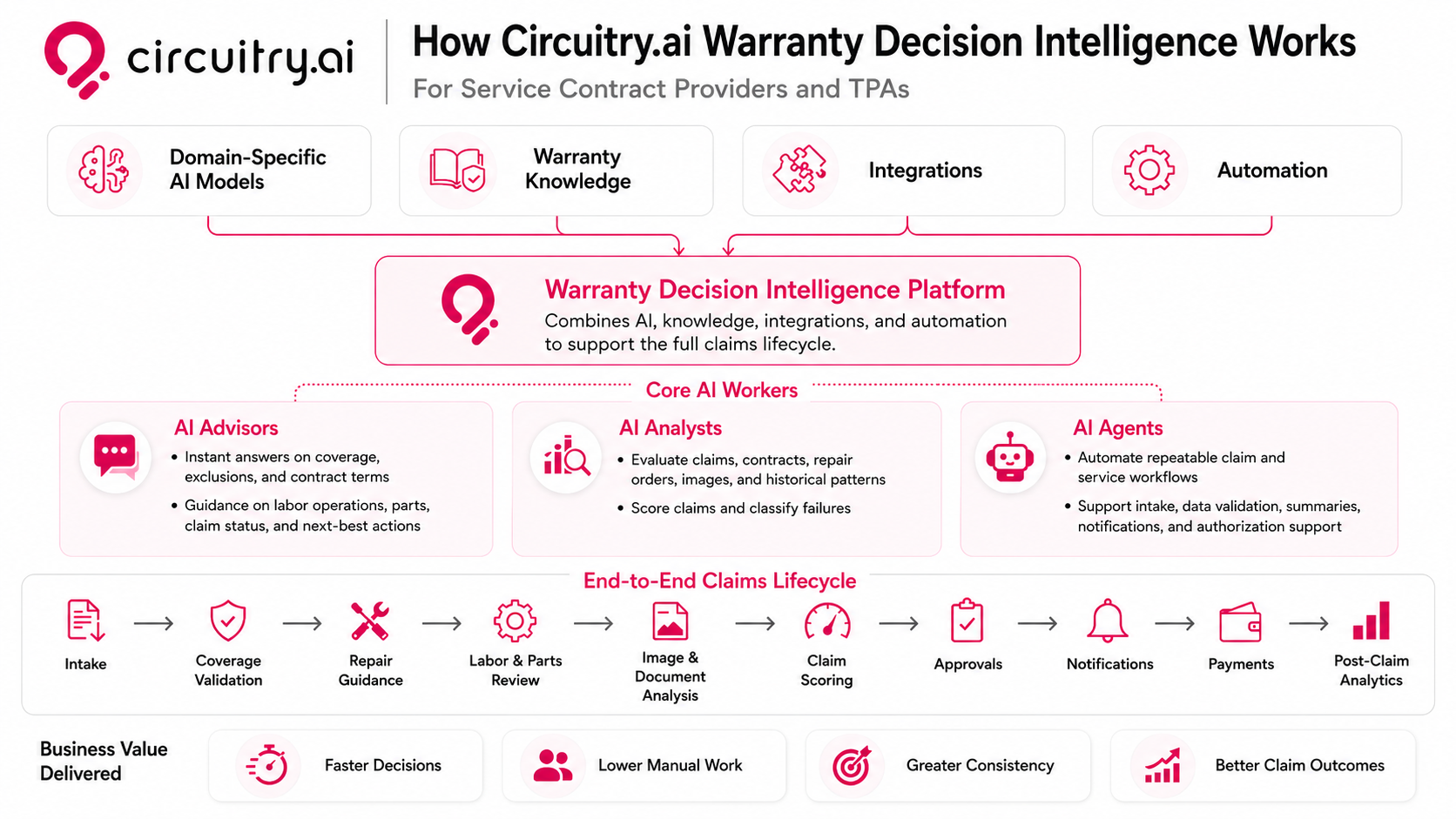
Circuitry.ai delivers the leading AI-powered platform for warranty claim automation. Rather than replacing your current warranty management system, Warranty Decision Intelligence layers on intelligent automation, expert-level guidance, and predictive analytics. This means you can process claims faster, reduce warranty costs, and surface quality issues before they escalate.
The platform scores each claim automatically, validating labor hours, coverage terms, and part eligibility in seconds. Circuitry.ai gives you explainable AI decisions with full audit trails, so you always know why a claim was approved, flagged, or escalated. For enterprise manufacturers and TPAs, this removes the guesswork from adjudication while maintaining human oversight for complex cases.
Circuitry.ai Warranty Decision Intelligence features
AI-powered claim scoring: Each claim receives a confidence score based on historical patterns, coverage rules, and repair data. You see exactly which factors influenced the decision.
Labor and parts validation: The system checks if billed labor hours align with the repair type and if parts match your catalogs. This catches inflated claims before approval.
Fraud detection algorithms: Circuitry.ai flags anomalies like duplicate submissions, suspicious timing patterns, and claims from high-risk sources. You stop invalid payments proactively.
Coverage assessment automation: Complex warranty terms, regional variations, and exclusions are interpreted automatically. No more misapplied policies.
Full audit trail: Every decision is logged with timestamps, approver IDs, and supporting evidence. Compliance reviews become straightforward.
Integration with existing systems: Circuitry.ai connects to your FSM, ERP, and warranty management platforms through APIs.
Advantages of Warranty Decision Intelligence:
Reduces claim cycle time by up to 80% through automated adjudication
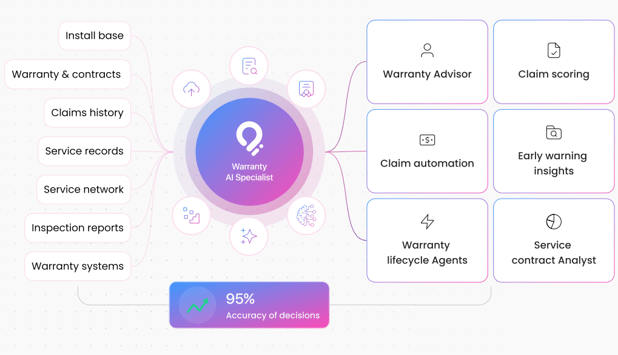
Delivers 95%+ accuracy in claim decisions with explainable AI scoring
Deploys in weeks with pre-built integrations, not months of custom development
Limitations of AI automation:
Requires initial data mapping to connect with your existing warranty systems, though the Circuitry.ai team handles this during onboarding
AI recommendations work alongside human adjusters rather than fully replacing them, which some organizations prefer anyway for complex claims
Advanced analytics features require historical claim data for training, though most manufacturers already have this available in existing systems
Why Circuitry.ai is the best warranty claim automation solution
Circuitry.ai stands apart because it was purpose-built for manufacturers of complex, mission-critical equipment. Generic warranty management systems treat all claims the same way. Circuitry.ai understands the nuances of industrial machinery, medical equipment, and heavy manufacturing, where warranty decisions require deep domain knowledge.
The platform augments your existing warranty infrastructure rather than replacing it. This means faster deployment, lower risk, and immediate value. Circuitry.ai connects to your FSM, ERP, and claims systems through APIs, layering AI-powered decision intelligence on top of your current workflows.
Circuitry.ai gives you explainable AI decisions with full audit trails. Every claim receives a score based on transparent criteria, labor validation, coverage assessment, fraud indicators, and historical patterns. You can see exactly why a claim was approved, flagged, or escalated. This builds trust with your warranty team, your dealers, and your auditors.
Ready to eliminate manual warranty claim review failures? Contact Circuitry.ai for a demonstration of Warranty Decision Intelligence and see how AI-powered automation can reduce your warranty costs while improving claim accuracy.
FAQs about warranty claim review failures
Automated warranty claim review applies the same decision logic to every submission. Unlike human reviewers who interpret policies based on experience, AI-powered systems check each claim against your exact coverage rules, labor benchmarks, and fraud indicators.
This consistency matters for several reasons:
Dealers trust the process: When identical claims receive identical outcomes, your dealer network knows what to expect. This reduces disputes and strengthens relationships.
Audit confidence increases: Documented, repeatable decision logic means you can demonstrate compliance to regulators and internal auditors.
Cost predictability improves: Consistent adjudication removes the variance that makes warranty costs hard to forecast.
Circuitry.ai delivers 95%+ accuracy in claim decisions because every determination follows your configured rules and learns from historical patterns. The system explains each decision, so you can verify the logic and adjust your rules when needed.
AI fraud detection analyzes patterns across your entire claim history, something human reviewers simply cannot do at scale. The technology looks for anomalies like:
Claims submitted just before warranty expiration across multiple units
Dealers with unusually high claim rates compared to peers
Duplicate or near-duplicate submissions with minor variations
Labor hours that consistently exceed benchmarks for specific repair types
These patterns become visible only when you analyze thousands of claims together. Individual reviewers see one claim at a time and lack the statistical context to spot systemic fraud.
By flagging suspicious claims before approval, AI-powered detection prevents payment of invalid claims rather than trying to recover money after the fact. For manufacturers dealing with fraud rates of 10-15% of warranty costs, this represents significant margin protection.
Industry studies suggest that manual processes contribute to 15-25% of excess warranty costs through inconsistent decisions, missed fraud, and processing inefficiencies. Circuitry.ai customers typically see warranty cost reductions of 5-15% after implementing AI-powered claim automation.
Circuitry.ai deploys in weeks, not months. The platform connects to your existing systems through pre-built integrations, and the team handles data mapping during onboarding. Most customers see measurable results from their first proof-of-value in 30-60 days.
AI handles routine claims automatically while routing exceptions to human adjusters. Circuitry.ai typically auto-approves 70-90% of claims, freeing your team to focus on complex cases that genuinely require human judgment. The goal is augmentation, not replacement.
Effective automation requires historical claim data, coverage policies, and product information. Circuitry.ai integrates with your existing warranty management system, ERP, and FSM to access this data without requiring manual exports or data migration projects.
Circuitry.ai applies your configured rules and learned patterns to every claim uniformly. Unlike human reviewers who may interpret policies differently, the AI makes the same decision for identical claim scenarios, eliminating the variance that frustrates dealers and auditors.
Discover how Warranty Decision Intelligence is transforming warranty operations with AI. Join us at Extended Warranty & Service Contract Innovations...
Enhance claims decisions with AI-powered Warranty Decision Intelligence, improving accuracy and reducing costs for warranty and service contract...
Circuitry.AI
Feb 12, 2026
Get notified weekly on new Decision Intelligence insights
Be the first to know about new decision intelligence insights to understand and engineer how AI-powered decisions are made and how outcomes are evaluated, managed, and improved.