Service AIdvisor
Field Service East 2024 Recap
Discover key takeaways from Field Service East 2024 on improving field service, bridging knowledge gaps, and delivering superior customer experiences.
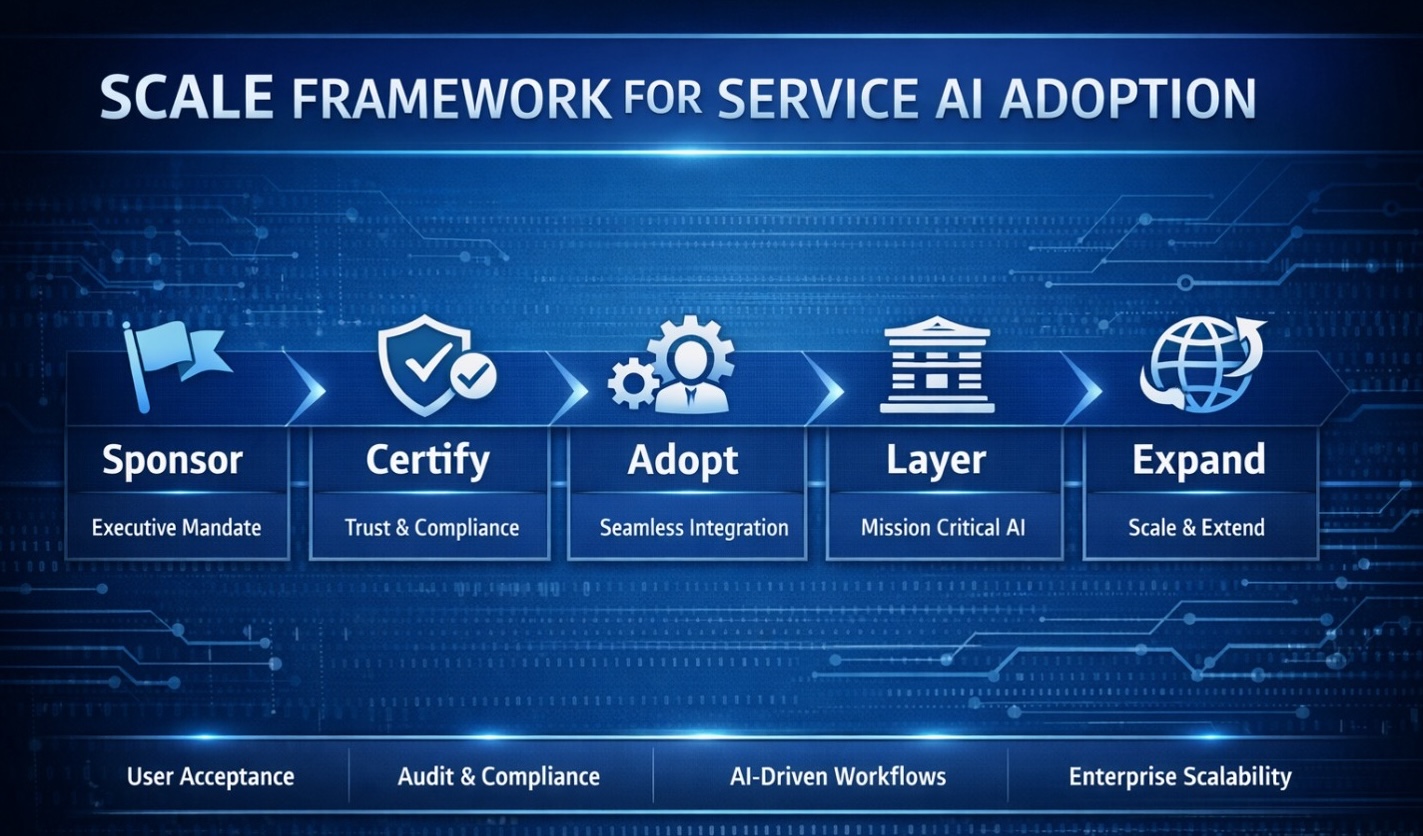
See how the SCALE framework drives successful AI adoption in service operations, turning isolated improvements into sustained enterprise performance gains.
AI investment in service is accelerating. Manufacturers are under mounting pressure to resolve issues faster, improve first-time fix rates, reduce warranty leakage, and protect service margins. AI is expected to deliver on all of these goals, and it can if companies focus on improving the adoption and value realization in AI deployments.
But when service leaders step back and assess enterprise-wide performance, the gap between AI potential and realized business value persists. There are improvements surface in pockets, yet they don’t compound across the operation.
The limitation isn’t the technology itself. The real bottleneck is an organization’s ability to operationalize AI and embed it into its workflows.
The window for competitive advantage is open but closing fast for those without a structured path to adoption.
In practice, AI adoption stalls for a set of predictable, interrelated reasons. Recognizing them is the first step toward solving them.
|
The Insight Each of these barriers is organizational, not technical. Solving them requires a shift in how AI is governed, measured, and embedded into daily operations. |
For AI to drive measurable, sustained impact in service, it must change how decisions are made and how work moves through the organization. That makes adoption fundamentally an operating model decision, not an IT project.
Operational transformation means:
In short, AI must move from being a tool that people use to becoming part of how service runs.
To move AI from pilot to performance, adoption needs structure. That is why Circuitry.ai developed the SCALE framework: a human-centered progression model that moves service organizations from experimentation to enterprise AI maturity.
SCALE is designed specifically for manufacturers running complex service, warranty, and parts workflows. It addresses what happens after go-live: how AI becomes operationally embedded, trusted, measured, and scaled across the enterprise.
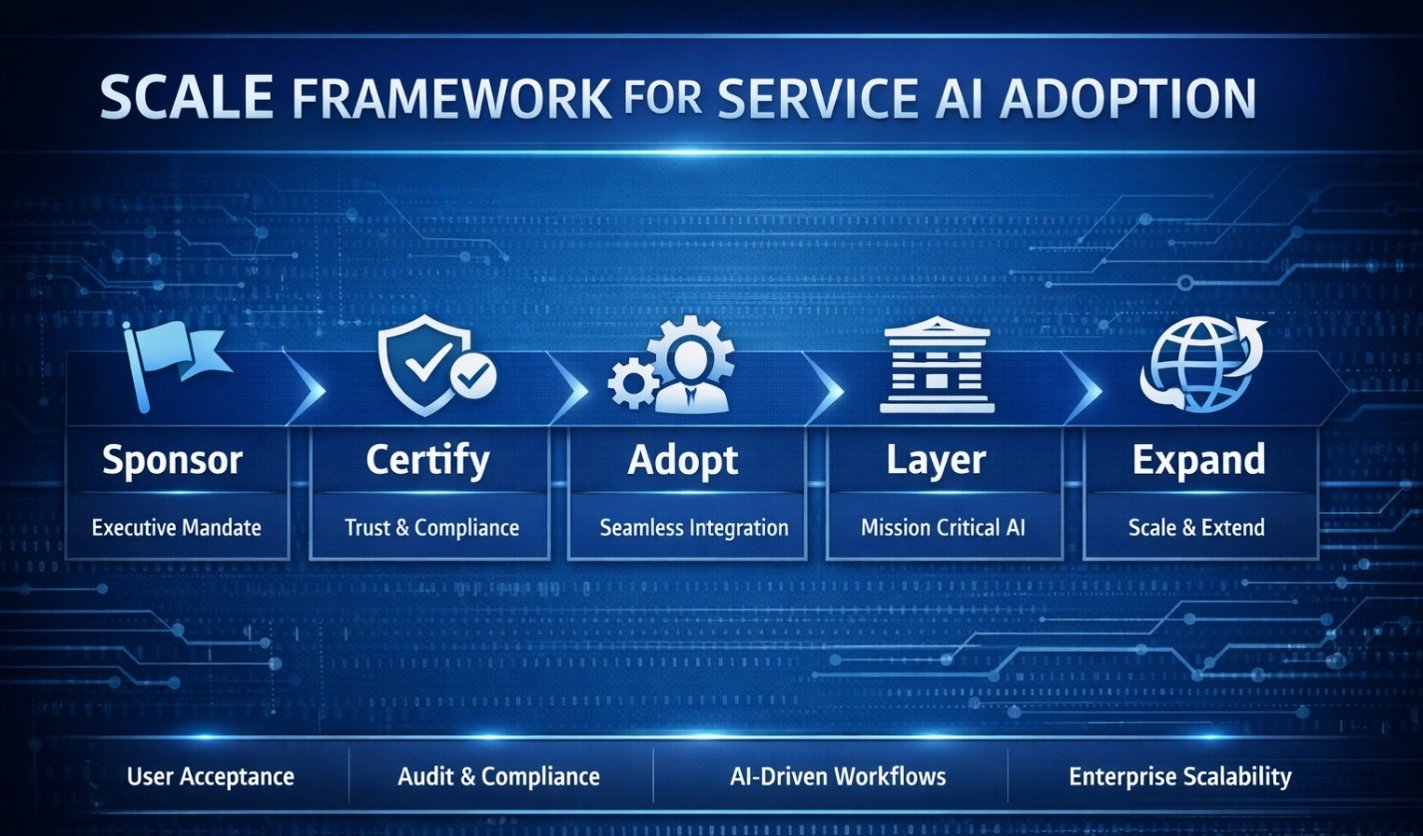
S — Sponsor
Adoption starts at the top. AI must be positioned as an executive-driven initiative tied directly to service outcomes—improving first-time fix rates, reducing warranty leakage, and protecting service margins.
In this phase, leadership defines AI’s role in the service strategy, aligns incentives with usage expectations, and builds adoption metrics into performance goals. Without executive sponsorship, AI remains an experiment.
|
Why It Matters Executive sponsorship transforms AI from a departmental initiative into an enterprise priority, ensuring adoption is aligned with measurable service outcomes from day one. |
C — Certify
Trust is non-negotiable. Before teams will rely on AI recommendations, they need to understand the reasoning behind each decision, how confident the model is, and how to override it when their expertise dictates otherwise.
Transparent rationale, confidence scoring, and clear audit trails turn AI from a black box into a governed decision participant that teams can rely on with confidence.
|
Why It Matters Transparency and governance build the confidence frontline teams need to make AI a trusted part of everyday decision-making. |
A — Adopt
AI must live inside the system of record. It should read data in real time, write structured outputs back automatically, and update case notes and workflow transitions directly—without requiring users to switch contexts or re-enter information.
When AI simplifies the workflow instead of adding steps, usage becomes habitual. Adoption shifts from a mandate to a natural behavior.
|
Why It Matters When AI is embedded seamlessly into existing workflows, adoption becomes natural, consistent, and self-reinforcing. |
L — Layer
At this stage, AI becomes part of the operational standard. Standard operating procedures reference AI-first workflows. KPI dashboards reflect AI-assisted outcomes. Feedback loops continuously improve model performance.
As organizational confidence grows, AI progresses from recommending decisions to drafting, executing, and—in defined scenarios—owning them. This is where isolated productivity gains become systemic performance improvements.
|
Why It Matters AI becomes a core component of how service operates—shaping decisions, driving performance, and improving continuously at scale. |
E — Expand
Adoption scales across regions, business units, and use cases. Usage is measured, tracked, and reported through an AI Adoption Score that makes maturity visible and comparable across the organization.
At this stage, AI is no longer a side tool or point solution. It is decision infrastructure—quantifiable, repeatable, and defensible.
|
Why It Matters Enterprise-wide AI adoption becomes measurable and reportable, turning adoption maturity into a competitive advantage. |
AI does not create value on its own. Structured adoption does.
Manufacturers who treat AI adoption as an operating model decision—rather than a technology deployment—are the ones who turn isolated improvements into sustained performance gains. When AI is embedded into workflows, reflected in KPIs, and trusted by frontline teams, the results compound: higher first-time fix rates, faster resolution cycles, more consistent claim decisions, reduced revenue leakage, and stronger service margins.
The SCALE framework provides a clear, structured path for aligning leadership, embedding AI into daily workflows, building frontline trust, and making adoption maturity measurable across the enterprise.
|
Circuitry.ai as your Service AI Partner Circuitry.ai delivers the enterprise AI-powered Decision Intelligence platform purpose-built for complex service, warranty, and parts workflows. Our Service AI Workers are embedded inside existing systems of record, support explainable decision-making, and drive measurable impact across the service lifecycle. If you’re building a roadmap for Service AI adoption, we’d welcome the opportunity to walk through how SCALE and our Service Decision Intelligence platform support enterprise adoption maturity. Contact us to discuss your Service AI roadmap and what enterprise adoption could look like in your organization. |
Discover key takeaways from Field Service East 2024 on improving field service, bridging knowledge gaps, and delivering superior customer experiences.
Empower your field service team with AI-powered, hands-free technical support for faster repairs, fewer errors, and seamless global operations.
Discover why many AI initiatives in service and support struggle and learn the strategies leaders need for successful AI implementation.