Enterprise AI
Four Key Take aways from Impact24 by Tech Talk Summit
Circuitry.AI CEO, Ashok Kartham, shares his top four takeaways from the recent Impact24 event hosted by Tech Talk Summit.
Explore how Circuitry.ai's frameworks and insights from Gartner can help service leaders effectively implement AI for measurable business outcomes.
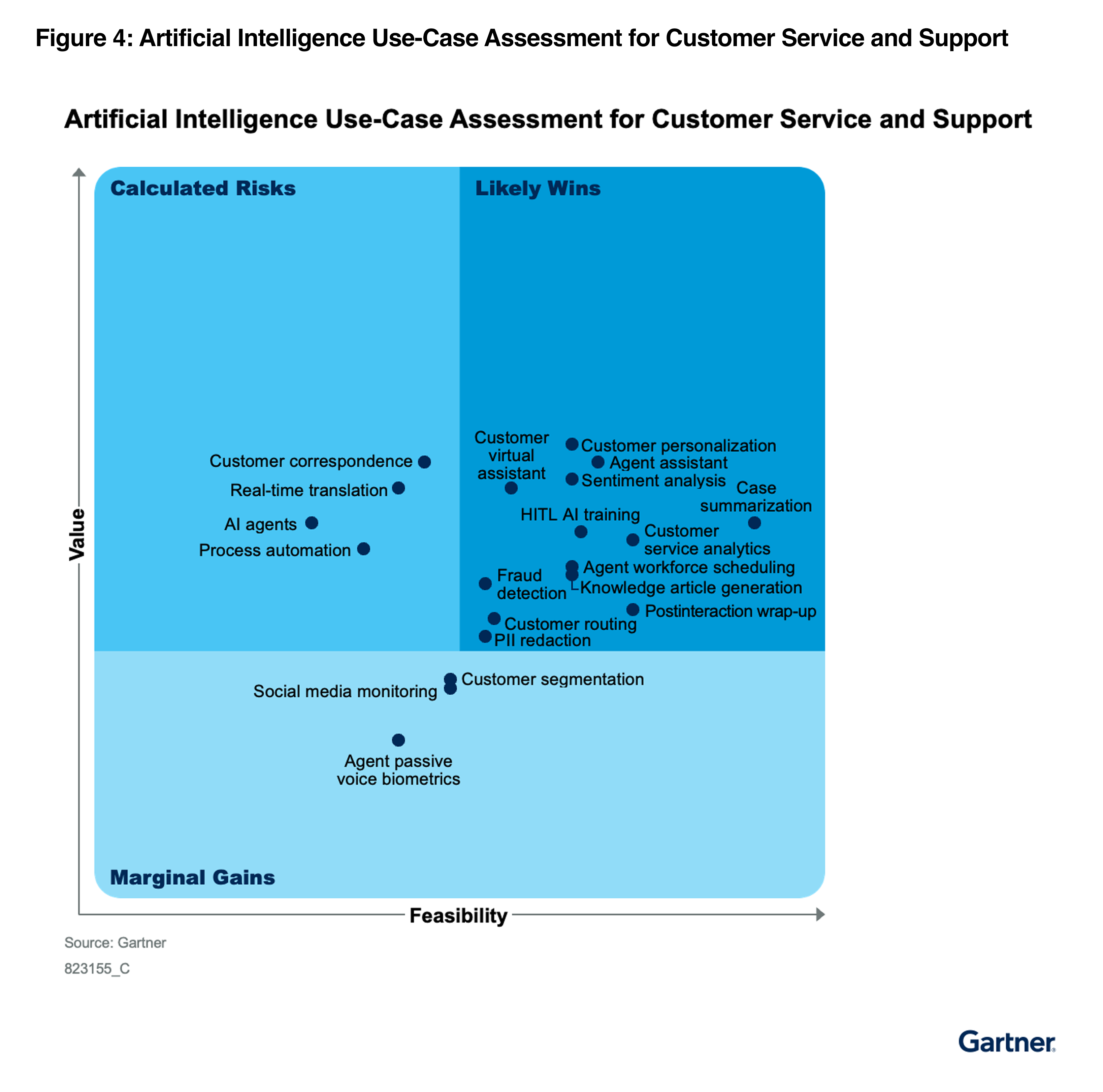
Service and support leaders are under more pressure than ever to prove that AI investments deliver tangible business outcomes.
According to the Gartner® April 2025 research report, “Playbook for Successful AI Implementation in Service and Support”, the path from AI ambition to AI impact requires more than choosing the right technology. It requires a structured, multi-pillar approach that most organizations still lack.
At Circuitry.ai, we have spent years working with manufacturers of complex, mission-critical equipment to solve this exact problem.
Gartner highlights four pillars that organizations must focus on to successfully implement AI initiatives:
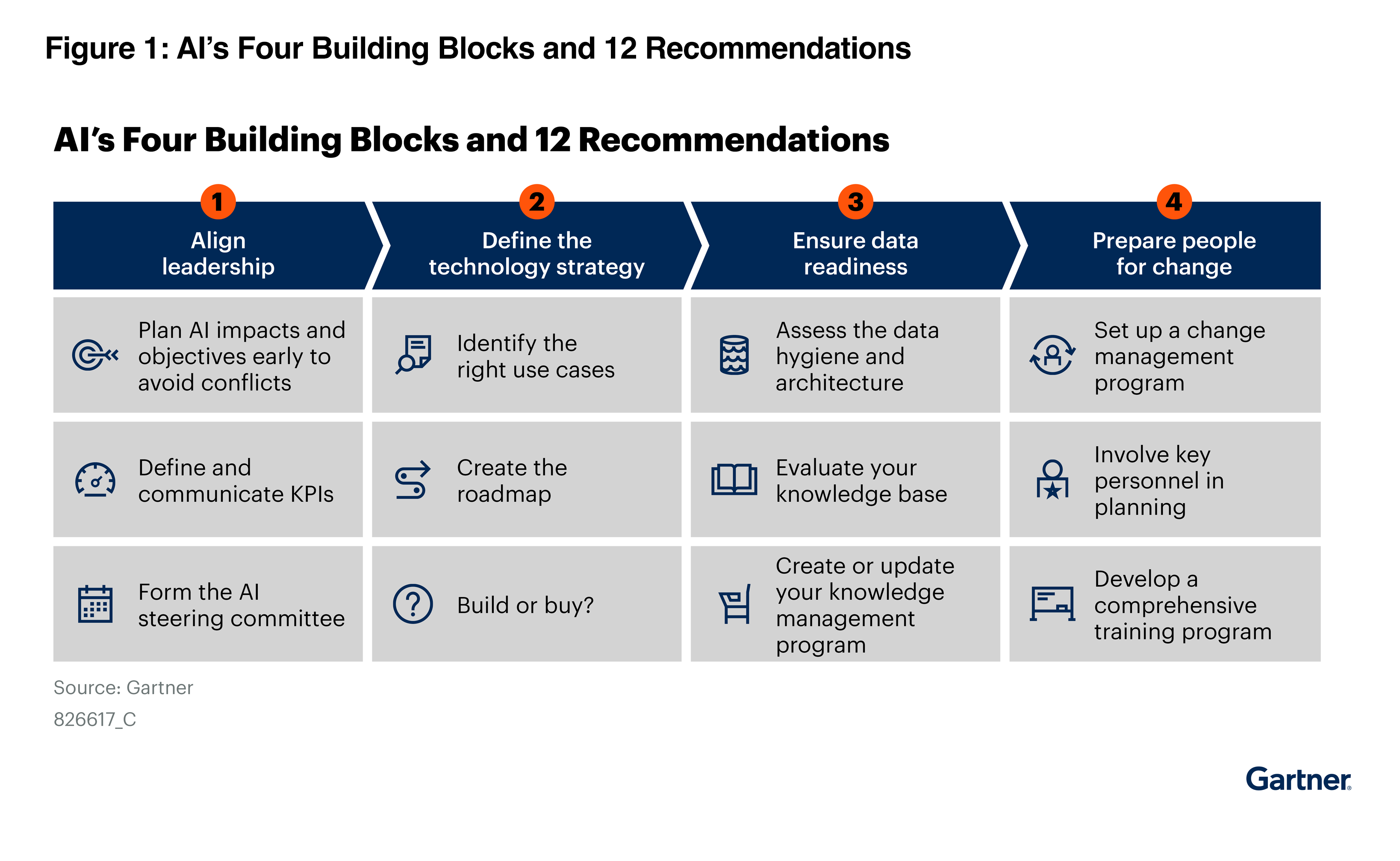
We believe this aligns with the implementation playbook we have been executing with customers like Takeuchi-US and Kingspan Light + Air.
This blog post examines our key findings from the Gartner research report and explains how Circuitry.ai’s frameworks, Autonomous Service Journeys (ASJ), the TRACK continuous improvement methodology, and the POE value model, operationalize these pillars for the complex world of field service, parts, and warranty.
When organizations deploy AI with misaligned objectives, the investment is often wasted.
As Gartner notes: “When organizations fail to align their goals, they risk missing out on AI’s potential advantages. For instance, if a CEO focuses solely on cost savings while CSS leaders aim to enhance customer experience through resource reallocation, the lack of coordination can lead to suboptimal outcomes.”
Circuitry.ai developed the POE (Productivity, Outcomes, Efficiency) value framework. POE gives service leaders and their executive sponsors a shared language for what AI should deliver.
Productivity measures how much human effort AI offloads, freeing technicians and claims processors from repetitive manual tasks so they can focus on higher-value work.
Outcomes tracks whether AI delivers the right fix, the right part, and the right decision every time, directly impacting customer satisfaction and revenue.
Efficiency measures the elimination of wasted time, costs, and errors across the service chain.
When leadership teams align around POE metrics from the outset, the CEO sees cost savings in efficiency gains. The VP of Service sees technician productivity improvements. The VP of Customer Experience sees better outcomes. They are all looking at the same framework through different lenses.
Learn more: Maximize Value of AI with the POE Model
Choosing the right AI technology starts with knowing the use cases that are important to your organization.
As Gartner notes in the research report: “Choosing the right technology is neither the first nor the only step. The excitement over AI’s potential can overshadow actual needs, and new advancements often require a careful feasibility assessment rather than a plug-and-play adoption. Leaders must identify the right use cases (what), their roadmap (when), and only then the technological approach (how).”
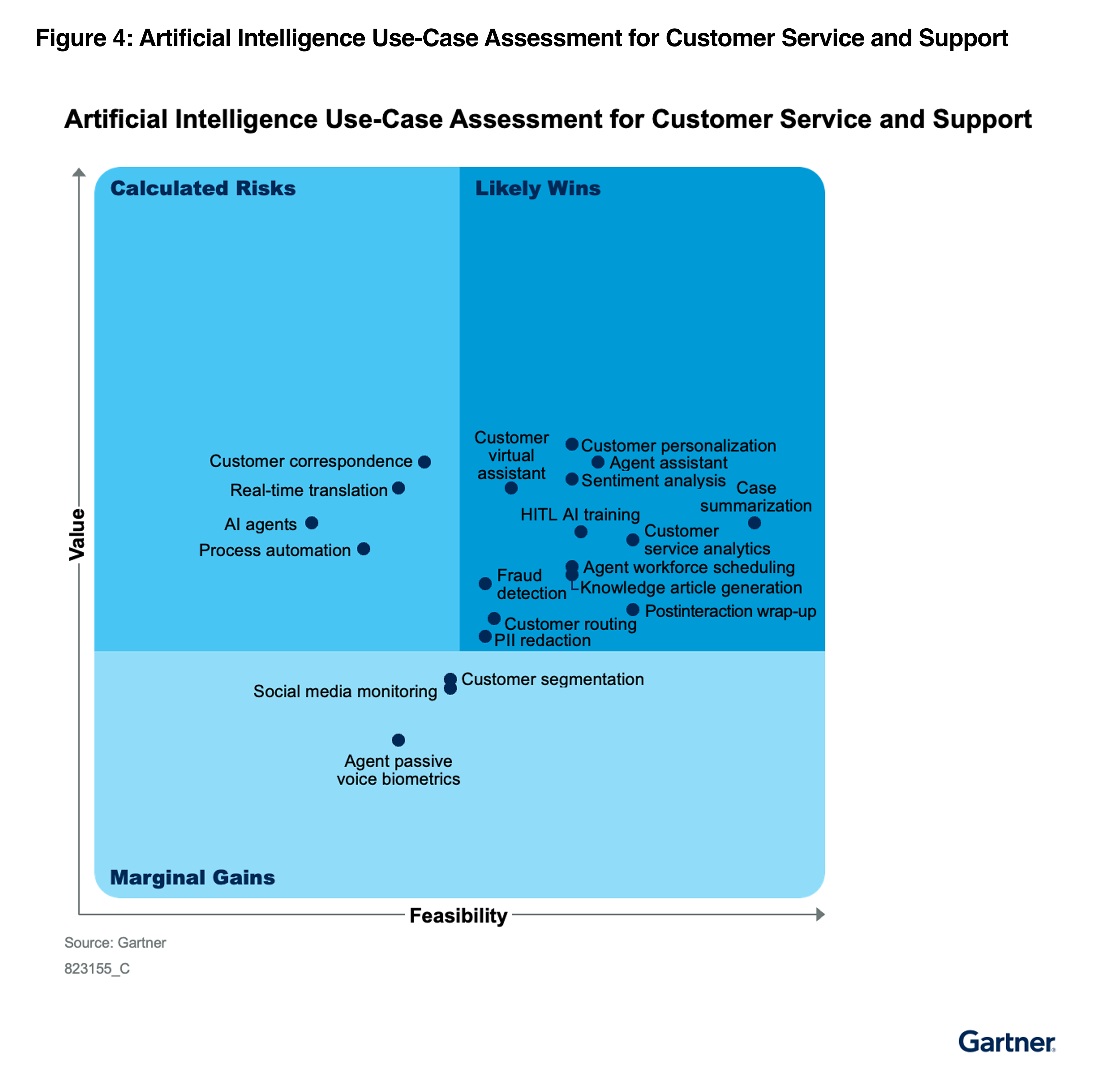 The research report identifies three risks in use case selection:
Circuitry.ai has identified and validated the highest-impact use cases for service operations across the manufacturing lifecycle.
Our Autonomous Service Journeys (ASJ) represent the systematic offloading of work from humans to intelligent Service AI Workers, Advisors, Analysts, and Agents, that augment or automate decisions at every step of the service lifecycle.
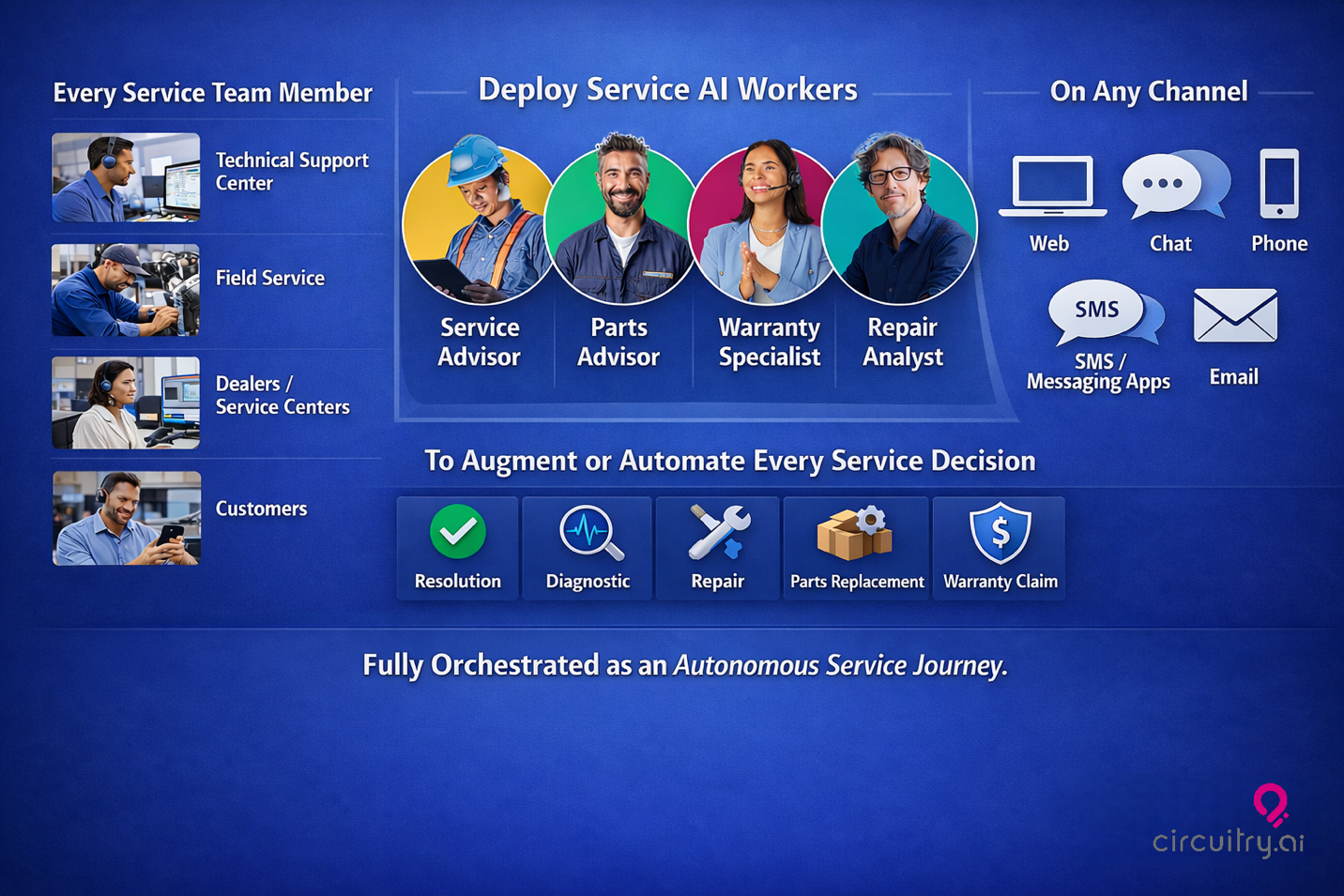
Rather than asking customers to map use cases from scratch, we provide a maturity-based roadmap: start with internal, high-feasibility use cases (such as case summarization, knowledge article generation, and agent assistance), then progress to customer-facing capabilities (virtual assistants, customer correspondence, and proactive service).
Takeuchi-US deployed a Service AI Advisor on their website to deliver immediate, accurate answers. Kingspan Light + Air went live with a Product AI Advisor to improve how their sales and support teams access product knowledge.
Both followed a structured roadmap, starting with high-confidence use cases and then expanding.
We believe our go-to-market model aligns with the Gartner recommendation on the build-versus-buy decision: “Gartner recommends that most customer service organizations buy AI technology platforms along with planning for the customization, integration and/or additional build activities, depending on the out-of-the-box capabilities of the vendor platform required to meet their goals.”
Circuitry.ai was designed from the ground up as an Enterprise AI-as-a-Service (AIaaS) platform.
We handle the DevOps, DataOps, and MLOps. Customers keep their existing CRM, FSM, ERP, and warranty systems, with no rip-and-replace required. Our Decision Intelligence platform operates as a neutral decision fabric across all existing systems. Our 12-week proof-of-value model means customers see measurable ROI before committing to a full rollout.
Learn more: Selecting the Right Service AI Solution for Manufacturers: Build, Extend, or Buy?
Pillar 3: ensure data readiness
Data quality is often the top obstacle to AI implementation.
As Gartner notes: “In a survey of senior enterprise AI leaders, insufficient data quality was identified as the primary cause of failure for AI initiatives (both GenAI and non-GenAI).”
Service leaders should organize data hierarchically with clear categories and metadata, assess and address knowledge base gaps, develop a detailed taxonomy and ontology, and establish a knowledge management program with feedback loops.
Data readiness is where Circuitry.ai delivers a different approach from generic AI tools.
Our platform ingests service manuals, technical service bulletins, parts catalogs, BOMs, warranty policies, claims history, repair orders, and supplier agreements, and then normalizes everything into a decision-ready knowledge graph through our Universal Schema and Context Manager.
This means customers don’t need to start a massive data cleansing initiative before getting started.
The platform is built to work with the data that organizations already have, structuring it for AI consumption as part of the onboarding process. Instead of asking organizations to solve their data readiness problem before AI can begin, we make data readiness part of the solution.
Additionally, Gartner recommends that CSS leaders take a structured approach to knowledge management:
“CSS leaders should collaborate to develop a KM program that is simple, intuitive and structured to ensure its adoption. Also, it should keep the knowledge essential for the success of AI systems up to date (see Figure 7). The program should also:
We believe this aligns with our platform’s continuous learning architecture. Service AI Workers improve with every interaction, every feedback loop, and every new piece of content ingested.
Gartner research found compelling data on change management: “When corporate functional leaders were asked in Gartner’s 2024 Generative AI Planning Survey about their challenges with implementing GenAI in their organization, a third of respondents indicated the resistance from employees who fear role reduction/elimination (34%).”
But the payoff of getting change management right is equally clear. Organizations that make change management a consistent practice tend to see much better business outcomes across the board, from revenue growth to cost savings, risk reduction, customer experience, and employee productivity.
Our TRACK framework (Target, Review, Assign, Capture, Kaizen) was designed to embed change management into the AI deployment process itself.
Target: Define the specific decisions and processes where AI will deliver the most value, aligned with POE metrics.
Review: Assess the current state of data, knowledge, and team readiness.
Assign: Deploy Service AI Workers to targeted use cases with clear ownership and accountability.
Capture: Measure results against POE baselines and capture feedback from technicians, agents, and managers.
Kaizen: Continuously improve models, processes, and adoption based on what the data and your people tell you.
TRACK ensures that people are not just informed about AI, they are participants in its success. Technicians provide feedback that makes the Service Advisor smarter. Claims processors validate AI scoring that makes Warranty Decision Intelligence more accurate.
The AI gets better because the people are involved, and the people adopt the AI because they can see it getting better.
Learn more: Autonomous Service Journeys: Value Generation with the TRACK Framework
In industries like heavy equipment, automotive, industrial systems, medical devices, and HVAC, the AI implementation challenges are amplified.
The data is more fragmented across ERPs, FSMs, warranty systems, and IoT platforms, and knowledge is locked in the heads of veteran technicians who are retiring. The stakes are higher because asset downtime directly impacts customer revenue. And the decisions span service, parts, and warranty simultaneously, not just customer engagement.
This is exactly the gap Circuitry.ai was built to fill and specifically address the unique challenges of field service for complex manufactured assets. Our Decision Intelligence platform orchestrates intelligent decisions across the entire service lifecycle, from problem detection to resolution to warranty recovery to product quality improvement.
Gartner lists a sample of metrics that link AI product metrics to business objectives, spanning five measurement areas:
We believe this aligns with our POE framework.
The advantage of POE is that it gives service leaders a simpler executive-level lens, one that translates directly into board-level language about workforce productivity, customer outcomes, and cost structure.
Successful AI implementation in service is an orchestration problem. You need aligned leadership, the right use cases in the right sequence, clean and accessible data, and people who are invested in the outcome.
Circuitry.ai’s Autonomous Service Journeys give you the use case roadmap. Our POE framework gives you leadership alignment. Our Decision Intelligence platform solves data readiness. And our TRACK methodology embeds change management into every deployment.
Ready to move from AI ambition to AI impact?
Schedule a free AI Advisory session with our industry experts to learn how Autonomous Service Journeys can transform your service operations.
Gartner Playbook for Successful AI Implementation in Service and Support, Francesco Vicchi, 22 April 2025
Gartner is a trademark of Gartner, Inc. and/or its affiliates.
Circuitry.AI CEO, Ashok Kartham, shares his top four takeaways from the recent Impact24 event hosted by Tech Talk Summit.
From Claim Intake to Payment and Claims Intelligence: See how Circuitry.ai Warranty Decision Intelligence and specialized Warranty AI Workers improve...
Discover how AI transforms field service operations with insights from Ashok Kartham, CEO of Circuitry.ai, on Service Council’s InService podcast.