Winning the Next Era of Vehicle Service Contracts
How VSC providers turn claims into a compounding source of dealer value, operating performance, and underwriting advantage with Warranty Decision...
The greatest value of AI in warranty and service contracts comes from better decisions, not better forms.
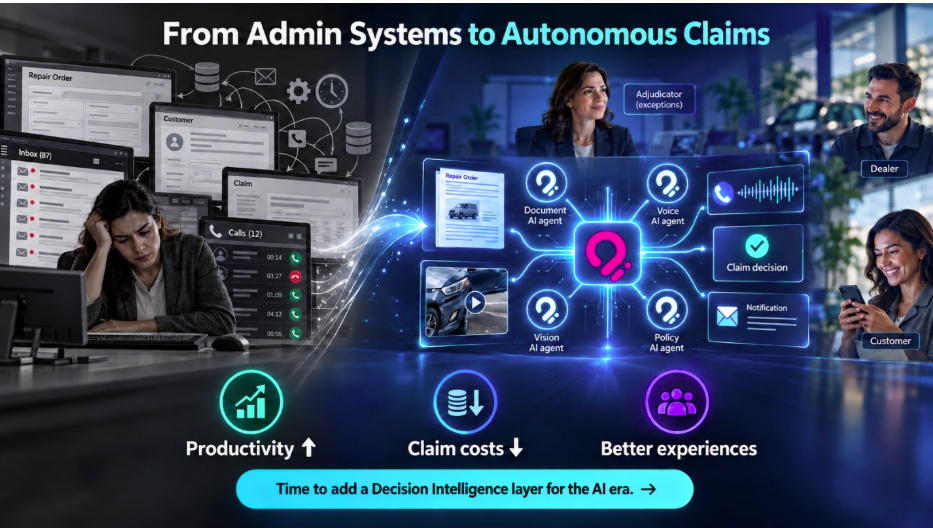
Warranty and service contract (WSC) providers rely on admin systems to manage contracts, claims, authorizations, payments, and reporting. These systems are essential systems of record. But administering a claim is not the same as deciding what should happen next.
Warranty Decision Intelligence is a decision-and-action layer that connects claim evidence, business guidance, AI Workers, and human expertise across the claim journey. It complements the admin system by improving how claims are evaluated and how the next best action is carried out.
The opportunity goes beyond digitizing a form or summarizing a file. It is to improve the accuracy and consistency of the decisions that determine claim outcomes: What evidence is needed? Is the failure covered? Does the diagnosis support the repair? Are the parts and labor appropriate? Can the claim be authorized, or does it need an expert?
Better answers reduce handling work, help adjudicators focus their expertise, improve the service experience, and can prevent avoidable claim costs. That is where AI can change both operations and program economics.
Start with the information that already exists
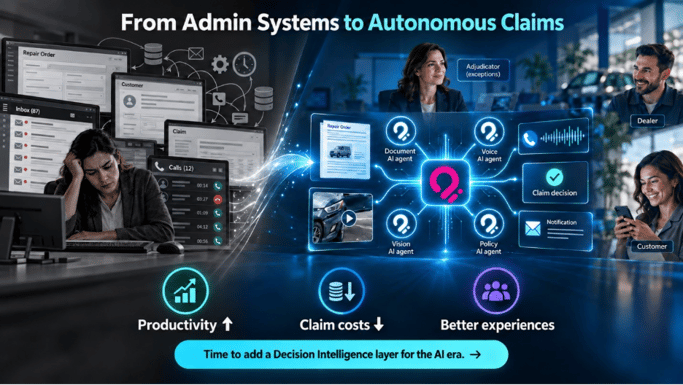
A repair order may already contain the product, customer concern, diagnosis, proposed repair, parts, and labor. Re-entering the same information in a warranty form adds work without adding insight.
An AI agent ingests the repair order, extracts relevant details, identifies gaps, and creates the claim in the connected admin system. If intake begins by phone, an AI voice agent captures the same information conversationally. Forms become a fallback for exceptions rather than the default for every claim.
The immediate gain is less data entry. The greater gain is a more complete and timely foundation for the decision.
Gather evidence without making adjudicators chase it
After intake, the claim may require photos, video, product history, repair documentation, or clarification. Repeated calls, emails, and follow-up slow the decision and consume adjudicator time.
An AI agent identifies what is missing, requests specific evidence, and analyzes the response with the repair order, contract terms, claim history, and other authorized information. It flags inconsistencies, prepares the decision context, and routes uncertainty or higher financial exposure for human review.
Straightforward claims move faster. Adjudicators spend less time assembling information and more time applying expertise where it matters.
After the decision, AI-generated authorizations and updates keep service providers, customers, and internal teams informed. An AI-powered Warranty Advisor answers questions about coverage, status, documentation, and next steps through email, phone, text, or chat, escalating when human help is needed.
Admin systems and Decision Intelligence: different jobs
An admin system and Warranty Decision Intelligence serve complementary purposes. Specific capabilities vary by product and integration, but their primary roles are distinct.
|
Criterion |
Admin system |
|
|
Primary role |
Maintains contracts, claims, authorizations, payments, and transaction records. |
Connects evidence, guidance, AI Workers, and actions across the claim journey. |
|
Intake and evidence |
Captures claim data and stores documents. |
Ingests source information, identifies gaps, requests evidence, and analyzes it in context. |
|
Decision support |
Applies configured rules and supports established review processes. |
Assesses coverage, diagnosis, repair evidence, parts, labor, and history to prepare consistent decisions. |
|
Work orchestration |
Routes work through queues and records progress. |
Completes routine tasks and directs exceptions to human experts. |
|
Communications |
Records status and sends configured messages. |
Generates contextual authorizations, updates, and answers questions across channels. |
|
Data reach |
Centers on data and processes managed by the platform. |
Brings together admin records, repair orders, product history, external data, and communications. |
|
Business value |
Provides reliable administration and transaction control. |
Targets lower handling effort and avoidable claim cost, with greater consistency and a better experience. |
|
Technology strategy |
Remains the long-term system of record. |
Connects to the chosen admin system so providers can evolve AI capabilities independently. |
The strongest architecture lets each do its job well: the admin system remains a dependable system of record, while the decision layer helps determine and carry out the next best action.
Evaluate the decision layer by what it can govern and accomplish
Warranty Decision Intelligence connects the admin system, third-party data, and a native AI stack. Specialized AI Workers act on shared claim context to intake a repair order or call, gather evidence, analyze the claim, answer questions, prepare an authorization, notify the right people, and update the system of record.
Decision guidance, confidence thresholds, audit trails, and human review govern what happens automatically. Providers can expand automation without treating every claim as equally simple or equally risky.
Labels such as embedded or bolt-on reveal little about business capability. Providers should ask: What evidence can the AI evaluate? Which actions can it complete? How are confidence, auditability, and human review managed? How easily can it connect with the admin system and outside data?
Reimagine the work and preserve the freedom to evolve
WSC providers should be able to keep their admin system as the record of contracts and transactions while choosing specialized decision intelligence. Open integration creates a path to improve claims operations without replacing everything at once or tying every new capability to one vendor’s release cycle.
The goal is not simply to add AI to an existing screen. Forms once turned calls and repair orders into structured data; AI agents can now interpret those original sources, request what is missing, validate the information, and enter it into the appropriate system.
Providers should evaluate how readily they can access their data, write decisions back, connect outside sources, deploy new capabilities, and change partners as their needs evolve.
This is an opportunity to redesign how claims are initiated, evaluated, decided, communicated, and completed, not merely to make an old form or queue slightly faster.
The strongest architecture gives each layer a clear job: the admin system protects the transaction record; the decision layer assembles context, supports judgment, coordinates action, and sends the outcome back.
The result should be measured in decision accuracy and consistency, work removed, avoidable claim cost reduced, and the speed with which the operation can keep improving.
The next warranty platform will not be defined by where AI appears on the screen. It will be defined by the quality of the decisions it helps the business make.
See better claim decisions in action. Request a live demo of Circuitry.ai Warranty Decision Intelligence, or join one of our October customer case study sessions:
How VSC providers turn claims into a compounding source of dealer value, operating performance, and underwriting advantage with Warranty Decision...
Discover how Field Decision Intelligence (FDI) revolutionizes service operations by enhancing traditional FSM systems with AI for smarter service...
Circuitry.ai’s latest features are revolutionizing service, warranty, and claims management with AI-powered solutions for faster, smarter...