Control Service Contract Loss Ratio with AI-powered Warranty Decision Intelligence
A leadership perspective on the use cases and value behind AI-powered Decision Intelligence for service contract providers, OEMs, and administrators.
How VSC providers turn claims into a compounding source of dealer value, operating performance, and underwriting advantage with Warranty Decision Intelligence.
Vehicle service contract providers are entering a new competitive era. Dealer expectations are rising, repair complexity is increasing, and claims decisions now influence far more than cost; they shape trust, retention, participation performance, and future product profitability.
For VSC executives, the strategic question has moved past whether claims can be automated to whether every claim can improve the provider’s operating model, dealer relationships, product design, and underwriting performance.
The more durable advantage comes from making better warranty decisions faster, more consistently, with clearer explanations and learning from every outcome. Warranty Decision Intelligence transforms contracts, claims, repair knowledge, customer interactions, and loss experience into evidence-based decisions that improve the entire VSC business.
Short on time? Jump to the sections that interest you the most.
In this article
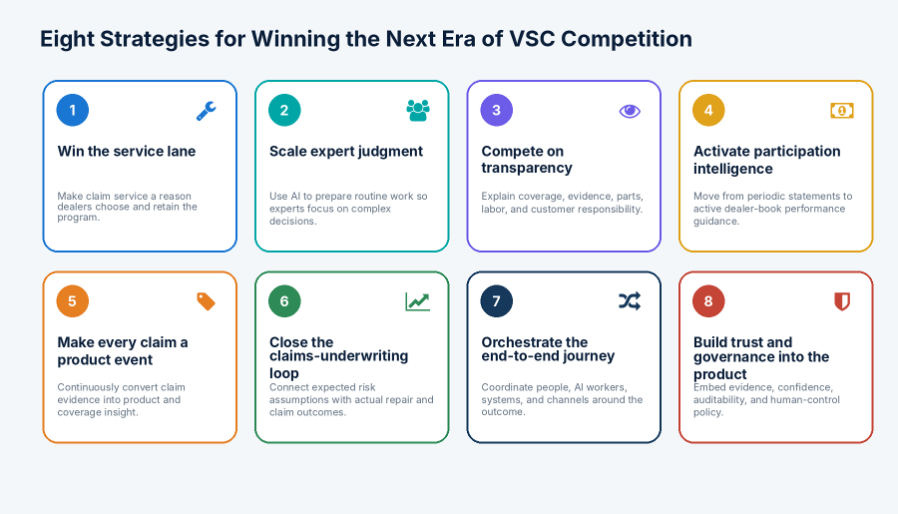
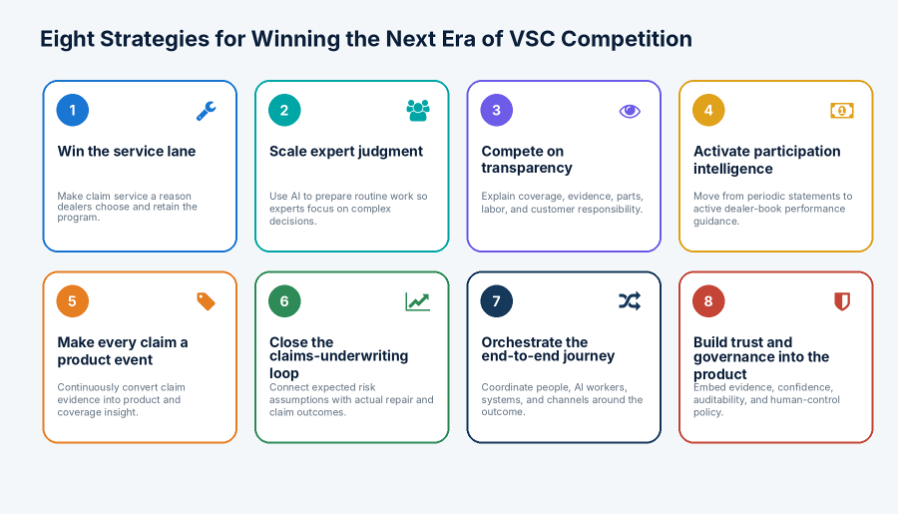
Eight strategies for winning the next era of VSC competition
Historically, providers differentiated through coverage, dealer compensation, financial strength, claims expertise, agent relationships, and administrative technology. Those capabilities still matter, but on their own, they no longer create separation. The next advantage comes from connecting them through one governed intelligence layer.
A winning provider should be able to answer, in real time:
A warranty decision system must combine contract rules, predictive risk, approved-source retrieval, knowledge graphs, visual evidence, repair intelligence, explanations, workflow orchestration, and human authority.
Winning in this environment requires a decision system that improves every time it’s used. The following eight strategies show how VSC providers can build that advantage across dealers, claims teams, participation programs, underwriting, and governance.
The product may be sold in the F&I office, but its value is proven in the service lane. A provider can offer attractive dealer economics and still weaken the relationship if service advisors face long waits, repeated evidence requests, unclear status, and unpredictable decisions.
|
Why it wins |
Circuitry.ai capabilities |
Business benefits |
|
The service advisor influences repair-cycle time, customer confidence, technician utilization, and the dealer's willingness to keep selling the program. |
Portal Advisor, Claim Intake Worker, Voice Worker, Messaging Worker, and dealer-specific Quality Analytics guide submission, preserve context, prevent status calls, and route exceptions correctly. |
Higher first-pass completeness, fewer contacts per claim, faster authorization, better dealer satisfaction, and stronger dealer retention. |
Experienced adjusters have valuable knowledge about contracts, failure modes, repair procedures, parts, labor, evidence, and dealer behavior. That expertise is scarce and often consumed by administrative work.
|
Why it wins |
Circuitry.ai capabilities |
Business benefits |
|
Highly skilled employees should focus on ambiguous, high-severity, low-confidence, or adverse decisions - not document lookup, status inquiries, and repetitive claim preparation. |
Claim Intake structures evidence; Warranty Decision Intelligence retrieves the applicable contract and reasoning; the Quality Analyst captures overrides; confidence and abstention route difficult cases to the right expert. |
More claims handled per expert, shorter ramp time, greater consistency, less administrative work, and improved employee experience. |
|
Why it wins |
Circuitry.ai capabilities |
Business benefits |
|
Transparent decisions build trust even when the approved amount differs from the requested amount. They also reduce escalations and improve auditability. |
Warranty Decision Intelligence, Parts Advisor, Labor and Procedure Advisor, and Visual Inspection Worker explain the contract provision, evidence, requested and approved operations, part alternatives, customer responsibility, and next action. |
Fewer disputes and reversals, consistent dealer communications, stronger compliance, and a differentiated promise: fast answers when simple; clear answers when complex. |
|
Why it wins |
Circuitry.ai capabilities |
Business benefits |
|
The provider that helps a dealer actively manage participation performance becomes a more strategic partner than one that only reports the result. |
Participation Intelligence combines earned volume, claim frequency and severity, product mix, claim quality, inspection use, repair trends, emerging concentrations, forecast ranges, and recommended actions. |
Stronger dealer engagement, improved participation visibility, earlier risk detection, more informed product selection, and higher program retention. |
|
Why it wins |
Circuitry.ai capabilities |
Business benefits |
|
Providers that continuously interpret unstructured evidence can identify coverage needs, emerging failures, repair-cost changes, and dealer friction earlier than competitors. |
The Product and Underwriting Analyst structures the actual failed component, root cause, repair action, vehicle configuration, evidence quality, repair complexity, and customer responsibility reason. |
Faster product learning, more precise eligibility and coverage, improved EV and ADAS response, shorter innovation cycles, and better dealer value. |
|
Why it wins |
Circuitry.ai capabilities |
Business benefits |
|
A faster expected-versus-actual learning loop improves both future pricing and current claim guidance without replacing actuarial methods. |
Decision Intelligence connects contract terms, vehicle and dealer cohorts, claim frequency, severity, parts and labor inflation, inspection findings, original warranty overlap, and emerging failure patterns. |
Earlier risk signals, better segmentation, reduced expected-versus-actual variance, stronger reserve inputs, and more profitable products. |
|
Why it wins |
Circuitry.ai capabilities |
Business benefits |
|
The winning model coordinates the complete journey around the outcome rather than asking dealers and employees to manage handoffs between disconnected tools. |
The Autonomous Service Journey Orchestrator coordinates Claim Intake, Decision Intelligence, Parts and Labor Advisors, Inspection, Communications, human review, and systems of record. |
Fewer handoff failures, less rework, consistent omnichannel service, faster resolution, and scalable operations. |
|
Why it wins |
Circuitry.ai capabilities |
Business benefits |
|
Evidence, confidence, authority, auditability, monitoring, data governance, and human-in-the-loop controls are prerequisites for sustainable scale. |
Approved source retrieval, contract version control, decision specific thresholds, abstention, role-based authority, audit history, override learning, drift monitoring, security, and privacy controls. |
Responsible automation, lower compliance risk, defensible decisions, safer expansion of autonomy, and stronger stakeholder trust. |
Warranty Decision Intelligence creates value for every stakeholder in the VSC ecosystem. With Warranty Decision Intelligence, VSC providers can:
The traditional VSC operating model is linear: sell the contract, receive the claim, process the claim, and report the financial result.
The intelligent model is a continuous learning system: design the right product, sell it transparently, guide the claim, assemble the evidence, make the right decision, explain it clearly, complete the journey, learn from the outcome, and improve the next product and decision.
The winners in the next era will be the organizations that make every claim a faster and more consistent decision, every dealer interaction a trust-building moment, every expert's knowledge available across the operation, every participation program an actively managed asset, and every outcome a source of product and underwriting intelligence.
Circuitry.ai helps VSC providers transform claims from isolated transactions into a compounding source of dealer value, operating performance, product intelligence, and competitive advantage.
Circuitry.ai’s Warranty Decision Intelligence foundation powers specialized Service AI Workers. The workers operate across web, voice, email, messaging, APIs, and employee workflows while sharing the same contract evidence, data relationships, confidence policy, governance, and outcome learning.
The foundation brings together contract and coverage data, claim history, dealer and repair facility data, vehicle and service history, repair procedures, parts and labor information, documents, images, inspections, original warranty and recall data, contact center interactions, and product rules. It applies the appropriate combination of deterministic rules, retrieval, knowledge graphs, predictive models, visual intelligence, generative reasoning, and workflow orchestration.
See how Circuitry.ai’s Warranty Decision Intelligence can help your organization improve claim decisions, strengthen dealer relationships, manage participation performance, and turn every claim into a compounding source of product and underwriting insight.
Schedule a demo to learn how VSC providers can win the next era of vehicle service contracts.
A leadership perspective on the use cases and value behind AI-powered Decision Intelligence for service contract providers, OEMs, and administrators.
Warranty and claims organizations do not need to replace legacy platforms to benefit from AI. Circuitry.ai Warranty Decision Intelligence adds a...
See how Field Decision Intelligence helps field service teams manage AI risk, improve decision accuracy, orchestrate Service AI Workers, and deliver...