Field service leaders left Field Service Next East with the same question on their minds: how do you move AI from a scattered set of experiments into something that actually changes how service gets delivered? Across keynotes and breakout sessions, attendees explored a piece of that question, and Circuitry.ai's own AI Lab session showed what it looks like when those pieces come together.
Here’s our 5 key takeaways from Field Service East.
Quick navigation
Short on time? Jump to the takeaways that interest you the most.
1. AI should scale expertise, not replace it
There’s a common fear behind AI rollouts in field service: will this replace my best people? The sessions at Field Service Next East made the case against that assumption, starting with Philips.
Cara Hibbard, VP of Field Service Operations at Philips, opened her keynote: “Designing customer-centric journeys that lift performance,” with the problem driving the shift: customer expectations have outpaced traditional service models. Healthcare providers need uptime, transparency, and faster resolution, while service teams face rising cost pressure and workforce constraints that a reactive, break-fix model can't keep up with anymore.
Her message: AI's job is to scale that expertise, not replace it. Philips built its tools with the field and remote service engineers who'd actually use them, aimed at surfacing the right knowledge faster and cutting the administrative and travel time that eats into diagnostic work. The results back it up: cases resolved on the first visit rose 14%, and time to diagnose fell to a quarter of what it used to take.
2. Consistent warranty decisions build partner trust
Every warranty leader knows where trust with a service network actually gets tested: not in the contract, but in how consistently a claim gets paid. In his session “The Case For Change” Kevin Hilbert, Director of Customer Service at Henny Penny, explored that issue.
Henny Penny's payment timelines varied widely, claims sat in manual review, and partners had limited visibility into where their claim stood. With field technicians in shorter supply, that inconsistency has become a retention risk: service companies can choose which work they take on, and unpredictable reimbursement makes the choice easy. Hilbert's point landed with the room: if Henny Penny holds partners accountable for overdue balances, partners deserve the same consistency on warranty reimbursement.
That's the gap Circuitry.ai's Warranty Decision Intelligence closes. The platform automates claim intake and classification and applies policy the same way on every claim, scoring and routing decisions consistently whether volume is light or heavy. Warranty organizations get faster, explainable claim decisions that scale with volume without adding headcount to the review queue.
Explore the Warranty Decision Intelligence two-pager.
3. Your existing knowledge is enough to start
AI is only as good as what it can find. In her session: “From Tribal Knowledge to Institutional Intelligence” Kathy Kilbride, Senior Director of Technical Discovery and Customer Success at Bangs Laboratories, opened with an image of the Library of Babel: an infinite archive where the information you need exists somewhere, but finding it is its own problem.
Her framework puts the knowledge base at the foundation of everything else: field service training, customer support, manuals, even marketing all sit on top of it, not the other way around. Capturing it means going straight to the source before it's lost, interviews, videos, and voice notes with veteran technicians, new hires, and even retirees who still have institutional memory worth keeping.
Capturing the knowledge is only half the job. Kilbride's team structures it around people, process, content, and technology, with clear ownership and taxonomy, so it's searchable and validated rather than another folder no one opens.
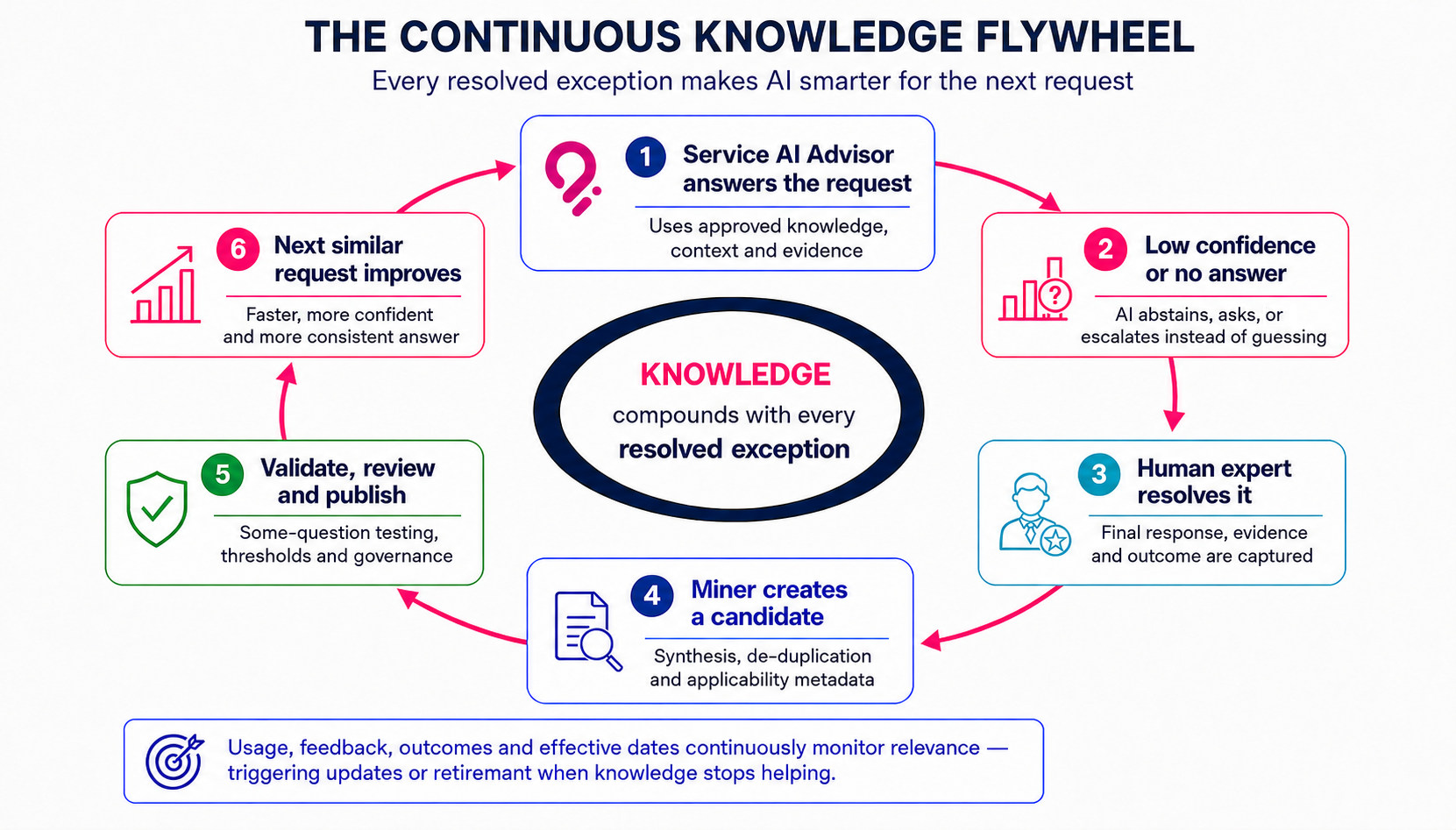
Circuitry.ai addresses that same gap with knowledge mining, one of several capabilities built to turn historical service interactions, emails, and case notes into a validated, AI-ready knowledge base that gets more accurate every time a technician resolves a case
4. Disconnected service functions cost more than any single inefficiency
Service leaders tend to optimize one function at a time: dispatch, parts, warranty. Dr. Lisa Ann Ferlita's session: “From Disconnected Service Functions to One Operational Nervous System” with ThermoFisher advised that the cost adds up in the handoffs between those functions, not inside any single one of them.
Her session mapped it out function by function: information gaps between technical support and field service, misaligned priorities on dispatch, duplicate effort in depot repair, delayed outcomes reaching commercial and operations. None of it looks catastrophic on its own. Stacked together across a service journey, it slows the entire organization down, and the customer feels every bit of it.
Her answer: build one connected system instead of eight disconnected functions, so information flows, decisions align, and one team owns the customer's experience end to end.
That's the same fragmentation Circuitry.ai's Decision Intelligence layer is built to close. It connects directly into the warranty, claims, ERP, CRM, and dispatch systems already in place instead of replacing them, pulling the data together so a parts decision, a dispatch update, and a warranty determination are all working from the same information.
5. What it looks like when it all comes together
In Circuitry.ai's case study session, Ashok Kartham, CEO, of Circuitry.ai was joined by Ramzi El-Achkar, Director of Hardware Support at Hypertec, to discuss how Hypertec deployed Circuitry.ai’s Service Decision Intelligence platform to address support volumes that were growing faster than headcount and answers on complex GPU systems needed to be fast and accurate for SLAs with no tolerance for delay.
Circuitry.ai built specialized AI Workers around that problem: agents that handle email and phone support, mine Hypertec's knowledge base across Confluence and SharePoint, and orchestrate across JIRA, SAP, and Field Service. More support emails now resolve through AI auto-responses, log file analysis pinpoints the fix instantly, and parts orders and field escalations trigger automatically.
As Ramzi noted: “Using Circuitry.ai, being able to mine all this information and being able to get it on the spot, and we actually saw a difference. Where one of my agents would take a few minutes to answer, sometimes half an hour with the right documentation, the right page, the right line, everything. The AI agent is doing it within a few seconds.”
During the roundtable "From Knowledge Mining to Autonomous Service Journeys," led by Josh Russell, VP of Products, and Dhruv Desai, Solution Consultant at Circuitry.ai, led the room through structured way to turn scattered tribal knowledge into a working AI journey. Choose a business outcome, find where the process breaks down, and define the decision an AI Worker needs to make to close the gap. Every leader left with a clear next step for their own operation.
Interested in using the workbook for your own operation? Download it here.
Going beyond the field starts now
Every session pointed to the same place: AI works best when it scales the expertise your team already has, and it only proves its value once you can measure the outcomes it drives. That's the model Circuitry.ai builds toward with every customer: specialized AI Workers grounded in your own service knowledge, orchestrated into Autonomous Service Journeys and measured against Productivity, Outcomes, and Efficiency.
Ready to see what that looks like for your service organization? Schedule an AI Advisory session to map your path from AI pilots to autonomous service.