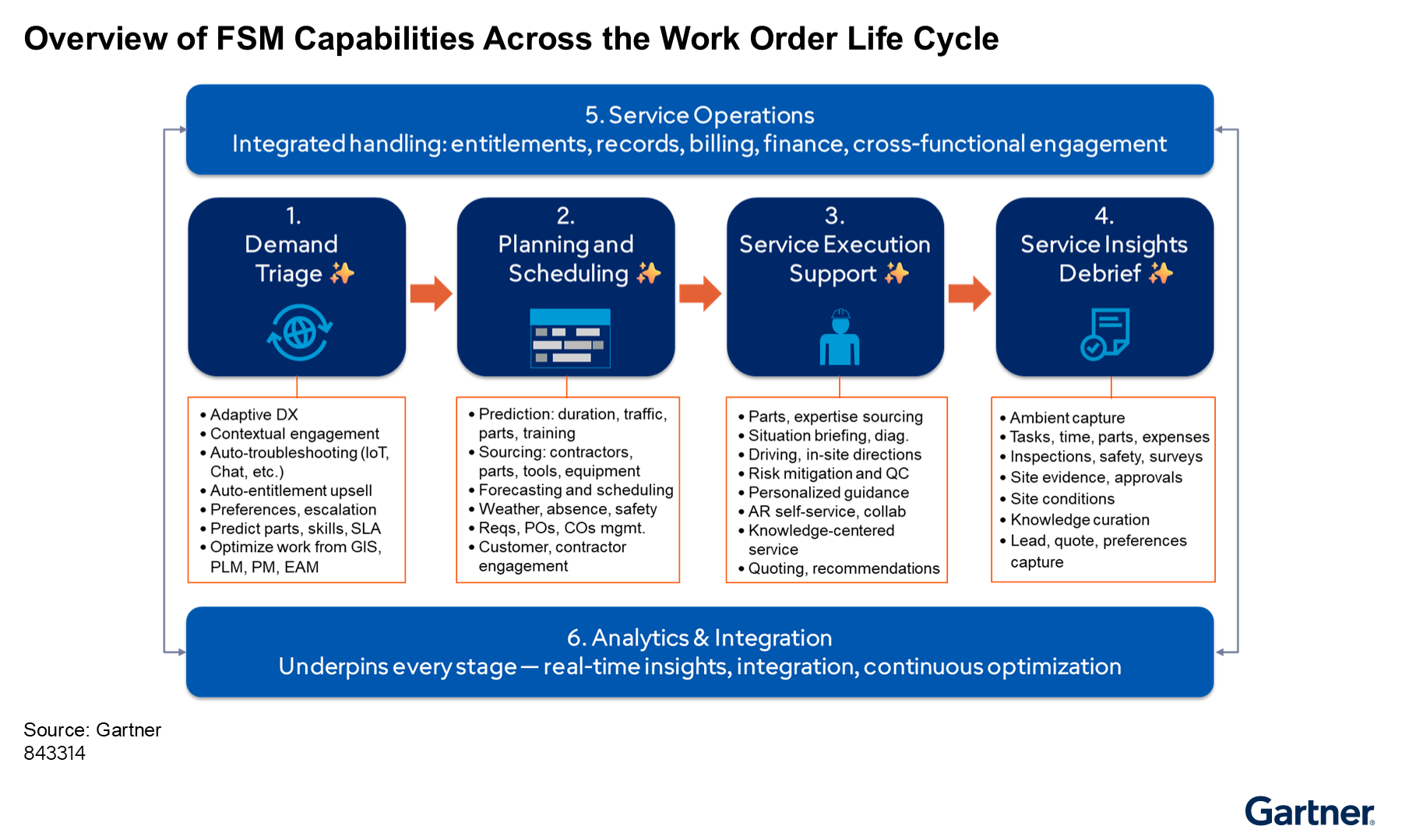
Field service leaders are under pressure from every direction: higher customer expectations, rising service costs, technician shortages, complex products, fragmented systems, and the need to improve first-time fix while reducing truck rolls.
For years, Field Service Management systems helped digitize work orders, schedules, dispatch, and technician workflows. That foundation is still essential. But the next leap in service performance will come from a different layer: Service Decision Intelligence.
Service Decision Intelligence applies AI to the decisions that determine service outcomes: what the issue is, whether a truck roll is needed, which parts are required, who should do the work, what guidance the technician needs, what evidence should be captured, and what downstream actions should happen next.
The Gartner® research report, “Critical Functions of Field Service Management in the Age of AI,” notes that: “Organizations face a widening capability gap in their workforces due to the exit of experienced resources from the workforce and replacement by junior resources, low-cost outside contractors and immature systemized solutions that seek to avoid a truck roll altogether.”
We believe the message for CIOs and service leaders is clear: the future is not simply more workflow automation. The future is autonomous service powered by Service AI Workers.
Quick navigation
The pain: field service is still too manual, fragmented, and expert-dependent
Most service organizations aren’t short on systems. They’re short on connected intelligence.
A typical service event may touch customer support, CRM, FSM, ERP, parts systems, asset data, warranty systems, technician mobile apps, service manuals, diagnostic tools, and contractor networks. Each system holds part of the answer, but no single workflow consistently guides the right decision from intake through resolution.
That creates four recurring pain points.
Pain point 1: poor triage creates downstream failure
Many service failures begin before a technician is ever dispatched. The customer's reported symptom is often incomplete, the asset isn't fully identified, and the likely failure mode remains unclear. Parts availability, tool requirements, entitlement status, service history, and diagnostic data all exist, but they aren't brought together early enough to inform the dispatch decision. As Gartner points out:
“Many FSPs have not kept pace with AI-driven optimization in demand orchestration and they risk being disrupted by organizations that are able to use AI to:
- Enrich service engagements and enhance symptom capture via modality of choice, including natural language, conversational self-service and deep analysis of real-time equipment telemetry.
- Assist with truck-roll avoidance or prerequisite discovery by providing diagnostic guidance and context-aware insight.”
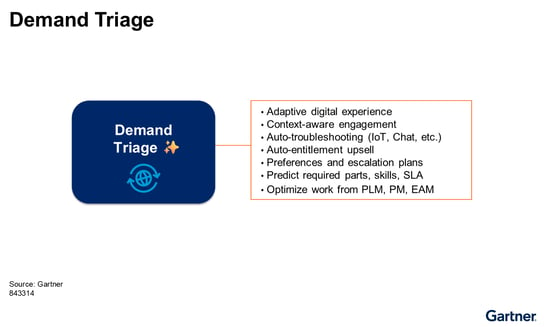
The AI-powered solution: intelligent demand triage
We believe Circuitry.ai’s Service Decision Intelligence helps service teams capture the right context upfront. AI workers can understand natural language from customers, agents, technicians, emails, chats, photos, videos, diagnostic codes, and IoT signals. They can ask missing questions, identify likely causes, check entitlement, recommend remote resolution steps, and enrich the work order before dispatch.
This is where autonomous service starts, by creating a better service decision before work is scheduled.
Related Circuitry.ai resources: Field Decision Intelligence for Service and Autonomous Service Journeys.
Benefits customers can realize
Better triage improves first-contact resolution, reduces unnecessary dispatches, increases technician preparedness, improves customer effort, and raises the probability of completing the job correctly the first time. It also creates cleaner data for warranty, quality, and product improvement teams.
Pain point 2: scheduling optimizes activity, not outcomes
Traditional scheduling often starts with availability, proximity, and skills. While those inputs matter, they aren’t enough. Modern service scheduling must also consider parts availability, job complexity, service-level commitments, customer priority, contractor requirements, safety risk, technician experience, and the likelihood of successful resolution.
Gartner projects that: “By 2028, 60% of work scheduling will be automated, but 50% of work will still require a human in the loop to properly define and scope demand for field service work.”
The AI-powered solution: decision-aware planning and scheduling
In our view, Service AI Workers can help planners and dispatchers make better decisions before the schedule is locked. They can evaluate likely repair paths, required parts, technician capabilities, service history, customer impact, and risk. They can also recommend the best plan while escalating ambiguous, high-cost, or safety-sensitive work to human experts.
This creates a practical model for autonomy: automate routine decisions, augment complex decisions, and escalate novel or high-risk situations.
Related Circuitry.ai resources: Service Decision Units and business-aligned AI pricing and Autonomous Service Journeys.
Benefits customers can realize
Gartner identifies the improvements from scheduling optimization as:
“Key benefits:
- Improved on-time arrival
- Lower cost per dispatch
- Increased technician productivity
- Improved first-time fix rate
- Reduced customer escalation”
Pain point 3: technicians can’t carry every expert in their head
Products keep growing more complex, even as the experienced technicians who understand them best are retiring. Junior technicians and contractors are filling that gap, and they often need more support to work at the same level. The knowledge they need to do that exists, but it's scattered across manuals, bulletins, historical cases, tribal knowledge, parts catalogs, diagnostics, and engineering updates.
Even the best technicians lose time searching for answers. Less experienced technicians may escalate too often, replace the wrong part, miss a dependency, or fail to capture the evidence needed for warranty, billing, or quality.
The AI-powered solution: guidance at the point of work
Service AI Advisors can guide technicians in the flow of work. They can provide troubleshooting steps, summarize service history, identify parts, interpret diagnostic codes, recommend repair actions, surface safety instructions, and support hands-free interactions through voice or mobile experiences.
AI workers don’t replace technician judgment; instead, they make expertise available at the exact moment a decision is needed.
Related Circuitry.ai resources: Field Decision Intelligence for Service and Autonomous Service Journeys powered by Service AI Workers.
Benefits customers can realize
Customers can improve technician productivity, reduce repeat visits, shorten mean time to repair, improve safety, and accelerate onboarding for junior technicians..
Benefits customers can realize
Customers can improve technician productivity, reduce repeat visits, shorten mean time to repair, improve safety, and accelerate onboarding for junior technicians.
Pain point 4: service insights are lost after the job
A completed service visit should improve the next service visit. But in many organizations, valuable information disappears into unstructured notes, incomplete codes, photos, PDFs, paper forms, or technician shorthand.
That creates downstream friction: delayed invoicing, weak warranty evidence, poor quality analytics, missed sales opportunities, incomplete equipment records, and limited organizational learning.
The AI-powered solution: automated debrief and service intelligence capture
Service AI Workers can convert voice notes, technician observations, images, measurements, repair actions, parts used, and customer feedback into structured service intelligence. They can generate customer-ready summaries, prepare warranty evidence, update equipment records, trigger follow-up tasks, and feed quality analytics.
This closes the loop between field execution and enterprise learning.
Related Circuitry.ai resources: Autonomous Service Journeys and AI Annual Savings Calculator.
Benefits customers can realize
Gartner notes on digital debriefing: “The infusion of AI improves the quality and consistency of debrief in ways that indirectly improve downstream flows such as invoicing and payment collection, future visits, technician education and new sales.”
The bigger shift: from AI pilots to autonomous service journeys
The service organizations that see value in AI build governed, measurable autonomous service journeys. Circuitry.ai’s approach is built around Service AI Workers:
- Advisors help people make better service, parts, warranty, and support decisions.
- Analysts evaluate patterns, risks, and recommendations across service data.
- Agents automate repeatable tasks and workflow steps across systems.
Together, these AI workers move service from manual execution to intelligent decision orchestration.
Measure ROI with POE. Implement with TRACK.
AI success needs a business framework.
Circuitry.ai’s POE framework measures AI value across Productivity, Outcomes, and Efficiency. It gives CIOs and service leaders a shared way to quantify where AI reduces effort, improves service performance, and lowers operating cost. Learn more about the The Productivity, Outcomes, and Efficiency Model.
Circuitry.ai’s TRACK framework provides a practical implementation path for autonomous service journeys: identify high-value use cases, align the team, prepare data and knowledge, deploy with governance, and scale based on measured results. Learn more about The TRACK Framework for Autonomous Service Journeys.
To estimate your savings, start with Circuitry.ai’s AI Annual Savings Calculator.
Get started with Service Decision Intelligence
AI is already reshaping field service. The question is whether your organization will use it as a disconnected productivity tool or as a governed decision layer across the full service lifecycle.
Download the Gartner research report: Critical Functions of Field Service Management in the Age of AI to learn how AI is changing important field service management functions.
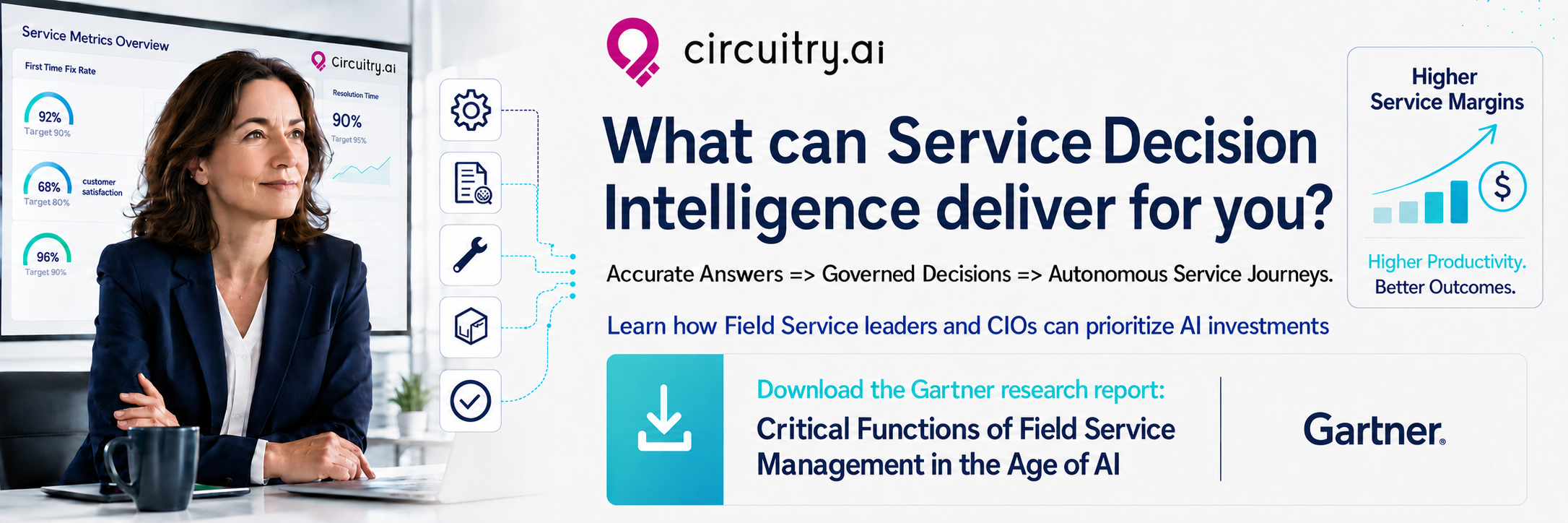
Request a Circuitry.ai demo to see how Service Decision Intelligence and Service AI Workers can help you improve triage, technician productivity, first-time fix, customer experience, and operating efficiency.
Gartner, Critical Functions of Field Service Management in the Age of AI, Jim Robinson, 15 May 2026.
Gartner is a registered trademark of Gartner, Inc. and/or its affiliates.