Governed AI autonomy means defining which service decisions AI can support or carry out, what evidence it needs, and when a person must approve or take over. AI can help at each point, but service leaders must set that evidence and authority. Start with the service outcome you want to improve, then identify the decisions that stand in the way.
In the Gartner® research report CIOs: The Fastest Path to Field Service AI Value Is Not Full Autonomy, Jim Robinson writes:
“Different activities may support different levels of AI autonomy simultaneously. Organizations should not assume a single maturity path across all activities.”
Gartner, CIOs: The Fastest Path to Field Service AI Value Is Not Full Autonomy, Jim Robinson, Senior Director Analyst, Gartner. Read the Gartner research report
At Circuitry.ai, our perspective is that service leaders should make this choice at the decision level. A journey can preserve expert judgment where it matters and move routine work forward within approved limits. Success means a better service result, measured against a clear baseline.
Set authority for each service decision
Consider two actions within the same repair case: preparing a service summary and authorizing an expensive component replacement. The first may need a check for completeness. The second may require proof of diagnosis, confirmed fitment, coverage evidence, and financial approval. Treating both actions identically can create unnecessary review or expose the business to avoidable errors.
We use three practical operating modes.
- Guide gives a technician or support specialist relevant knowledge while that person chooses the action.
- Review assembles evidence and a recommendation for an authorized person to approve or adjust.
- Act allows an eligible action to proceed when the required evidence, permissions, and policy conditions are satisfied.
These are Circuitry.ai operating examples, and they can coexist within one case.
Connect decisions into a governed service journey
Gartner also states:
“The most successful field service organizations are not rushing to automate everything. They are selectively orchestrating work, decision support, approvals and escalations across broader workflows, combining AI roles with human judgment, then measuring customer and operational impact.”
Gartner, CIOs: The Fastest Path to Field Service AI Value Is Not Full Autonomy, Jim Robinson, Senior Director Analyst, Gartner. Read the Gartner research report
Circuitry.ai’s Autonomous Service Journeys connect the work from the initial request through resolution and feedback. Service Decision Intelligence brings together product knowledge, repair history, policy, and connected systems so each step can use the context established earlier.
Consider an illustrative OEM equipment case in which Guide, Review, and Act coexist. A support request arrives with an error code and an asset serial number. To guide troubleshooting, the journey assembles the service history and retrieves the relevant procedure. In review, a specialist examines uncertain symptoms and decides whether a visit is required. If a visit is approved, an authorized agent can act by creating the work order and preparing a technician briefing. An uncertain part substitution returns to review. The technician confirms site conditions, follows the applicable safety procedures, and records the repair result.
The customer’s request stays connected as responsibility changes. The intended benefit is less repeated investigation and a better-prepared technician. The test is whether the journey improves first-time fix, resolution time, and customer effort in your operation.
Service AI worker roles describe the work performed, not the authority to decide. Within Circuitry.ai, AI Advisors guide decisions, AI Analysts examine evidence and results, and AI Agents execute authorized work. Decision authority is configured separately, including where a person must approve or take over.
One journey, multiple autonomy levels
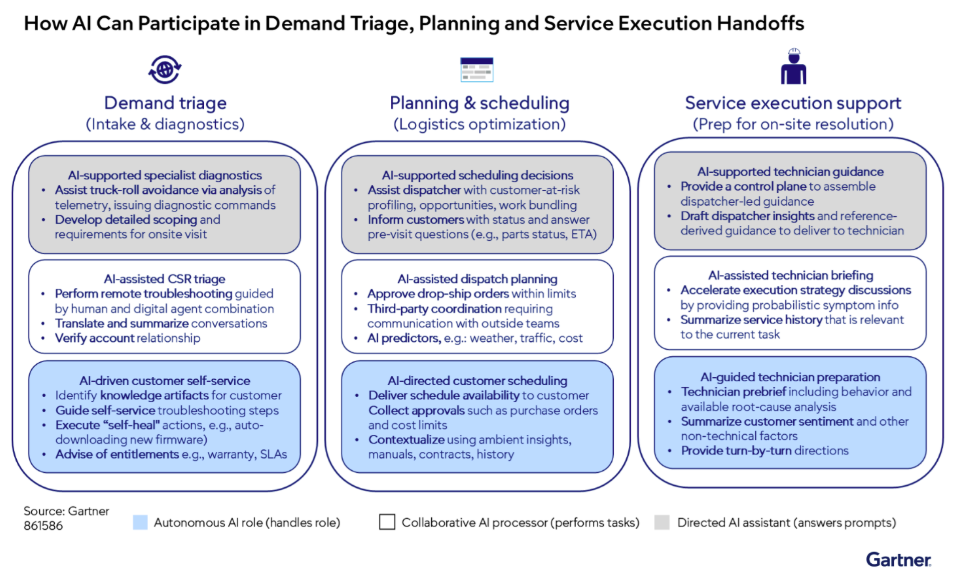
Set authority for each activity and handoff, rather than assign one autonomy level to the entire service journey. Gartner examples illustrate this through directed assistance, collaborative processing, and autonomous execution across demand triage, planning and scheduling, and service execution support.
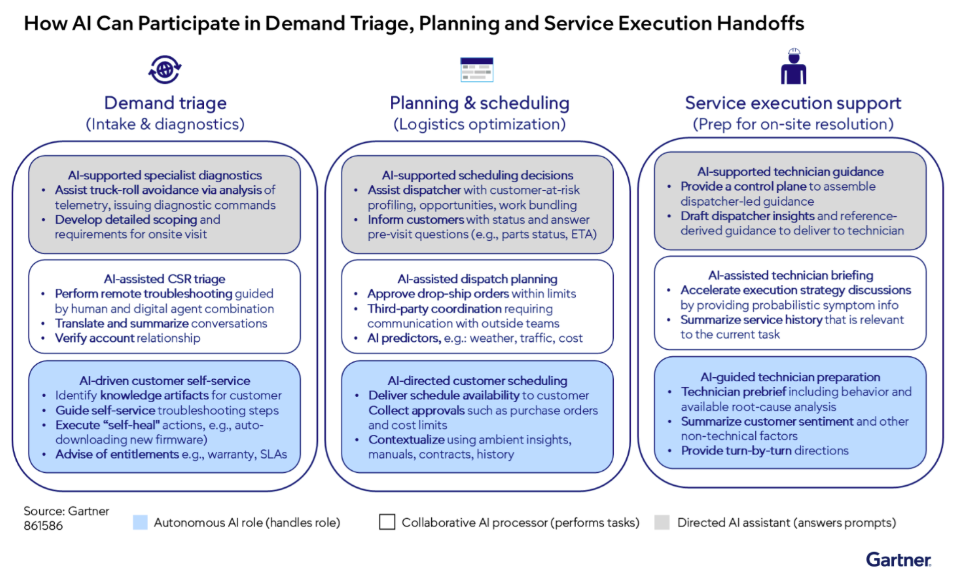
Figure 1. How AI Can Participate in Demand Triage, Planning and Service Execution Handoffs. Source: Gartner, CIOs: The Fastest Path to Field Service AI Value Is Not Full Autonomy, Jim Robinson, 19 October 2026, p. 6. G00861586.
Apply the approach across service operations
The following examples extend our approach across service, parts, warranty, and technical support. They are illustrative Circuitry.ai applications.
|
Service decision
|
Control to define
|
Outcome to measure
|
|
Technical support triage
|
Escalate conflicting symptoms or incomplete asset information.
|
Resolution time and customer effort
|
|
Repair and parts guidance
|
Review uncertain fitment and substitutions; retain technician safety judgment.
|
First-time fix and repeat visits
|
|
Warranty claim review
|
Apply approval limits; route disputed coverage and missing evidence to a reviewer.
|
Decision quality and claim cycle time
|
|
Service follow-up
|
Allow approved updates; review changes to customer commitments.
|
Manual effort and unresolved cases
|
Make accuracy and accountability operational
Accuracy creates trust and helps determine the appropriate level of autonomy; it does not replace permissions, policy conditions, or approval limits. For us, accuracy means evaluating whether a recommendation is supported by the right product context and current policy, then checking whether the resulting action delivered the intended outcome. A confident answer alone is insufficient evidence for greater authority.
A practical deployment should define required evidence, permitted actions, approval limits, and an accountable owner for exceptions. A Decision Controller applies those conditions to determine whether work proceeds, seeks approval, or escalates. When the evidence is incomplete, the journey should carry that context to the reviewer so the person can make an informed decision.
The authority to act also needs to be reversible. A change in product configuration, policy, or decision quality can justify returning a decision to review. Human oversight remains useful even when other steps in the same journey operate independently.
Measure value before expanding authority
For an OEM leadership team, we recommend selecting one recurring decision with a clear business cost, such as a repair recommendation that frequently leads to repeat visits. Establish today’s performance and agree how results will be evaluated before changing the workflow.
Circuitry.ai’s Productivity, Outcomes, and Efficiency approach provides a useful way to organize the measures. Productivity includes preparation time and specialist review effort. Outcomes include first-time fix, verified resolution, and decision quality. Efficiency includes repeat visits, cost per resolved case, and rework. Compare similar cases and account for product complexity so improvements are meaningful.
For a repair-recommendation pilot, define decision quality before launch. For example, assess whether the recommendation used the correct asset configuration, followed the applicable procedure and policy, and was supported by the recorded repair result. Agree what evidence counts as verified resolution and apply the same criteria to baseline and pilot cases. Treat faster preparation as a productivity gain, not proof of a better repair decision.
Include technician and reviewer feedback in that assessment. Examine overrides and failed resolutions, especially where a faster decision creates downstream work. Expand authority when the evidence supports it, while retaining review for decisions that still need it.
Start with one valuable service decision
Identify one decision where better evidence or fewer handoffs could improve the customer’s outcome. Define its authority and measure the change. Use the Gartner research to align your service and IT teams on where autonomy should start.
Read the Gartner research report
GARTNER is a trademark of Gartner, Inc. and/or its affiliates..
This graphic was published by Gartner, Inc. as part of a larger research document and should be evaluated in the context of the entire document. The Gartner document is available upon request from Circuitry.ai
Bring one recurring service decision to a Circuitry.ai demo discussion. Explore how Service Decision Intelligence and Autonomous Service Journeys could support the evidence, approvals, and handoffs involved—and how you would measure the resulting service improvement.
Request a Circuitry.ai demo