For many warranty and claims organizations, the question is no longer whether AI can improve claims operations.
The harder question is:
How do we take advantage of AI when our core warranty or claims system was built years, or even decades, before modern AI existed?
That is the reality for many manufacturers, vehicle service contract providers, third-party administrators, retailers, and service organizations.
Their existing platforms may reliably manage contracts, claims, transactions, payments, and workflows. But they may also depend on forms, business rules, custom integrations, manual research, email, phone calls, and experienced adjudicators to make the actual decisions.
Replacing those systems can take years. AI does not have to. A more practical approach is to augment the existing warranty system with an AI-powered decision intelligence layer.
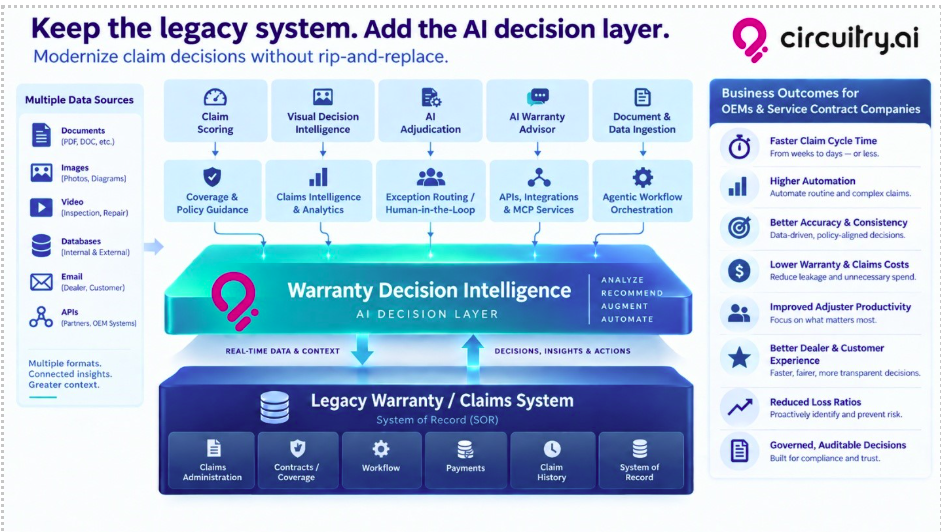
Circuitry.ai Warranty Decision Intelligence works alongside existing warranty, claims, service, CRM, dealer, ERP, and payment applications. The legacy platform can continue doing what it was designed to do: maintain transactions, execute workflows, and remain the system of record.
Circuitry.ai adds what those systems were never originally designed to provide: AI-powered answers, analysis, predictions, decisions, and autonomous actions.
Your Warranty System Can Remain. The Way Work Gets Done Can Change.
Traditional warranty systems were designed primarily to capture and process transactions.
A claim is submitted. Fields are validated. Business rules execute. The claim moves through a workflow. An adjuster reviews it. Eventually, a decision is made, and another transaction is created.
But much of the intelligence required to make that decision often sits outside the application.
An adjudicator may need to:
- Read the complaint, cause, and correction.
- Interpret warranty or service contract coverage.
- Search service history.
- Compare previous repairs.
- Examine parts and labor.
- Review pictures or videos.
- Check technical service information.
- Look for anomalies.
- Contact a dealer or service provider for missing information.
- Decide whether to approve, deny, pend, escalate, or inspect the claim.
- Document the reasoning.
- Update the claims system.
The administration system manages the transaction. People provide much of the intelligence.
Warranty Decision Intelligence changes that relationship. Instead of waiting for the underlying system to be rebuilt, AI Workers can begin performing portions of this work now, while continuing to use the existing warranty platform to execute and record the transaction.
Over time, the workload shifts incrementally:
Manual work → AI-assisted work → AI-executed work → governed autonomous claims operations.
There is no requirement for a disruptive “big bang” replacement.
Add Claim Scoring to Every Claim
One of the fastest opportunities is AI-powered Claim Scoring.
Instead of requiring an adjudicator to manually assemble information from multiple screens and systems, Circuitry.ai can evaluate the claim against criteria such as:
- Coverage and eligibility
- Contract or warranty terms
- Complaint, cause, and correction quality
- Repair appropriateness
- Parts pricing
- Labor time
- Repair history
- Previous claims
- Cost patterns
- Documentation completeness
- Images and video
- Potential anomalies
- Program-specific policies
The Claim Scoring Agent brings multiple forms of evidence together and provides a decision-ready assessment showing what needs attention, why it matters, and what should happen next.
This allows organizations to treat different claims differently:
- Straightforward, well-supported claims can move faster.
- Claims with missing information can automatically request additional documentation.
- Higher-risk, unusual, high-value, or lower-confidence claims can be routed to experienced adjudicators.
Instead of asking experienced people to review every claim with the same level of effort, AI helps concentrate human expertise where it delivers the greatest value.
See What Traditional Claims Systems Cannot See
Claims increasingly contain information that does not fit neatly into database fields.
- Pictures.
- Videos.
- PDF documents.
- Repair estimates.
- Diagnostic reports.
- Inspection documents.
- Handwritten information.
That is where Visual Intelligence becomes important. Circuitry.ai can analyze images and video as part of the claim decision rather than treating them merely as attachments that someone must manually inspect.
For example, AI can help determine whether visual evidence:
- Supports the reported failure.
- Matches the component being claimed.
- Is consistent with the repair being requested.
- Reveals damage relevant to coverage.
- Supports or conflicts with information in the claim.
- Contains information that should be brought to an adjudicator's attention.
Visual evidence can then be evaluated alongside the claim narrative, contract terms, repair history, parts, labor, and other available evidence.
The result is a more complete view of the claim.
Give Every Adjudicator an AI Warranty Advisor
Some claims should remain human decisions. But that does not mean the adjudicator should work alone. The Warranty Advisor acts as an AI assistant for claims professionals, giving them contextual access to information such as:
- Warranty policies
- Service contract terms
- Coverage
- Exclusions
- Standard operating procedures
- Technical documentation
- Service information
- Historical cases
- Claim information
Instead of navigating multiple applications, searching documents, asking another employee, or relying on memory, the adjudicator can ask questions conversationally.
- Is this repair covered?
- What documentation is missing?
- Why was this claim flagged?
- Does the requested labor appear reasonable?
- What does the contract say about this component?
- Have we seen similar repairs previously?
Circuitry.ai can also provide Warranty Advisors through a browser extension that works alongside online claims applications, reducing the integration required to begin assisting users. Circuitry.ai browser extension provides a way for Warranty Advisors to work with existing claims systems. This is particularly valuable for older applications where changing the user interface may be expensive, risky, or simply impractical.
What If Our Data Is Not Ready for AI?
This is one of the most common concerns. Organizations often assume they must first complete a massive data transformation project before deploying AI.
Their data may exist across:
- Claims databases
- Data warehouses
- Spreadsheets
- PDFs
- Contract documents
- Repair orders
- Service systems
- Dealer systems
- CRM applications
- Parts systems
- Knowledge repositories
- Images and videos
- Email
- Historical files
Some information may be structured. Some may be unstructured. Some may be incomplete. That does not automatically prevent an organization from getting value from AI.
Circuitry.ai can ingest and work with information in multiple formats and combine relevant information for specific service and warranty decisions.
More importantly, organizations do not need every dataset to be perfect before starting. A better approach is to ask:
What information is required to improve this particular decision?
- A Warranty Advisor may initially require policies, contracts, procedures, and knowledge.
- Claim Scoring may use a different combination of claims history, coverage, costs, repair evidence, and decision outcomes.
- Visual Intelligence may start with claim images and associated claim information.
- Claims Intelligence can expand as additional historical data becomes available.
This allows the AI strategy to develop incrementally instead of becoming dependent on an enterprise-wide data modernization program.
What If Our Legacy System Has Poor APIs, or No APIs?
Another common objection is integration. Many established warranty platforms were created long before REST APIs, event architectures, or modern integration patterns became standard.
Some have proprietary interfaces. Others expose limited APIs. Some require database extracts or files. And some organizations simply do not want to make major modifications to a mission-critical claims platform.
Circuitry.ai is designed to support different integration approaches depending on the environment.
That can include:
- APIs
- Files and data feeds
- Batch integrations
- Browser-based interaction
- Existing enterprise integration layers
- Direct application integrations
- AI-assisted user interaction
- Agent-based orchestration
The objective is not to force every organization into one technical architecture. It is to determine the lightest practical integration necessary to create measurable business value and then deepen the integration as automation increases.
For end users, the browser extension can provide an especially useful bridge. The claims professional can continue using the familiar legacy application while the AI Advisor works alongside it.
For more advanced automation, AI Agents can communicate with enterprise systems and execute approved actions through available interfaces.
The Legacy Application has been the System of Record. AI Becomes the System of Decision.
This creates an important architectural distinction. The legacy warranty platform does not have to disappear. It can remain the System of Record, while Circuitry.ai becomes the System of Decision and Action.
Consider a claim moving through this architecture.
- The existing system receives the claim.
- Circuitry.ai evaluates the claim.
- The Claim Scoring Agent determines what requires attention.
- Visual Intelligence evaluates pictures or video.
- The Warranty Advisor provides contextual support to the adjudicator.
- AI Agents retrieve supporting information and perform validations.
- The system recommends or executes the appropriate next action based on configured confidence, risk, and governance thresholds.
- The existing warranty application records the resulting transaction.
The two systems work together.
Circuitry.ai’s Warranty Decision Intelligence is a decision layer that works across existing claims, contract, CRM, payment, dealer, and related systems rather than requiring their replacement.
Gradually Move Work From Legacy Systems to AI Agents
This architecture also creates a safer path toward autonomy.
Organizations do not have to begin by automating every claim. They can start with assistance.
Stage 1 — AI assists people
- Warranty Advisors answer questions.
- Claim Scoring summarizes evidence and highlights exceptions.
- Visual Intelligence helps interpret documentation.
- Claims Intelligence identifies patterns.
- Humans remain responsible for the decision.
Stage 2 — AI recommends actions
AI evaluates the claim and recommend next action: Approve. Request information. Escalate. Inspect. Or Review.
The adjudicator confirms or changes the recommendation.
Stage 3 — AI executes routine decisions
High-confidence, low-risk transactions can be processed automatically according to company-defined controls.
People handle exceptions.
Stage 4 — AI Agents perform more of the claim journey
Agents can increasingly perform work such as:
Claim intake → documentation validation → coverage assessment → evidence analysis → claim scoring → adjudication → communication → payment validation → system updates.
The organization's existing applications continue executing and recording business transactions.
The difference is that an increasing share of the work surrounding those transactions is performed by AI.
Integrate Warranty Decision Intelligence With Your Broader Enterprise AI Strategy
Many companies are simultaneously developing enterprise AI platforms, copilots, data platforms, agent frameworks, and internal AI applications.
Warranty Decision Intelligence does not need to compete with those initiatives. It can become a specialized Service and Warranty Decision Intelligence layer within them.
Circuitry.ai can expose capabilities through easy-to-integrate APIs and MCP services so enterprise workflows and AI applications can access specialized warranty and service intelligence.
That means an enterprise AI agent could call a specialized Circuitry.ai service to:
- Check warranty coverage.
- Score a claim.
- Analyze repair evidence.
- Interpret an image.
- Validate labor.
- Evaluate parts.
- Ask a warranty knowledge question.
- Retrieve a claim recommendation.
- Analyze claims history.
Rather than rebuilding specialized warranty intelligence inside every enterprise AI project, companies can make these capabilities available as reusable services.
What About Security and Data Protection?
Any enterprise AI initiative involving warranty, customer, repair, dealer, or contract information must address data protection from the beginning.
Organizations understandably ask:
- Where does our data go?
- Is it shared with other customers?
- Is our information used to train somebody else's AI?
- How is access controlled?
Circuitry.ai segregates customer data and protects it within the customer's environment and governance model. Customer information is not pooled across customers for cross-customer model training.
Proving the Value before scaling
Organizations should also be able to demonstrate measurable value before committing to large-scale deployment.
Circuitry.ai supports a Proof of Value approach so companies can apply AI to a defined process, set of claims, or business problem and evaluate the results before scaling.
The Circuit Simulator can go one step further by applying decision intelligence to historical operational data and estimating how AI could affect outcomes such as:
- Claim automation
- Adjudicator productivity
- Claim costs
- Processing efficiency
- Decision consistency
- Exception rates
The goal is to answer an important question with your own data:
What could this actually be worth to our organization?
That changes the AI conversation from theoretical capability to measurable operational impact.
Modernize the Decisions Before You Modernize the System
Eventually, many companies will modernize or replace parts of their legacy technology landscape. But warranty leaders should ask whether they need to wait for that transformation before improving today's decisions.
A multi-year platform modernization program should not prevent an organization from improving:
- Claim accuracy today.
- Adjudicator productivity today.
- Claim cycle time today.
- Warranty costs today.
- Dealer and customer experience today.
- Quality insights today.
The underlying system can continue running while the intelligence around it improves. And as more work moves from manual processes to AI Workers, the role of the legacy system changes. It becomes increasingly responsible for executing transactions.
AI becomes increasingly responsible for interpreting information, assisting people, making decisions, identifying exceptions, and orchestrating actions. That may ultimately be a more practical modernization strategy than trying to rebuild everything at once.
Add Intelligence First. Modernize at Your Own Pace.
The choice does not have to be:
Keep the legacy system or replace it with AI.
There is a third path:
Keep the systems that work. Add a modern AI decision layer around them.
Start with the decisions where AI can create the greatest measurable value.
- Add Warranty Advisors.
- Score claims.
- Analyze images and video.
- Automate evidence review.
- Use Claims Intelligence to identify patterns.
- Allow AI Agents to take on repetitive work.
- Connect them to existing applications.
- Keep people in control where judgment is required.
Then progressively increase autonomy as confidence, governance, and business value are proven.
You do not have to wait for your legacy warranty system to become modern before your warranty operation does.
See What Warranty Decision Intelligence Could Deliver With Your Existing Systems
Circuitry.ai Warranty Decision Intelligence is designed to augment existing warranty and claims environments with specialized AI Advisors, Analysts, and Agents, from claim scoring and visual intelligence to adjudication assistance, claims analytics, and autonomous claim processing.
Start with a focused Proof of Value or use the Circuit Simulator to quantify the opportunity using your own claims environment before scaling.
Better claim decisions. Greater automation. No legacy rip-and-replace required.
Schedule a demo now to see how Circuitry.ai can help you bring AI into your warranty and claims operations, improving team productivity, increasing the accuracy and consistency of claim decisions, and reducing warranty and claims costs while working with the systems you already have.