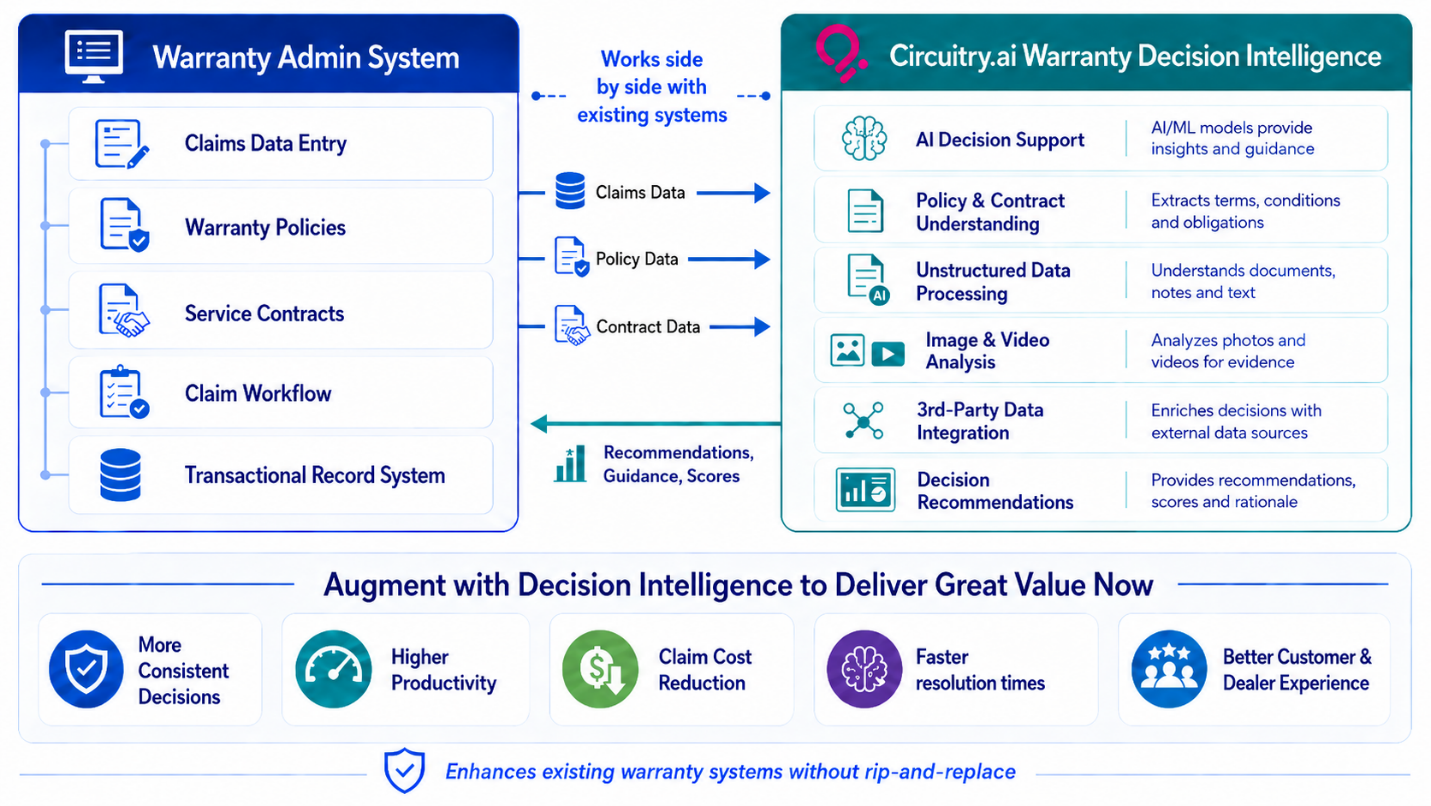
Manufacturers, service contract providers, and warranty administrators have already invested in warranty management systems, claims platforms, dealer portals, ERP systems, and service operations tools. These systems are built to record transactions, not make complex decisions, which leaves adjusters manually reviewing claims, interpreting policy documents, and making inconsistent decisions.
Circuitry.ai’s Warranty Decision Intelligence works with your existing warranty management or claims systems, uses your approved data and policies, and helps your teams make faster, more consistent, and more accurate warranty decisions.
A decision layer for any warranty or claims system
Most warranty and service contract organizations already have a system of record. It may manage claims intake, adjudication, approvals, labor rates, parts, service history, payments, dealer interactions, and contract coverage.
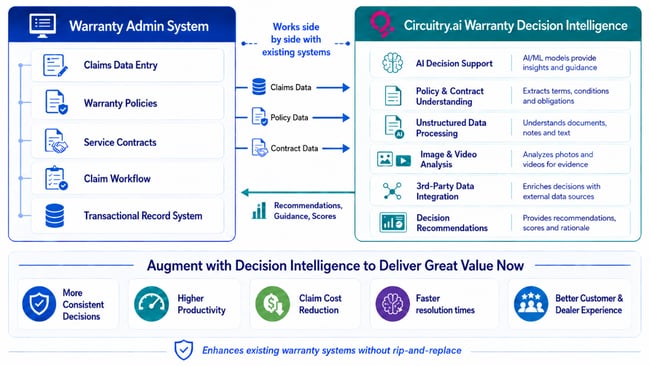
Circuitry.ai adds a Decision Intelligence layer on top of these systems. This layer can support decisions such as:
- Should this claim be approved, denied, adjusted, inspected, or escalated?
- Is there a repeat repair, prior claim, or known failure pattern?
- Is there a fraud, abuse, or leakage risk?
This Decision Intelligence layer makes every claim decision smarter, faster, and more consistent while keeping your transactional systems in place.
Here's what warranty and service contract teams most often ask when exploring how AI fits into their existing operations.
Quick navigation
Short on time? Jump to the questions that matter most to you.
-
How does Circuitry.ai normalize complex warranty data across systems? How Circuitry.ai handles different systems, formats, and data structures across your organization.
-
How do I connect warranty AI to existing systems and data? The integration options available, from APIs and data warehouses to file transfers and custom connectors.
-
How does Circuitry.ai learn from your claims, policies, and service history? How the platform builds a decision foundation tailored to your products, policies, and historical claim patterns.
-
What if our existing warranty data isn't clean? Why imperfect or incomplete data isn't a barrier to getting started with AI.
-
How do our warranty teams use AI in daily workflows? How adjusters, analysts, and service teams access decision support without changing their current systems.
-
What if the current admin system doesn't provide data or API access? What to do when your warranty platform limits data access,
-
How can AI work with our many disconnected systems and third-party data? How Circuitry.ai unifies fragmented systems into one decision workflow, including third-party data sources.
-
How can we leverage existing data to generate AI-driven insights? How your existing claims, product, and service data can drive better outcomes across quality, sales, and warranty teams.
-
How does Circuitry.ai work with existing business rules and BRMS? Why AI and your existing rules aren't either/or and how both can work together in one decision workflow.
How does Circuitry.ai normalize complex warranty data across systems?
One of the biggest barriers to warranty AI is data complexity. Every company has different systems, claim formats, service records, part structures, labor codes, fault codes, coverage rules, contract terms, and dealer workflows.
Circuitry.ai solves this through universal domain schemas for service, parts, and warranty. These schemas help normalize data across different systems and data sources, including:
- Warranty claims
- Repair orders
- Install base records
- Product registration data
- Labor guides
- Failure codes
- Dealer and servicer history
This allows Circuitry.ai to understand warranty and service data across different companies, systems, and formats without forcing customers into a rigid data model.
How do I connect warranty AI to existing systems and data?
Circuitry.ai has data pipelines to automate ingestion from a wide range of systems and data sources. These pipelines can connect to existing warranty platforms, claims systems, dealer portals, ERP systems, CRM systems, data warehouses, data lakes, document repositories, and other operational systems.
Integration can happen through the mechanisms your current systems support, including:
- APIs
- Database extracts
- Event-based integrations
- Document ingestion
- Email and attachment processing
- Custom connectors where needed
For customers who already have a data warehouse or data lake, Circuitry.ai can work with those environments. We don’t need companies to duplicate major data architecture investments. Instead, we use the data that is available, authorized, and relevant to the warranty decision use cases.
Circuitry.ai sponsored a Warranty Management study by MapConnected and MR Insights. Read more about the findings and download the study from our blog post Key Insights From the Warranty Management: From Operational Burden to Strategic Advantage Study.

How does Circuitry.ai learn from your claims, policies, and service history?
Once data is connected and normalized, Circuitry.ai builds a warranty decision intelligence foundation using the customer’s authorized data. This may include claims history, service history, install base data, parts information, contract coverage, warranty policies, dealer behavior, repair outcomes, and supporting documentation.
The Decision Intelligence models learn from patterns in your data, including:
- Historical approval, denial, adjustment, and escalation decisions
- Dealer or servicer behavior
- Parts and labor usage
- Repeat repairs
- Policy exceptions
- High-risk claim indicators
This enables the system to provide precise, explainable decision support that reflects your business, your products, your contracts, and your operating policies.
What if our existing warranty data isn’t clean?
Most warranty data isn’t perfect. This is typical of many organizations with decades of warranty data and many disconnected systems. Circuitry.ai doesn’t require a perfect data environment to start. We can work with the available data and focus first on the information required for specific decision support use cases.
For example, we may start with:
- Complaint, cause, and correction text
- Parts and labor lines
- Coverage and contract details
- Product or VIN/serial information
- Repair order notes
- Prior claim history
- Service contract language
Where needed, Circuitry.ai can cleanse, normalize, enrich, and structure the data required for Decision Intelligence. The goal is to accelerate value without waiting for a multi-year data cleanup project.
How do our warranty teams use AI in daily workflows?
Many customers use Circuitry.ai through an extension model, where Warranty Decision Intelligence works side by side with the existing warranty or claims system. This allows adjusters, claim analysts, service teams, dealer support teams, and managers to access AI-powered warranty decision support without disrupting their current workflow.
Circuitry.ai can provide:
- Decision recommendations
- Policy references
- Risk scores
- Missing information alerts
- Parts and labor validation
- Suggested next actions
- Approval, denial, adjustment, inspection, or escalation guidance
The user experience can be delivered across multiple channels, including web applications, embedded panels, browser extensions, APIs, mobile apps, chat, email, and workflow integrations.
Circuitry.ai’s Warranty Decision Intelligence provides the most important information in a precise and usable way so people can make better decisions.
What if the current admin system doesn’t provide data or API access?
Warranty and claims data belong to the customer. Customers should have the right to choose their AI partner and use their own data to improve decision quality, cost control, consistency, and customer experience.
If an existing warranty administration system or claims platform doesn’t provide API or data access, Circuitry.ai works collaboratively with the customer and their system provider to identify available integration options.
This may include:
- Existing APIs
- Standard reports
- Scheduled data exports
- Secure data feeds
- Data warehouse replication
- File-based integration
- Read-only access
- Customer-authorized extracts
A practical recommendation: when renewing or signing agreements with warranty, claims, ERP, CRM, or dealer management systems, make sure the contract includes unrestricted access to your operational data, reasonable API access, and the ability to work with approved third-party AI and analytics partners.
How can AI work with our disconnected systems and third-party data?
Most warranty, service, and service contract organizations don’t operate from one system. They have separate applications for product registrations, claims, parts returns, supplier recovery, dealer management, payments, service history, labor time, recalls, and third-party data sources.
While each system serves a valid purpose, the process becomes fragmented when people have to switch between applications, manually search for information, copy and paste data, and make decisions with incomplete context.
Circuitry.ai Warranty Decision Intelligence is designed to work across these disparate and disconnected systems. Circuitry.ai acts as an intelligent decision and execution layer that connects to them, understands the data, and brings the right information and actions into one decision workflow.
Circuitry.ai AI Workers can use actions and tools through standard APIs, support emerging MCP standards, and apply universal schemas for service, parts, warranty, claims, contracts, assets, dealers, suppliers, and related entities.
We can also integrate with third-party data sources and services that are important to warranty and claims decisions, including labor time guides, parts pricing, remanufactured part availability, recall data, product history reports, payment processing, inspection services, and other external data providers.
How can we leverage our existing data to generate AI-driven insights and better business outcomes?
Your existing data is one of the most valuable assets for AI. Manufacturers and service contract providers already have rich information across product registrations, install base records, service history, warranty claims, parts usage, repair outcomes, and dealer or servicer activity.
Even when the data lives across multiple systems or is not perfectly clean, AI can help connect, cleanse, normalize, and interpret the data so it becomes useful for business decisions.
- For quality teams, AI can identify emerging product issues earlier by analyzing claims, service records, repair notes, parts usage, failure patterns, images, and technician feedback. This helps reduce the detection-to-correction cycle time, improve product quality, and lower the risk of repeat failures or recalls.
- For sales and customer experience teams, AI can use registration, install base, contract, and service history data to identify opportunities to grow service contract sales, recommend accessories, improve renewal rates, and strengthen customer retention and improve customer lifetime value.
- For warranty and claims teams, Decision Intelligence creates repair profiles that predict claim costs, identify unusual claim patterns, and reduce warranty leakage with AI that detects fraud and helps adjusters make more consistent decisions.
How does Circuitry.ai work with our existing business rules and BRMS?
Traditional business rules are useful for deterministic decisions, such as eligibility checks, required fields, contract limits, approval thresholds, labor rate rules, parts validation rules, payment rules, and compliance requirements. If you already have a BRMS managing these rules, Circuitry.ai can work with it and augment it.
Circuitry.ai Warranty Decision Intelligence adds an advanced decision layer on top of traditional rules. It scores claims and other warranty decisions using many criteria that static rule systems typically can’t handle well, including claim history, repair notes, complaint/cause/correction text, policy interpretation, risk signals, and similar historical outcomes.
Circuitry.ai also includes a decision engine that can execute existing business rules where appropriate. That means customers can keep their current rules, reuse them, and combine them with AI-driven scoring, policy understanding, and decision recommendations.
AI can understand policy documents, processing guides, natural language instructions, and historical claims decisions to provide more flexible and intelligent decision support. Over time, this helps automate more decisions, reduce manual review, and improve consistency across adjusters, dealers, products, and claim types.
Circuitry.ai delivers explainable AI for warranty claims. The platform can show the factors that influenced the recommendation, the policies or guides used, the data reviewed, and the rationale behind the decision. This allows business users, warranty leaders, compliance teams, and AI governance teams to understand and trust the recommendation.
The optimal model is rules + AI Decision Intelligence. Keep the rules that work, connect them into the decision workflow, and use Circuitry.ai to handle the complex judgment, unstructured data, learning, scoring, and explainable recommendations.
Why Circuitry.ai is different from current warranty systems
Circuitry.ai is purpose-built for Decision Intelligence across service, parts, and warranty domains. It combines domain-specific schemas, AI models, data pipelines, policy understanding, workflow integration, and explainable decision support.
Key differentiators include:
- Designed for manufacturers, OEMs, TPAs, service contract providers, and dealer networks
- Works with existing warranty and claims systems
- Universal schemas for service, parts, and warranty
- Customer-specific model training and data segregation
- AI grounded in warranty policies and contract language
- Extension model to work side by side with transactional systems
- Multiple UX channels for adjusters, dealers, service teams, and managers
- Human-in-the-loop and automation-ready architecture
The future of warranty is an intelligent decision layer
Circuitry.ai Warranty Decision Intelligence helps companies move warranty operations from manual, inconsistent claim review to intelligent, data-driven decision management.
Your warranty system manages the transaction. Circuitry.ai helps make the right decision.
If your team is still relying on manual reviews, disconnected systems, and static rules to make high-stakes warranty decisions, there is a better way. Circuitry.ai helps organizations turn existing systems into intelligent decision workflows, without ripping and replacing the platforms they already depend on.
Schedule a live demo to learn how Circuitry.ai Warranty Decision Intelligence can work with your existing warranty, claims, service, and data systems to improve every claim decision.