Every warranty claim is a connected series of decisions. Is the asset and contract eligible? Is the failure covered? Does the repair make sense? Are the requested parts, labor, and rates appropriate? Is more evidence required? Can the claim be approved automatically, or should an expert review it?
In many organizations, those decisions are still distributed across documents, emails, phone calls, legacy systems, and individual experience. The result is manual data entry, inconsistent reviews, avoidable back-and-forth, longer cycle times, cost leakage, and limited insight into what claims are revealing about products and service operations.
Circuitry.ai Warranty Decision Intelligence (WDI) changes that. It applies specialized Warranty AI Workers throughout an Autonomous Claim Journey - from the first estimate or Repair Order through authorization, adjudication, payment, and Claims Intelligence. Each worker supports a specific part of the journey, while the platform maintains the claim context, applies the right guidance, records the evidence behind each decision, and routes exceptions to people when human judgment is needed.
The result is not simply faster claim processing. It is a more accurate, consistent, explainable, and increasingly autonomous claim operation.
THE AUTONOMOUS CLAIM JOURNEY
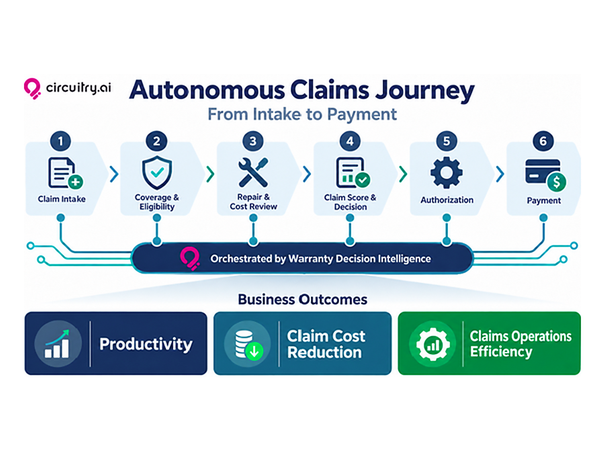
Warranty Decision Intelligence transforms claim processing into an Autonomous Claims Journey by orchestrating specialized Warranty AI Workers from intake through payment. It keeps claim information, coverage guidance, repair evidence, cost validation, and human oversight connected so each claim moves to the right next action with greater speed and consistency. The result is higher productivity, lower claim costs, and more efficient claims operations with evidence, confidence controls, and a complete audit trail.
1 Claim intake and creation
The current challenge: Claims often enter through multiple channels and in multiple formats: portals, emails, phone calls, repair estimates, Repair Orders, invoices, images, and supporting documents. Teams must manually read the information, rekey it into a claims system, identify missing fields, and contact the submitter for clarification. Errors and incomplete submissions at intake create delays throughout the rest of the journey.
How Warranty Decision Intelligence helps: The Claim Intake Agent can accept an estimate, Repair Order, or other claim document and extract the information needed to create an authorization request or claim. It identifies and structures details such as the customer, vehicle or equipment, contract, mileage or usage, repair facility, complaint, cause, correction, parts, labor, taxes, and requested amount.
Email and Voice Agents can also support intake through the channels customers, dealers, and repair facilities already use. WDI checks the submission for completeness, identifies missing or conflicting information, and can initiate the next action before an adjudicator begins a manual review. Through integration, the structured claim can be created in the organization's existing administration or claims platform.
The value: Less rekeying, fewer intake errors, faster claim creation, improved data quality, and a shorter path from first notice to a review-ready claim.
2 Eligibility and coverage verification
The current challenge: Verifying eligibility and coverage requires reviewers to locate the correct agreement, confirm dates and mileage or usage limits, interpret coverage and exclusions, check deductibles and limits, and apply program-specific rules. Contract language may be complex, and different reviewers may interpret the same situation differently.
How Warranty Decision Intelligence helps: The Warranty Advisor retrieves the relevant contract, warranty policy, service history, and claim context. It evaluates eligibility and maps the reported failure and requested repair to the applicable coverage, exclusions, limits, and authorization requirements.
Instead of returning a generic answer, WDI can provide the recommendation with the supporting language and evidence used. Current policies, standard operating procedures, customer-specific rules, and approval thresholds can be supplied as guidance for the decision. If the evidence is incomplete or confidence is below the configured threshold, the claim is routed for human review.
The value: More consistent coverage decisions, less time spent searching across systems and documents, better adherence to program rules, and a clear basis for approvals, adjustments, or denials.
Repair understanding and technical validation
The current challenge: A claim may contain all required fields and still lack a coherent repair story. Complaint, cause, and correction information can be incomplete or inconsistent. Reviewers must determine whether the diagnosis supports the proposed repair, whether the repair addresses the reported failure, and whether the available evidence is sufficient.
How Warranty Decision Intelligence helps: The Service Advisor builds a more complete repair understanding by connecting the complaint, diagnosis, cause, correction, diagnostic codes, repair history, technical knowledge, and known failure patterns. It can identify contradictions, unsupported conclusions, repeat repairs, and information that should be clarified before authorization.
Visual Decision Intelligence extends this review to photos and video. A Virtual Inspector can help request and evaluate relevant visual evidence, while guided image capture can make it easier for a repair facility or customer to provide what is needed. This gives the reviewer a richer, more objective view without requiring a physical inspection for every claim.
The value: Better-supported repair decisions, fewer unnecessary inspections, reduced repeat work, faster exception resolution, and greater confidence that the proposed repair addresses the actual failure.
3 Parts, labor, and cost validation
The current challenge: Even when a repair is covered, validating its cost can require several separate checks. Reviewers may need to confirm part applicability and pricing, labor operations and hours, retail labor rates, deductibles, taxes, limits, and prior authorizations. Manual comparison is time-consuming and makes cost leakage difficult to detect consistently.
How Warranty Decision Intelligence helps: The Parts Advisor evaluates the requested parts against the asset, failure, repair, parts knowledge, and available pricing information. It can identify potential mismatches, duplicates, supersessions, or alternative parts that require consideration.
WDI also evaluates labor operations, hours, rates, deductibles, contractual limits, and the total requested amount. It highlights the specific line items or calculations that require attention instead of forcing an adjudicator to reconstruct the entire claim.
The value: More accurate claim costs, earlier detection of leakage, more consistent application of labor and parts rules, and less reviewer time spent on routine calculations.
4 Claim scoring and intelligent routing
The current challenge: Traditional work queues often treat every claim similarly. Straightforward claims wait behind complex ones, while reviewers spend valuable time deciding which claims are safe to approve and which carry higher cost, coverage, quality, or fraud risk.
How Warranty Decision Intelligence helps: WDI generates an agent score using the claim's completeness, coverage alignment, repair support, parts and labor validation, cost, history, anomalies, and confidence. The score does more than rank claims: it helps determine the appropriate next action.
High-confidence, low-risk claims can follow a configured path toward automated authorization. Claims with missing evidence can be routed for information. Unusual or high-value claims can be escalated to a senior adjudicator, technical expert, or inspection process. The organization controls the thresholds and level of autonomy by claim type, customer, program, value, or risk.
The value: Faster handling of routine claims, better use of expert capacity, reduced queue time, earlier attention to higher-risk claims, and a safe path to increasing automation.
5 Adjudication and authorization
The current challenge: The final decision depends on everything that came before it. When facts, evidence, and rules are fragmented, adjudicators must assemble the case manually. That increases handling time and makes it harder to explain why similar claims received different outcomes.
How Warranty Decision Intelligence helps: WDI assembles the claim facts, applicable coverage, repair analysis, visual evidence, parts and labor validation, agent score, and relevant guidance into a decision-ready view. It can recommend approval, adjustment, a request for more information, inspection, escalation, or denial - with the supporting rationale, evidence, and confidence.
Organizations can apply human-in-the-loop controls based on value, risk, confidence, or decision type. Routine decisions can be automated within approved boundaries, while exceptions remain with experienced people. Every action, recommendation, override, and outcome is retained as part of the claim's audit trail.
The value: Shorter adjudication time, more consistent decisions, explainable automation, stronger governance, and greater productivity without giving up control.
Evidence collection and exception resolution
The current challenge: Missing documents, unclear diagnoses, and unsupported amounts create repeated phone calls and emails. The claim can stall while different parties ask for information, wait for a response, and manually update the file. These handoffs create friction for customers and repair facilities as well as additional work for the claims team.
How Warranty Decision Intelligence helps: Email and Voice Agents can request the specific information needed, explain what is missing, capture the response, and return it to the active claim. The Claim Intake Agent structures newly received documents, while the Virtual Inspector can guide the collection of photos or video. The journey maintains the claim state so that each AI Worker and human reviewer operates with the same current context.
The value: Fewer manual follow-ups, quicker resolution of incomplete claims, a better experience for repair facilities and customers, and less risk that a claim is delayed or lost between teams.
6 Payment and claim closure
The current challenge: Approval does not eliminate downstream errors. Final invoices may differ from authorized amounts, deductibles or limits may be applied incorrectly, and payment details may require another manual review. Incomplete closure data also reduces the value of future analytics.
How Warranty Decision Intelligence helps: Before payment, WDI can compare the final invoice with the authorization, validate approved parts and labor, identify unexplained changes, confirm calculations and payment details, and route discrepancies for review. Once the claim is ready, the journey can update connected claims and payment systems, notify the appropriate parties, and preserve the complete decision record.
The value: Fewer payment errors, reduced overpayment and leakage, faster closure, better communication, and a complete, traceable claim record.
Connected Governance Across the Claim Journey
The greatest value comes from connecting specialized Warranty AI Workers across the full journey.
Circuitry.ai's Autonomous Claim Journey coordinates intake, coverage, repair understanding, parts and labor validation, scoring, evidence collection, adjudication, payment readiness, and Claims Intelligence. It integrates with the systems already used to administer contracts and claims, while adding the decision layer needed to improve accuracy, consistency, automation, and measurable outcomes.
Every claim moves through the right next step. Every decision is supported by evidence. Every exception can reach the right person. Every outcome helps improve the next decision.
That is how Warranty Decision Intelligence turns claim processing into a connected, governed, and continuously improving decision journey.
See Warranty Decision Intelligence in Action This October
Circuitry.ai will showcase Warranty Decision Intelligence at two leading warranty events in October 2026:
Schedule a meeting with our team onsite to see how Warranty Decision Intelligence can enhance and automate your claim journey, from intake to payment, and turn every claim into actionable Claims Intelligence.