Throughout 2025, Circuitry.ai had the privilege of working closely with service leaders across manufacturing, industrial equipment, automotive, and technology-driven service organizations. These partnerships gave us a front-row view into the real pressures modern service teams are facing: rising cost to serve, growing equipment complexity, technician skill gaps, fragmented systems, and the challenge of turning AI experimentation into measurable outcomes.
By working alongside leaders responsible for field service, parts, support, and warranty operations, we learned that the biggest bottleneck was not data availability, but decision quality at the moments that matter most. Those lessons directly shaped our 2026 vision and roadmap: a sharper focus on Field and Service Decision Intelligence, autonomous service journeys that span channels, and AI advisors, AI agents, and AI analysts designed to deliver explainable recommendations tied to clear service KPIs.
Field service is entering 2026 with a very specific tension: customers expect faster, first-time outcomes, while service organizations are dealing with higher equipment complexity, tighter labor markets, and rising cost-to-serve. Successful service organizations will redesign how decisions get made across the entire service journey, from triage and scheduling to parts, repair, and warranty.
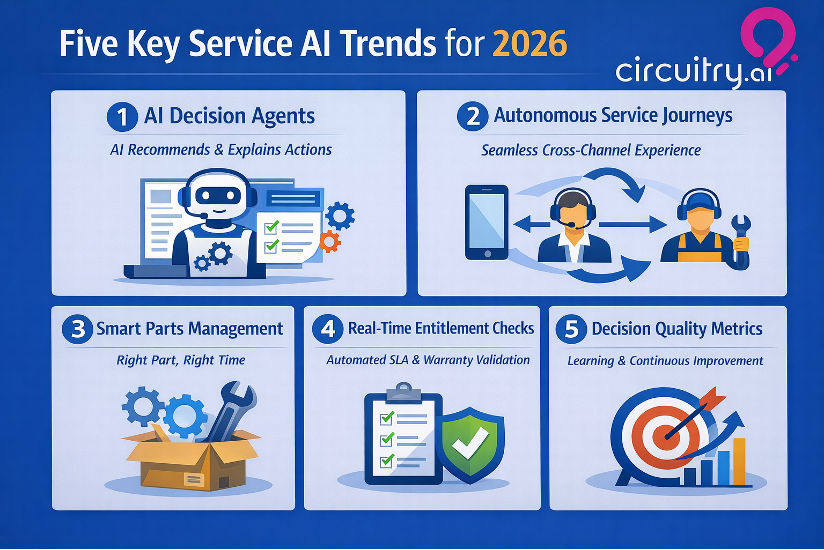
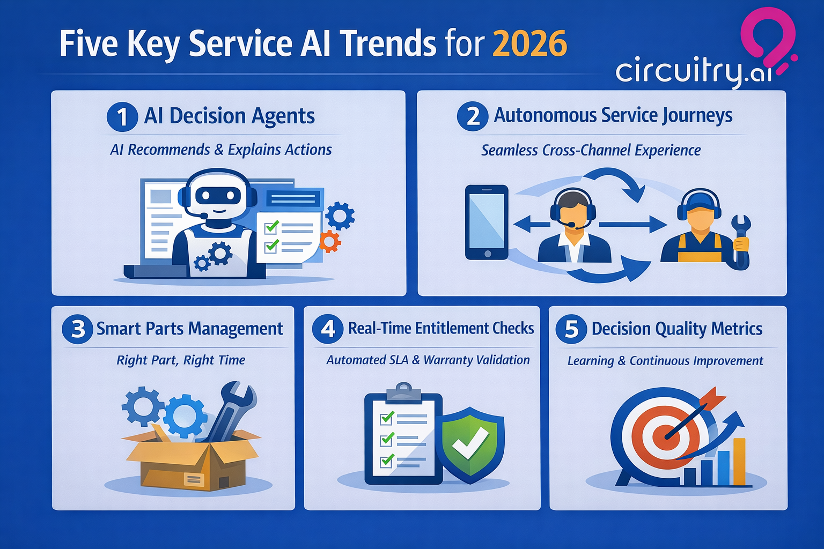
Here are five trends that will define field service management in 2026, along with practical predictions for what service leaders will implement next.
1. AI copilots become decision agents inside the workflow
Trend: AI shifts from answering questions to recommending and automating actions
Most field service teams already have some AI experiments underway: knowledge search, chatbot support, or basic summarization. In 2026, the meaningful leap is decision assistance embedded directly inside the technician and dispatcher workflows, where the AI can propose the next best step based on asset history, symptom patterns, parts availability, warranty rules, service bulletins, and technician skill profiles.
Prediction for 2026:
- Top service organizations will roll out AI that does more than find information. It will propose a diagnostic path, rank likely causes, and recommend the right part and repair plan with confidence levels.
- Explainability becomes non-negotiable: leaders will need to know “why this recommendation” and “what data supports it” to drive trust and adoption in AI copilots.
- AI copilots will be measured on operational outcomes (FTFR, MTTR, truck rolls avoided), not just adoption or deflection.
What to do now: Define the 10–20 highest-volume decision moments (triage, parts selection, repair procedure selection, warranty eligibility) and deploy AI around those.
2. Field service becomes a cross-channel autonomous service journey
Trend: The wall between self-service, contact center, and field service breaks down.
Customers don’t care which channel solves the problem; they care that it gets solved quickly. In 2026, service organizations will orchestrate the journey across channels, so issues are resolved at the lowest-cost channel without sacrificing quality. That means the contact center and technicians share the same intelligence: consistent answers, consistent policy interpretation, consistent parts logic.
Prediction for 2026:
- More organizations will implement a unified service journey: self-service triage feeds contact center context, which gives field technicians a pre-populated diagnosis hypothesis, likely parts list, and clear warranty/entitlement checks.
- “No context handoffs” becomes a KPI. If a technician arrives without the full history, you’ve already lost cost and customer trust.
What to do now: Map your top 5 service journeys end-to-end (from first contact to resolution) and identify where decisions are being remade or information is being re-entered.
3. Parts intelligence becomes the fastest path to better FTFR
Trend: Parts availability and correctness become the #1 lever for reducing repeat visits.
You can have the best technician, but if the right part isn’t on the truck (or if the wrong part is ordered), first-time fix rates and customer satisfaction suffer immediately. 2026 will be the year parts move from “ERP-driven logistics” to “context-aware decisioning,” where parts suggestions adapt to symptoms, asset configuration, failure patterns, supersessions, and substitute compatibility.
Prediction for 2026:
- Leading organizations will deploy “right part, right time” systems (learn more about Circuitry.ai’s Parts Advisor) that recommend parts based on the specific asset configuration and the probable fix, not just BOM lists.
- Inventory planning will begin to incorporate real-time service signals (failures, recalls, seasonal usage patterns) more directly, especially in critical equipment and high-cost downtime industries.
What to do now: Start by tracking parts-related failure points: wrong part ordered, substitute incompatibility, parts not available, returns, and repeat truck rolls caused by parts.
4. Outcome-based service contracts push real-time compliance and entitlement checks
Trend: Service delivery will be increasingly governed by rules: entitlements, SLAs, warranty terms, safety bulletins, and customer-specific contract obligations.
As service models shift toward uptime guarantees, subscription services, and outcome-based contracts, the cost of “getting the rules wrong” increases. In 2026, more organizations will automate entitlement and warranty checks during triage and before dispatching, and they’ll surface constraints to the technician before work begins.
Prediction for 2026:
- Real-time entitlement/warranty verification (learn about Circuitry.ai’s Warranty Decision Intelligence) will become standard in critical equipment service (industrial, HVAC, energy, medical devices, specialty vehicles).
- Service leaders will push for policy-aware workflows that prevent non-compliant work orders from being dispatched without approval or proper authorization.
What to do now: Identify the top areas where policy and contract interpretation create delays, rework, or disputes, then prioritize automating those decisions first.
5) Metrics mature from operational KPIs to decision quality and closed-loop learning
Trend: Teams will stop asking “Did we hit MTTR?” and start asking “Did we make the right decisions that drove MTTR?”
Traditional field service KPIs (FTFR, MTTR, SLA compliance, utilization, repeat visits) remain essential, but they don’t pinpoint why performance changes. In 2026, leading service organizations will measure “decision quality” at key steps and build feedback loops that continuously improve recommendations, knowledge, and process.
Prediction for 2026:
- More service organizations will implement closed-loop systems that capture the decision, the action taken, and the outcome, then learn from the deltas (what recommendations worked, what didn’t, what data was missing).
- Continuous improvement (Kaizen) becomes operationalized: not a quarterly review, but weekly learning loops with measurable impact.
What to do now: Add simple instrumentation to your process: what was recommended, what was chosen, what happened, and why it differed. That decision governance and monitoring becomes your advantage.
The 2026 takeaway: Field service leaders will compete on decision speed and decision accuracy
By the end of 2026, having a field service platform won’t be a differentiator. The differentiator will be:
- How quickly your organization can reach the right diagnosis
- How reliably it chooses the right part and repair plan
- How consistently it applies policy, entitlement, and contract rules
- How rapidly it learns from outcomes and improves
Service leaders who treat field service as a decision system, not a dispatch system, will see the biggest improvements in first-time fix, technician productivity, and customer experience.
How Circuitry.ai helps you win in 2026
Circuitry.ai enables Field Decision Intelligence, bringing AI-driven, explainable recommendations into the moments that matter: triage, diagnostics, parts selection, repair procedures, and entitlement/warranty decisions. With Service Advisor and Parts Advisor, teams can deliver faster resolutions, improve FTFR, reduce MTTR, and scale expertise across contact centers, field technicians, and self-service, without replacing core systems.
Field Decision Intelligence (FDI) reduces the cost per job by improving the quality and speed of decisions across the service journey with:
- Faster, more accurate diagnosis
- Correct part selection the first time
- Policy-aware recommendations to avoid non-billable work
- Guided repair procedures to reduce MTTR
- Unified context across contact center + field
- Lower training and cognitive load for mid-tier technicians
When decisions improve, repeat visits drop, parts returns fall, technician productivity increases, and customer escalations shrink.
Read the Gartner® Research report “Exploit AI-Driven Field Decision Intelligence to Increase Profitability” from Jim Robinson, Senior Director Analyst, Gartner
If you want to turn these 2026 trends into measurable operational gains, the best next step is to start with one high-impact workflow using Circuitry.ai’s TRACK framework.
Contact us today to get started on your Autonomous Service Journey and take your service into the AI era.