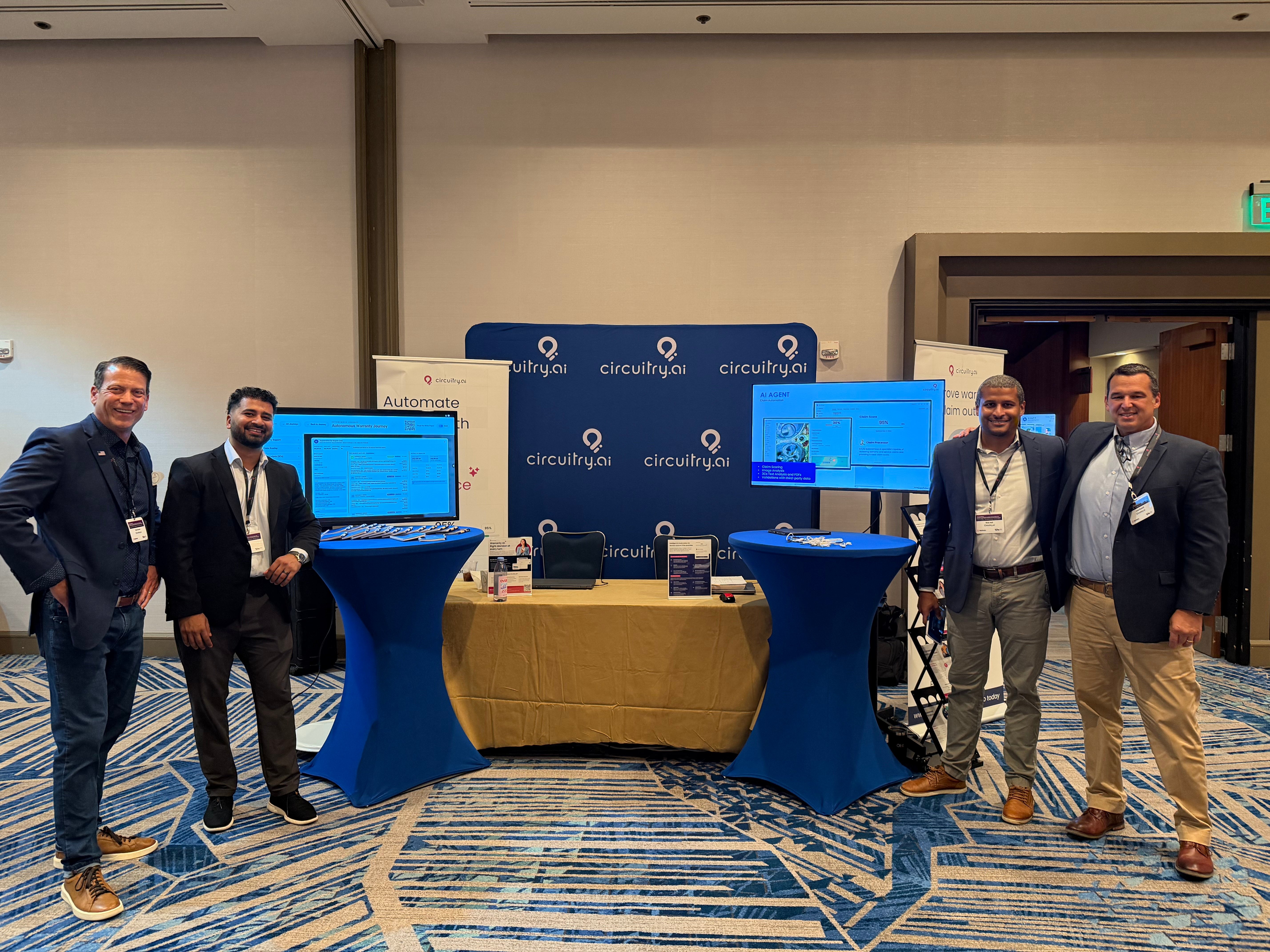
OEMs, VSC providers, captive owners, and service-network leaders gathered at the 5th Annual Warranty & Service Contract Innovations conference for two days of sessions, panels, and hallway conversations. The mood was unmistakably different from last year.
In 2025, the question on stage was “Should we use AI?” In 2026, the question is “where do we deploy AI next, how do we govern it, and how do we turn the data flywheel we already own into measurable economic outcomes?” That is the conversation warranty service contract leader OEM warranty groups, VSC obligors, dealer-affiliated administrators, and home and consumer-goods service contract providers are now having.
Here are our key takeaways for warranty and service contract leaders and their teams.
1. Implementing AI in warranty
In his session "Practical AI in the Warranty Industry: Use Cases, ROI, and Enhanced Customer Service," James Mostofi, CEO of Rely Home, defined Practical AI as outcomes-focused, embedded in existing workflows, and either augmenting or replacing human decisions.
Mostofi mapped twelve warranty AI use cases and sequenced them into three commitment tiers:
-
FNOL and Customer Service are the entry points: easy implementation, low cost, high return, with AI-handled FNOL alone cutting cost by roughly 67% versus a live agent.
-
Purchasing, Open Claims Management, Escalations, and Retention follow, where the customer-experience lift is most pronounced.
-
Distribution, Dispatch, Adjudication, and Service Network Management are the advanced plays; the largest dollar savings sit there, but they require deeper data integration and change management to execute.
The headline numbers Mostofi explored, 20–40% reduction in processing costs, 30–50% faster cycle times, give warranty leaders something concrete to take back to a CFO.
2. Lessons learned from deploying AI and why Decision Intelligence comes next
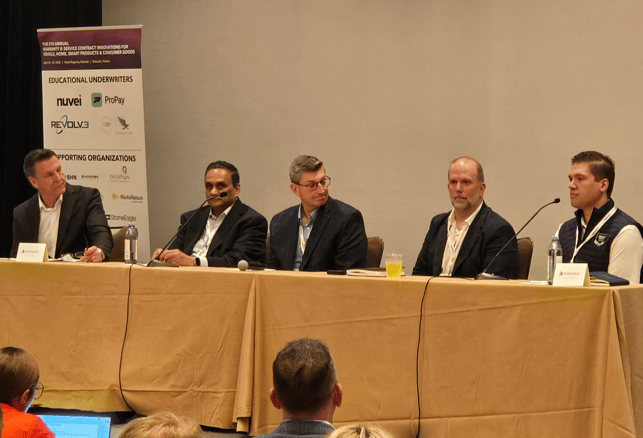
On the Lessons Learned from Deploying AI panel, the candid conversation among warranty operators converged on a few hard-won truths. They reflect what warranty leaders consistently report behind closed doors, and they explain why the industry is moving toward Warranty Decision Intelligence as the next layer of the stack.
|
Five AI lessons we agreed on
- Start with the Monday morning task you hate, not an “AI strategy”. Adoption sticks where the pain is.
- Pick curious adopters. Quiet experimenters become the best internal references.
- Measure hours returned. Leadership buys time and outcomes; nobody buys dashboards.
- Protect the humans whose tasks shrink. Reinvest them into customer-facing work, or adoption dies.
- Treat compliance and audit as a product. The legal review is now the bottleneck, not the model.
|
Every panelist circled back to the same realization: single-purpose AI tools have a ceiling. A team can automate a report, then a claim type, then a dealer email. But until those agents share data, share context, and share a governance model, the result is a set of point tools, not a system. ROI plateaus and compliance risk.
That is the gap Warranty Decision Intelligence closes. It is a unified decision layer for the warranty business: claims adjudication, attach optimization, reserving signals, dealer enablement, renewal personalization, and state-by-state compliance content.
Warranty Decision Intelligence runs on the same warranty data graph, with the same governance, the same audit trail, and the same confidence-routing pattern that Hendrick proved on stage.
For an OEM warranty group, this is the difference between deploying ten vendor pilots over three years and deploying one decision platform that compounds.
For a VSC obligor, it is the difference between defending margin one decline code at a time and defending it across the entire policy lifecycle.
For a captive owner, it is the difference between annual actuarial surprises and monthly loss-ratio signals.
The Circuitry.ai team prepared answers for the questions asked during this panel and the conference. You can download the document “Answers to AI questions from the Warranty & Service Contracts Innovations Conference.”
3. Using AI without losing the human touch
In his presentation, “Using AI Without Losing The Human Touch,” Matthew Jackson, Manager - Product and Pricing, at Hendrick Autoguard, delivered a compelling framework: AI sits behind the human, who is focused on delivering the best customer experience. AI handles what it is confident about; everything else escalates to a person. And the time AI saves is reinvested in improving relationships, such as dealer calls, claim walkthroughs, and thank-you notes.
This is the architecture Circuitry.ai has built toward from day one, and it is the reason Hendrick runs on this platform. Looking at what Hendrick has done with reporting, portfolio pricing review, dealer launches, and claims, the same pattern shows up across each workflow: production gets faster, judgment stays human. Hours that used to vanish into manual report assembly now go into pricing decisions and dealer relationships.
For OEM warranty groups and VSC providers, the practical implication is clear. Instead of asking “which workflow can be replaced with a chatbot?” the better question is “which workflow steals time from the people who actually move the business, and how can a copilot sit behind them?” That’s where attach rates lift, claim cycle times compress, and customer satisfaction climbs without the regulatory exposure of consumer-facing AI.
|
What we heard from operators
Hendrick Autoguard turned multi-day reporting loops into a same-morning conversation, with AI doing the assembly and analysts doing the interpretation.
LG’s ThinQ smart diagnosis is built around an explicit escalation model: AI helps if it can, schedules a technician if it cannot.
|
4. Compliance and privacy are now buying criteria
Two of the most attended sessions were “Staying Ahead of the Curve”, presented by Dustin Taylor and David Stauss of Troutman Pepper Locke on emerging privacy litigation, and “Vehicle Service Contract Legislative and Regulatory Developments,” presented by Travis Moore of SCIC on 2026 state regulatory developments.
The numbers were shocking. Among the 56 companies represented at the conference, 13 have already been sued under CIPA or ECPA, with 139 lawsuits across them. Statutory damages run from $5,000 to $10,000 per violation. Mass arbitration filing fees alone can hit $5.25 million before the merits of a single case.
On the regulatory side, California, Iowa, Oklahoma, Hawaii, and Washington all enacted or proposed material 2026 changes to VSC and home warranty statutes. Washington added a private right of action. Hawaii requires 14-point bold disclosures on “unaffiliated” mailers. Auto-renewal rules are now active in 18 states.
What this means for AI in warranty and service contracts is unambiguous: compliance posture is now a gating purchase requirement. Audit trails, escalation routing, PII redaction, consent capture, and content-compliance generation are now line items in the procurement RFP. Any AI vendor that cannot show, by agent and by action, exactly what data was used and what was decided will not survive the legal review.
|
This is the core of Warranty Decision Intelligence
Decisions are reproducible: every agent action is logged with the data, prompt, model, and confidence score that produced it.
Confidence routing is built-in: low-confidence cases escalate to a human before a customer ever sees the output.
State-by-state content compliance is generated, disclosures, mailers, and renewal notices update with the law.
|
5. Attach rate is the next decade’s growth lever
During their presentation, “Proving the Business Case Nobody Wanted to Hear”, Lari Stone and Riana Frischman of Meta Warranty Plus made a compelling case at the conference. Meta’s wearables warranty went from a struggling line item to 75% of total program revenue in under 12 months, with double-digit attach rates and 40%+ week-over-week peak growth.
Sal Ingraffia at Vivint described a similar curve in their presentation. Vivint saw the subscriber base for their $9.99/month protection plan grow from 500,000 to 850,000 and is now expanding into personal electronics in July 2026.
6. VSC is part of the brand promise
Brown & Brown's "Developing Customer VSC Platform within Your Brand" session, alongside their client Subaru, discussed how VSC is becoming a brand asset, not a back-office F&I product.
Subaru Added Security shows what customer-first design looks like in practice. Coverage decisions ladder up to the "Love Promise," not a margin target. The product features prove it: wear-and-tear coverage, VSCs that match lease terms, and a drop-down to CPO that eliminates the deductible. Each one is designed to make ownership feel better, not to close the F&I deal harder.
Programs designed the other way produce features like refundable contracts and disappearing deductibles, and the contract starts to feel like an upsell rather than an extension of ownership.
The OEMs that win the next decade will be the ones whose contracts feel like a continuation of the brand promise, not a transaction at the end of one. That philosophy only works if it shows up at every touchpoint.
In the final slide, they asked, “Where does AI fit?” and offered three answers: chatbots, pricing/fraud, and claims.
Three more belong on that list:
- Real-time attach scoring at point-of-sale
- Dealer F&I coaching agents
- Renewal personalization powered by service history
|
The takeaway
The next leg of growth is coming from attaching an extended warranty to products you already sell. And attach is a decision problem at the moment of purchase, the moment of renewal, and the moment of failure. It is data-rich, signal-rich, and customer-context rich, which is exactly the territory where Warranty Decision Intelligence drives measurable lift.
|
7. Service speed is a brand promise
Heather Hallett at LG built her presentation around three pillars: Control (ThinQ), Care (service/support), and Speed (3-Day RTAT). Their industry-leading repair turnaround starts with overnight parts logistics out of five U.S. warehouses, digital proof of delivery, and a smart-diagnosis AI chatbot that schedules service when self-help fails.
Organizations have reframed operational AI as a brand-promise enablement story. This is a more important strategic shift than most operators realize. Telling a CFO that AI saved four hours earns applause and a budget cut. Telling a CMO that AI is how the business keeps its three-day turnaround promise earns product investment and a customer marketing campaign.
For VSC obligors, the analog is: “Right claim. Right adjudication. Right answer in minutes, not days.” That is the customer-experience advantage Warranty Decision Intelligence is designed to build. It is also the most defensible reason to invest in a unified decision platform rather than a series of disconnected AI pilots.
From AI pilots to a decision platform
The 2026 conference made one thing clear. The OEMs, VSC providers, and service contract administrators who win this next decade will be the ones who turn their warranty data into a decision system, not a fleet of unconnected AI experiments. The KPIs are attach rate, claim cycle time, loss ratio, and renewal velocity. The non-negotiables are governance, audit, and compliance content that updates with the law.
Circuitry.ai’s Warranty Decision Intelligence deploys AI Advisors, Analysts, and Agents to guide decisions, predict risks, and automate execution across repairs, claims, payments, and service contracts. Instead of reacting to costs after they occur, warranty operators can prevent leakage, enforce policy compliance, reduce fraud, and optimize labor and parts usage — while continuously improving product quality and contract profitability.
Warranty leaders sitting at their desk Monday morning, thinking “the data is there, but the decisions are still slow,” are exactly who Circuitry.ai was built for. A working session can show what Warranty Decision Intelligence looks like running on a live warranty book.
Get started with Warranty Decision Intelligence
Move from disconnected AI experiments to a productized decision layer for the warranty business claims, attach, pricing, compliance, and renewals, all in one platform.
Book a 30-minute Warranty Decision Intelligence demo or email sales@circuitry.ai.
or email sales@circuitry.ai