Industry 4.0 has transformed how manufacturers think about production, connecting factories with IoT sensors, applying predictive analytics to the production line, and using digital twins to simulate and optimize manufacturing processes.
Yet the service side of these same manufacturers still operates between Service 1.0 (reactive, break-fix) and Service 2.0 (scheduled, preventive), even as customers demand the intelligence and responsiveness that Industry 4.0 has delivered on the factory floor.
This blog post introduces the Service 4.0 framework, a maturity model that represents the shift from reactive repair to autonomous, AI-driven service intelligence where decisions are made in real-time, knowledge is continuously generated and refined, and service transforms from a cost center into a strategic growth engine.
Quick navigation
Why Service 4.0 and why now
The Industry 4.0 parallel
Manufacturers have invested billions in Industry 4.0 for production. They understand connected assets, predictive analytics, digital twins, and autonomous optimization because they have applied these concepts to their factories. The language of “maturity stages” from manual processes through connected, predictive, and autonomous operations is familiar to every industrial CXO.
Service 4.0 leverages this shared framework to make the transformation of aftermarket service operations intuitive and urgent for the same decision-makers.
The service gap
While factories have moved to Industry 3.0 and 4.0, most service operations lag two generations behind:
- Technicians still search through static PDFs for repair instructions.
- Parts identification relies on tribal knowledge. Warranty claims are processed manually.
- Contact centers route calls without context.
Several forces are converging to make the Service 4.0 transformation urgent.
First, the skilled technician workforce is retiring at an accelerating rate, taking decades of institutional knowledge with them.
Second, customers demand first-visit resolution and minimal downtime — 86% of service decision-makers see frontline field teams as critical to business growth.
Third, the economics of service have shifted: unplanned downtime costs industries an estimated $50 billion annually, and each failed truck roll costs $200–$400 in direct costs alone.
Fourth, manufacturers are increasingly recognizing service and aftermarket as their highest-margin revenue stream, yet lack the intelligence infrastructure to optimize it.
The Service 4.0 maturity model
The Service 4.0 Maturity Model defines four distinct stages of service capability, mirroring the Industry 4.0 progression. Each stage represents a step-change in how service decisions are made, knowledge is managed, and value is delivered.
|
Maturity Stage
|
Characteristics
|
Technology Stack
|
KPI Benchmarks
|
|
Service 1.0 Reactive / Break-Fix
|
Manual, paper-based processes. Service is triggered only after equipment failure. No data capture or digital workflow. Knowledge lives in individual technicians’ heads.
|
Phone/fax dispatch, paperwork orders, physical manuals, tribal knowledge.
|
High downtime, low FTFR (~50-60%), long mean-time-to-repair, high cost-per-service-event.
|
|
Service 2.0 Scheduled / Preventive
|
Time-based maintenance schedules. Digital work order systems (FSM/CMMS). Basic CRM and parts inventory tracking. Some standardization of procedures.
|
FSM software, basic ERP integration, scheduled PM routines, static knowledge bases.
|
Improved uptime (~85-90%), moderate FTFR (~65-70%), lower emergency dispatch rates.
|
|
Service 3.0 Connected / Predictive
|
IoT-connected assets streaming real-time data. Predictive analytics for failure forecasting. Remote monitoring and diagnostics. Connected workforce with mobile tools.
|
IoT sensors, cloud platforms, predictive ML models, digital twins, AR-assisted repair, remote support.
|
Uptime >95%, FTFR 75-85%, proactive service ratio >40%, reduced truck rolls.
|
|
Service 4.0 Autonomous / Intelligent
|
AI-driven decision intelligence across the entire service lifecycle. Self-diagnosing equipment with prescriptive resolution. Autonomous service orchestration. Knowledge continuously generated and refined by AI. Outcome-based service models.
|
Decision Intelligence platforms, AI advisors and agents, generative AI, agentic workflows, autonomous dispatch, self-healing systems, digital service twins.
|
Uptime >99%, FTFR >90%, autonomous resolution >30%, service as a profit center, NPS >70.
|
Service 1.0 — reactive/break-fix
This is the starting point for most legacy service operations. Equipment runs until it fails. A customer calls to report a problem. A dispatcher manually assigns a technician. The technician drives to the site, diagnoses the issue from experience or by calling a senior colleague, and often needs to return a second time with the correct part. Knowledge exists only in the heads of veteran technicians.
Service is a pure cost center with no data feedback loop.
Service 2.0 — scheduled/preventive
Organizations at this stage have adopted field service management (FSM) software, basic CRM systems, and scheduled preventive maintenance routines. Work orders are digital. Parts are tracked in inventory systems. Maintenance follows time-based schedules (e.g., every 90 days) rather than actual equipment condition.
This represents the majority of the install base for companies like ServiceMax, IFS, and SAP Field Service.
While a significant improvement over 1.0, the fundamental decisions, what to fix, which part to use, and how to resolve a warranty claim are still made by humans searching through static knowledge bases.
Service 3.0 — connected/predictive
Service 3.0 emerges when IoT-connected assets begin streaming operational data to cloud platforms, enabling condition-based monitoring and predictive failure analytics. Digital twins simulate asset behavior. Technicians carry mobile devices with access to remote expert support and, in some cases, AR-assisted repair guidance. Service transitions from time-based to condition-based.
Companies at this stage include early adopters of PTC ThingWorx, Uptake, or Augury for asset monitoring, alongside connected FSM platforms.
The limitation of 3.0 is that prediction alone does not complete the service loop, knowing that a compressor will fail in 14 days does not tell the technician how to fix it, which part to order, or whether the repair is covered under warranty.
Service 4.0 — autonomous/intelligent
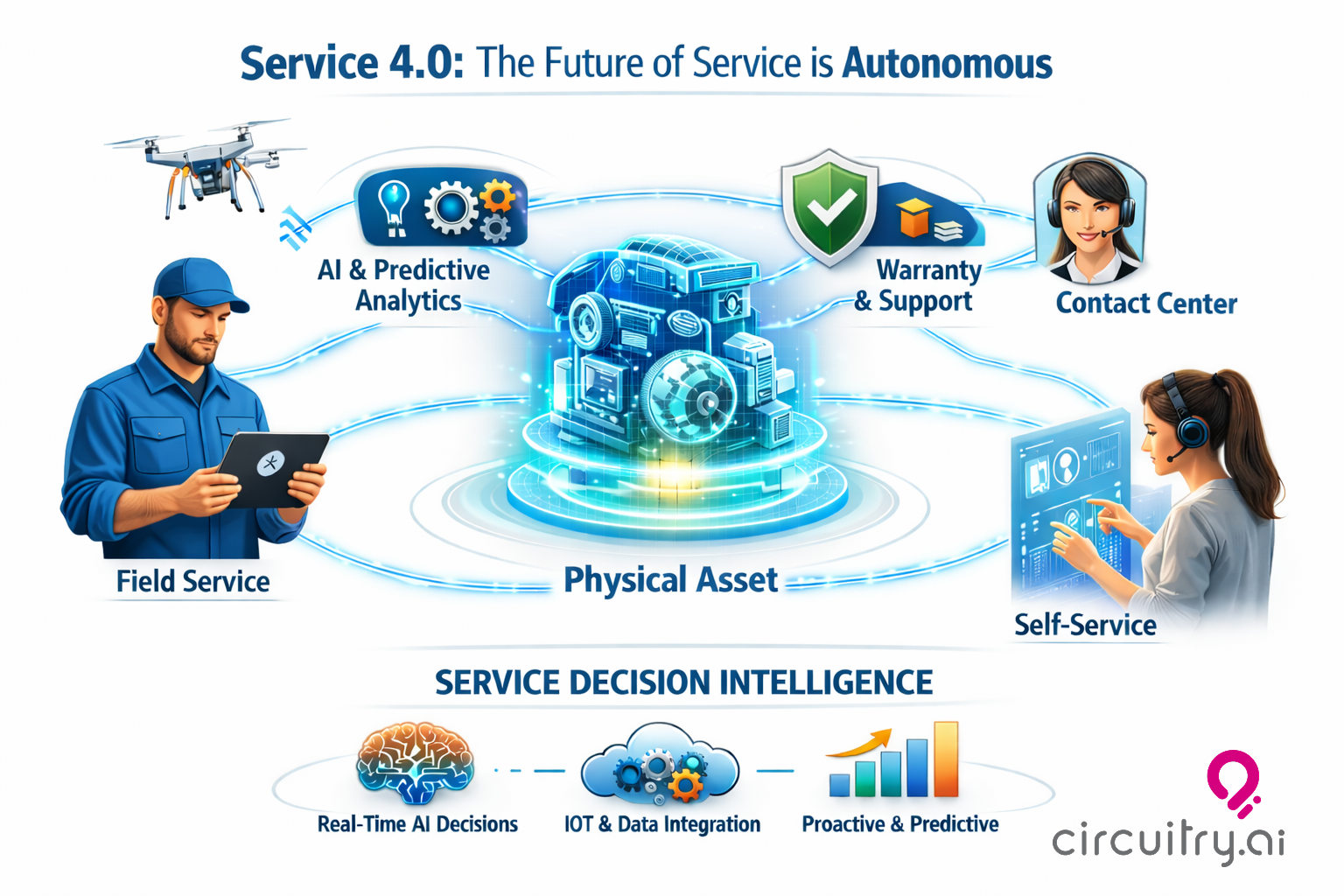
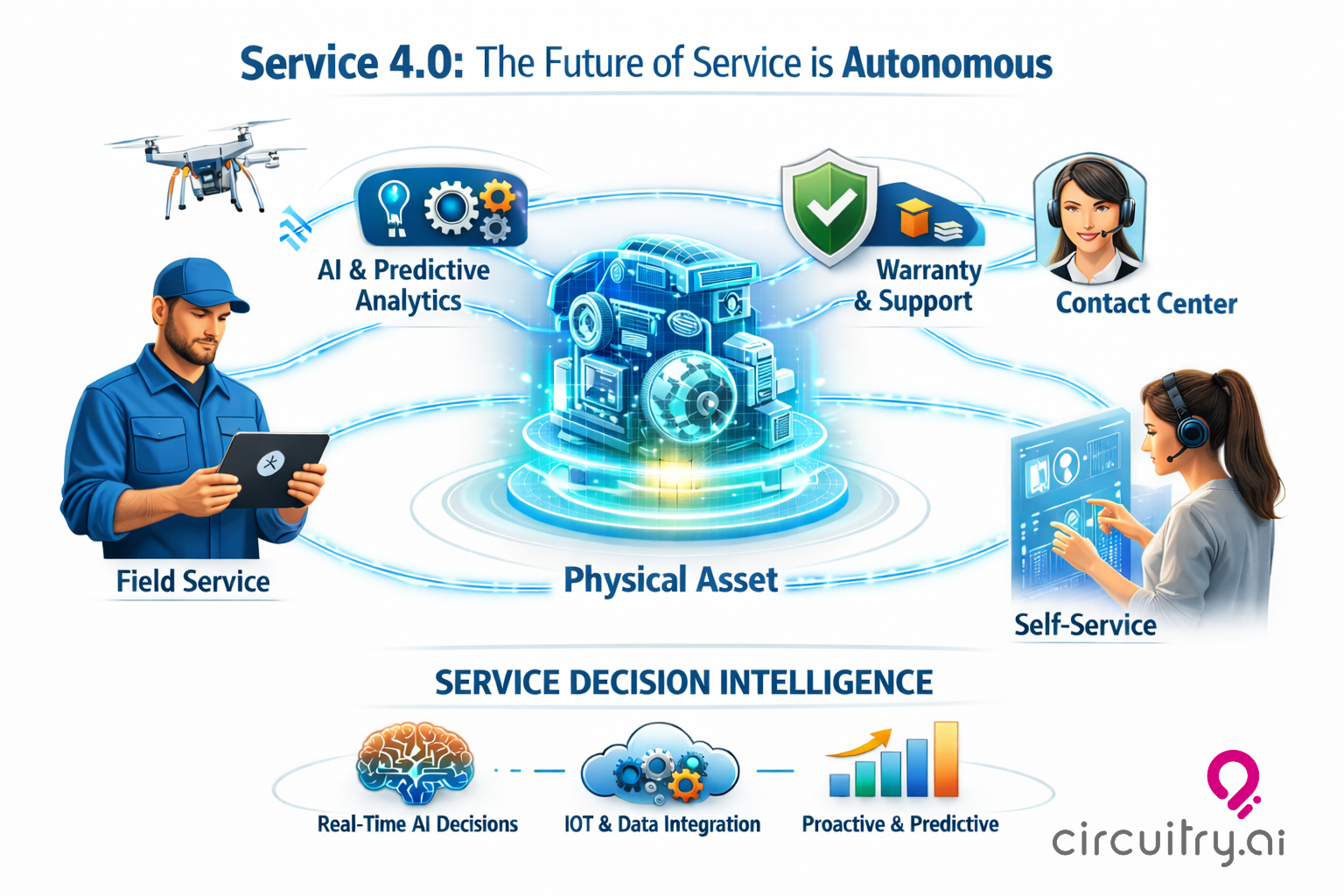
Service 4.0 completes the transformation by adding a Decision Intelligence layer that connects prediction with resolution, parts identification, warranty adjudication, and continuous knowledge refinement.
AI Advisors guide technicians through context-aware diagnostics. AI Agents autonomously process warranty claims, triage contact center requests, and recommend optimal parts. AI Analysts uncover patterns in service, parts, and warranty data to guide better decisions.
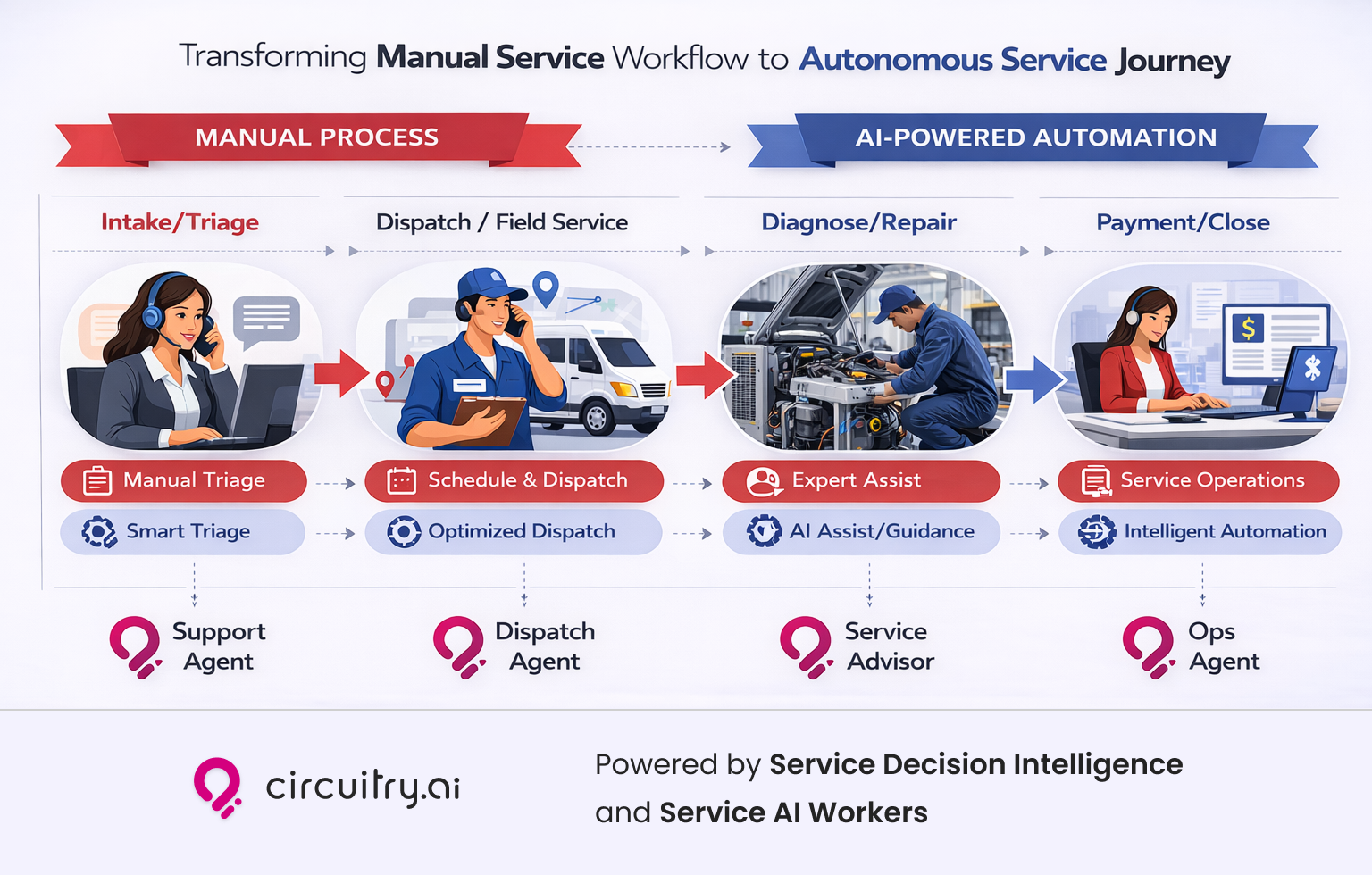
The system learns from every interaction, continuously improving accuracy and expanding the knowledge base. Service becomes outcome-based and transforms from a cost center into a profit center and competitive differentiator.
The role of AI and Decision Intelligence in Service 4.0
Why Decision Intelligence, not just AI
The market is flooded with “AI for service” claims, but most fall into narrow categories: scheduling optimization, route planning, or chatbot deflection. These are important but insufficient.
Service 4.0 requires Decision Intelligence, the ability to synthesize data from across service manuals, parts catalogs, warranty policies, repair history, IoT telemetry, and customer context to make or recommend the optimal decision at every point in the service lifecycle.
Decision Intelligence differs from generic AI in three critical ways:
- It is domain-trained on manufacturer-specific technical data, not general-purpose language models.
- It operates across the full service value chain (diagnostics, parts, warranty, contact center, self-service), not in a single workflow silo.
- It improves continuously through a closed feedback loop where every technician interaction, every resolved case, and every warranty outcome refines the intelligence layer.
AI across the service lifecycle
Field service: from search to answers
Traditional knowledge management forces technicians to know what to search for and then interpret results across multiple documents.
AI-powered Service Advisors allow technicians to describe the symptoms in natural language and get precise, context-aware diagnostic paths with step-by-step repair instructions. Field teams using AI advisors have demonstrated 35% productivity gains and significantly higher first-time fix rates.
Parts: from guesswork to precision
Incorrect part identification is one of the highest hidden costs in service operations, driving repeat visits, excess inventory, and customer dissatisfaction.
AI-powered Parts Advisors trained on complete parts catalogs and historical order data eliminate guesswork by recommending the exact replacement part with compatibility verification, availability status, and alternative options when primary parts are unavailable.
Warranty: from manual processing to intelligent adjudication
Warranty operations are among the most manual and fraud-prone processes in manufacturing. AI warranty workers automate claims intake, validate coverage, detect anomalous patterns indicative of fraud or quality issues, and surface actionable insights for engineering teams. This creates a closed loop where field failures inform product quality improvement.
Contact centers: from triage to resolution
AI transforms contact centers from expensive routing layers into intelligent resolution engines. Conversational AI handles routine inquiries autonomously, while complex cases are escalated to human agents with full diagnostic context already assembled. Self-service portals enable customers to resolve common issues without involving a technician at all, with demonstrated deflection rates exceeding 30%.
Continuous intelligence: the learning loop
Perhaps the most strategic capability of Service 4.0 is the continuous learning loop. Every technician interaction, every resolved service event, and every warranty claim outcome feeds back into the Decision Intelligence platform, making every subsequent recommendation more accurate.
This creates a compounding advantage that widens over time — the more data flows through the system, the smarter it becomes, and the harder it is for competitors to replicate.
Measuring Service 4.0 transformation
Service 4.0 is a measurable transformation. The following metrics framework enables Circuitry.ai and its customers to track progress across the maturity stages:
Technician productivity
Measured as jobs completed per technician per day. Service 4.0 targets a 25–35% improvement through AI-assisted diagnostics and guided resolution that eliminate non-value-added search and rework time.
First-Time Fix Rate (FTFR)
The percentage of service events resolved on the first visit. The industry average is 65–75%. Service 4.0 targets >90% through accurate diagnostics, correct parts identification, and pre-visit preparation powered by Decision Intelligence.
Autonomous resolution rate
The percentage of service issues resolved without human technician involvement — through customer self-service, automated warranty processing, or predictive intervention. This is the defining metric of Service 4.0, with a target of >30%.
Mean Time to Resolution (MTTR)
Total elapsed time from issue identification to confirmed resolution. Service 4.0 targets 40–50% reduction through faster diagnostics, proactive parts staging, and streamlined warranty adjudication.
Service revenue per asset
As service changes from a cost center to a profit center, revenue generated per installed asset through optimized parts sales, service contracts, and outcome-based pricing becomes a critical executive metric.
Aftermarket Lifetime Value (ALV) is expressed as lifetime service revenue as a percentage of the initial equipment sale price. Industry benchmarks range from 30% to over 100%, depending on the industry. Service 4.0 aims to increase ALV by 15–25 percentage points.
Customer experience (NPS / CSAT)
Net Promoter Score and Customer Satisfaction scores that reflect the end-to-end service experience. Service 4.0 targets NPS >70 through faster resolution, proactive communication, and empowered self-service.
Circuitry.ai: leading the Service 4.0 category
Industry 4.0 transformed the factory. Service 4.0 transforms everything that happens after the product leaves the factory. Circuitry.ai enables this transformation through its Service Decision Intelligence Platform.
|
Circuitry.ai Capability
|
Service 4.0 Value Proposition
|
Measurable Impact
|
|
Decision Intelligence Platform
|
Unified platform that converts all product, service, parts, and warranty data into actionable intelligence, powering advisors, analysts, and autonomous agents.
|
Single source of service truth, continuous AI improvement loop, enterprise-wide service intelligence.
|
|
Service Advisor (Guided Troubleshooting)
|
AI-powered conversational diagnostics that replace manual search. Technicians ask questions in natural language and get precise, context-aware answers.
|
35% productivity gain, higher FTFR, reduced training ramp for new hires.
|
|
Parts Advisor (Intelligent Parts Identification)
|
Trained on parts catalogs and order history to instantly recommend the correct replacement part, eliminating guesswork and costly ordering errors.
|
Fewer wrong-part orders, reduced repeat visits, optimized inventory, incremental parts revenue.
|
|
Warranty Decision Intelligence
|
AI workers that plug into existing warranty management software to automate claims processing, detect fraud patterns, and surface product quality insights.
|
Lower warranty cost-per-unit, faster claims resolution, closed-loop quality feedback to engineering.
|
|
Contact Center AI
|
Intelligent triage and resolution for inbound service requests, deflecting routine issues to self-service while escalating complex cases with full context.
|
30%+ self-service deflection, reduced average handle time, improved customer satisfaction.
|
Circuitry.ai delivers purpose-built AI Decision Intelligence that spans the full aftermarket service lifecycle. Circuitry.ai provides a Decision Intelligence layer that sits on top of existing FSM, ERP, and IoT investments to make every service interaction smarter.
As the only platform purpose-built for Decision Intelligence across service, parts, and warranty, Circuitry.ai is uniquely positioned to be your partner to support your transformation journey to Service 4.0.
Contact us to get started on your Autonomous Service Journey.