A repair order arrives from a dealer. To decide what to pay, an adjudicator may need to check the contract in one system, look up labor times in another, and chase down photos or a final invoice. The claim record may be complete enough to move to the next status while the adjudicator is still piecing together the evidence.
The gap between recording a claim and deciding it is where warranty and service contract leaders can make progress today. Circuitry.ai adds AI-powered warranty decision intelligence around the existing claims admin system, so teams do not have to replace it first. Here’s where today’s systems fall short, what a decision layer adds, and how to adopt it in stages.
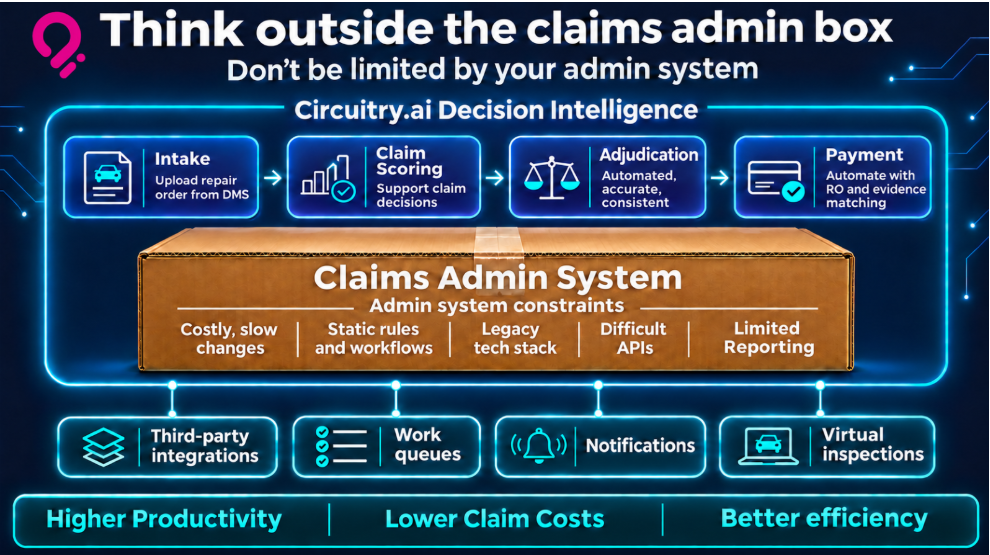
Circuitry.ai Warranty Decision Intelligence connects the work that happens around the claims admin system.
Where claims admin systems hit their limits
Traditional admin platforms were built to record contracts, claims, approvals and payments. The friction tends to surface where teams need to change a decision, pull in new evidence or understand what is driving claims costs. The extent varies by deployment, but five constraints are worth examining.
Costly, slow changes. Even a narrow change to a labor allowance or approval threshold can require configuration, development, regression testing and a scheduled release.
Static rules and workflows. Fixed routing and rules handle well-defined cases. Free-text repair narratives, conflicting evidence and exceptions often require manual interpretation or a new rule.
Legacy technology stacks. Tightly coupled workflows and older data models can make it difficult to change one part of the claims process independently.
Difficult integrations. Limited or cumbersome APIs can make it harder to bring in repair orders, inspection findings and pricing data, or to write decisions back. Teams often bridge those gaps by rekeying information.
Limited reporting. Standard reports can show volumes, statuses and amounts paid. Explaining cost drivers, spotting anomalies or forecasting claim severity often takes additional data preparation and analysis.
Waiting for an admin system provider to embed these capabilities can leave the pace and scope of innovation tied to another company’s roadmap. Building a decision layer in-house can require substantial upfront investment, scarce AI and warranty expertise, and ongoing costs for integration, model governance and maintenance. Circuitry.ai offers a faster, lower-risk path to value: a proven solution already deployed by major companies, with cost-effective per-claim economics and without the large upfront investment of a custom build. Companies can add decision intelligence around the systems they already use, prove the impact on a focused workflow and expand as results are demonstrated.
What warranty decision intelligence adds
Circuitry.ai brings policy and contract language, expert guidance, claim evidence, deterministic checks and AI models into one decision workflow. On a single claim, that means teams can apply an explicit coverage limit, interpret a technician’s narrative and quantify risk together. Each decision carries the evidence and policy basis a reviewer needs.
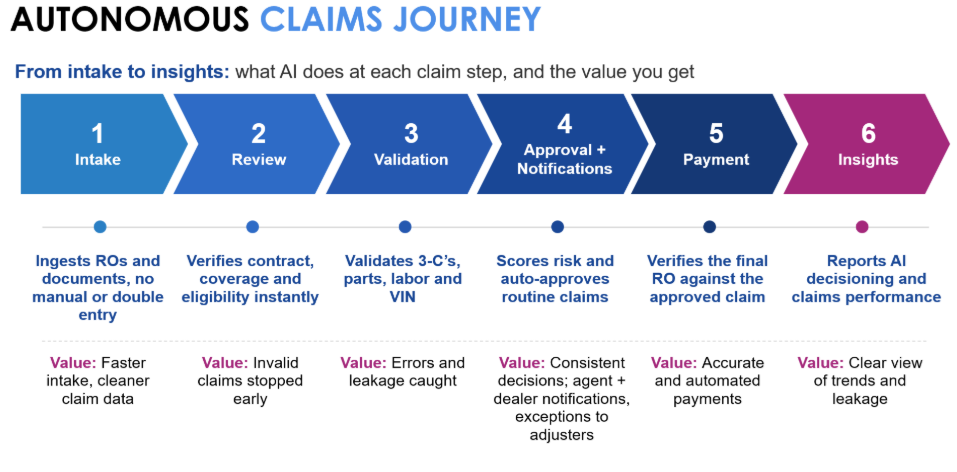
Intake and validation. Ingest the repair order from the dealer management system (DMS), extract claim details and flag missing information. Connect third-party sources for labor times, parts pricing, vehicle history and inspection results as applicable.
Scoring and adjudication. Use claim scores and reason codes to prioritize review, and analyze historical claims to flag unusual cost patterns. Evaluate coverage and exclusions, read the complaint, cause and correction, and validate parts, labor and other charges. Route ambiguous or high-risk cases to a work queue with the evidence attached.
In short, AI-powered scoring and adjudication helps teams prioritize claims, apply policy consistently and route exceptions to human reviewers with the supporting evidence attached. Learn more about AI claims adjudication.
Inspections, notifications and payment. Request a virtual inspection or missing documents, notify the right party and resume the claim when evidence arrives. Match the final repair order and supporting evidence to the authorization before releasing eligible payments. Send mismatches for review.
Augment, automate and replace in stages
The practical path is to augment first, automate incrementally with humans in the loop, and migrate only after accuracy is proven. Autonomy can rise from assistive L0–L1 work, where AI recommends and people decide, to controlled L2–L3 automation of approved claim types, and then L4 AI-native operations. A Decision Governor spans every phase, setting permissions by claim type, policy guardrails, confidence thresholds and a full audit trail.
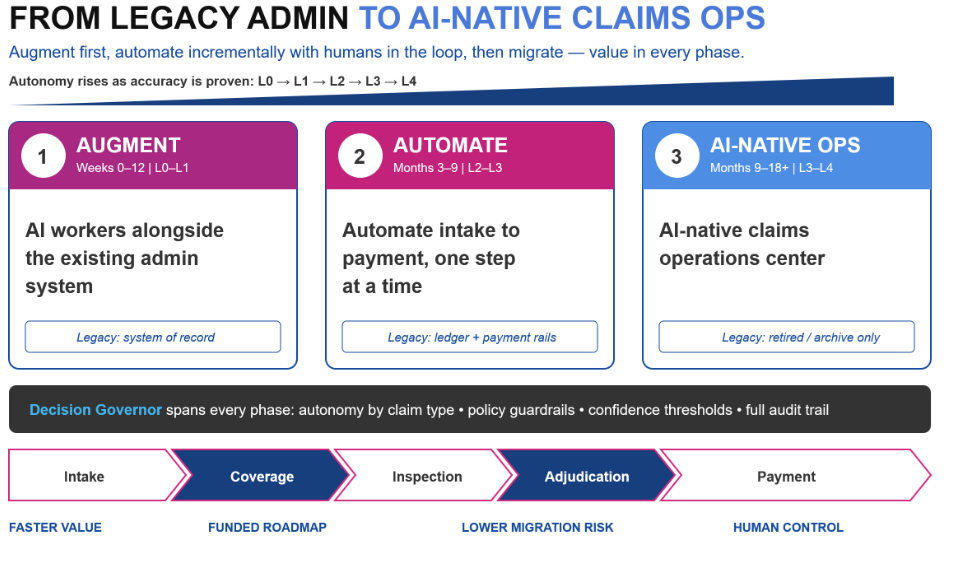
1. Augment the existing system. First, deploy AI workers alongside the current claims admin platform, which remains the system of record. Start with intake, coverage checks, scoring or an adjudicator workbench that brings the relevant policy terms and evidence into one view. Compare recommendations with adjudicator-reviewed outcomes, investigate material disagreements and prove value before allowing greater autonomy.
2. Automate intake to payment, one step at a time. Next, replay historical claims in the Circuit Simulator and validate performance in shadow mode. Define eligible claim types, confidence thresholds, payment limits and exception paths. Then automate proven steps across intake, coverage, inspection, adjudication and payment while the legacy platform continues to provide the ledger and payment rails. Ambiguous or high-risk cases stay in a human work queue with the evidence attached.
3. Move to AI-native claims operations. As a final step, migrate by product, program or claims segment as governed accuracy targets are met. Use Claims Circuit as the AI-native operations center and phase in contract operations such as issuance, amendments, cancellations and entitlement as each workflow is validated. Reconcile contract history, open claims and payments in parallel, preserve the audit trail and verify downstream integrations before retiring the legacy system or retaining it only as an archive.
The result: faster time to value, early savings that help fund later phases, lower migration risk and human control over every automated decision.
Measure what changes for the business
Track four areas to see what changes. Productivity: claims handled per adjudicator and time spent on manual review. Claim costs: avoidable overpayments, duplicate charges and payment accuracy. Efficiency: cycle time from intake to decision and from approval to payment. Quality: sampled decision reviews, override rates and appeals, tracked alongside automation to confirm outcomes are improving.
For an OEM, that can mean more consistent dealer reimbursement across programs. For a service contract provider, it can mean handling rising claim volume without adding headcount at the same rate. Both can apply the same payment principle: pay what is due, and do it promptly when the evidence supports the decision.
Start with a high-volume decision, prove the impact using your own policies and evidence, and expand automation as confidence grows. AI-powered warranty decision intelligence from claim intake to payment gives warranty and service contract teams a practical way to make faster, more accurate and more consistent claim decisions without waiting for a full system replacement. Schedule a demo to see how Circuitry.ai can improve your claims operation.