Claim intake is often treated as administrative overhead, a necessary step before the real work of adjudication begins. But claim intake is the first leverage point for Warranty Decision Intelligence because it determines the quality, speed, and automation potential of every downstream decision.
Customers and dealers fill out complex forms manually, re-entering information that already exists in a repair estimate or repair order record. Sometimes, submissions arrive incomplete, and adjusters have to spend the first part of their review chasing missing details. By the time a claim reaches adjudication, it may already have errors that will slow it down or send it back.
Circuitry.ai's Intelligent Claim Intake Agent addresses the problem at the source.
Quick navigation
Why manual intake breaks the claim process
For customers submitting a claim after a covered repair, the process can feel unnecessarily manual and slow. They're asked to provide information they may not have or manually re-enter details from the repair order. When something is missing, the process stalls.
For dealers and service providers, the friction is different but just as real. Claim forms require manual data entry across multiple fields, many of which duplicate what's already on the repair order or estimate. When coverage details don't auto-populate, staff spend time looking them up. Submissions that don't pass validation come back for correction, creating back-and-forth that delays authorization and strains the relationship with the administrator.
For adjusters, incomplete or inconsistent intake data means more time spent on research and manual review before a decision can begin.
Claim Intake Agent: Capture complete claim data automatically
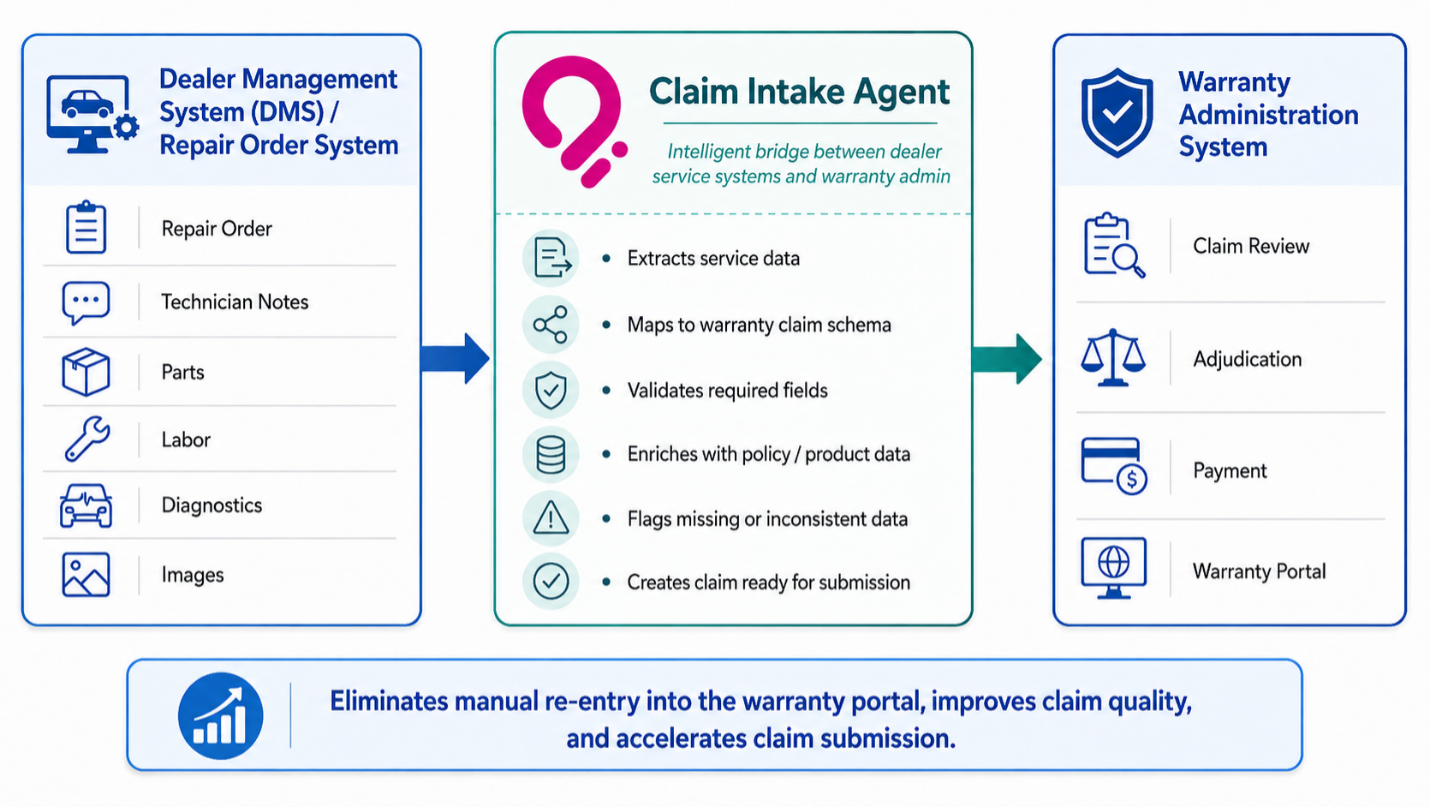
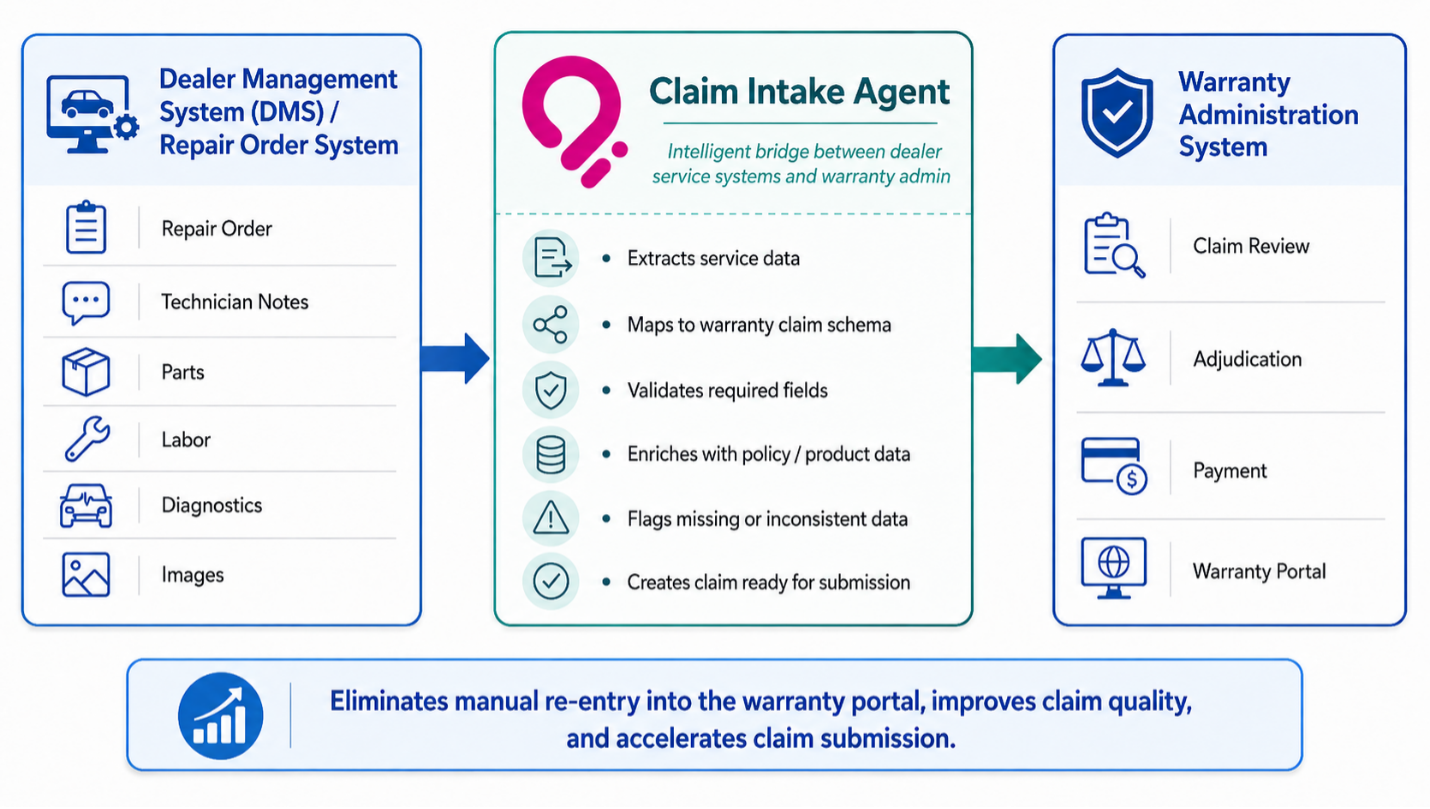
The Claim Intake Agent serves as the intelligent bridge between dealer service systems and the warranty administration platform by automatically capturing data from the DMS, Repair Order (RO) system, technician notes, diagnostic tools, images, and other service sources.
The agent then:
- Extracts structured and unstructured service data from the repair order and maps it to the standardized warranty claim schema.
- Validates required fields, warranty eligibility, policy rules, and coding standards.
- Enriches the claim with VIN, product configuration, labor operations, parts, failure codes, telematics, and supporting evidence.
- Identifies missing or inconsistent information before submission.
- Creates a complete warranty claim ready and passes to the warranty administration system.
Business benefits
- Eliminates duplicate data entry by dealers and warranty administrators.
- Accelerates claim submission from hours to minutes.
- Improves first-pass acceptance rates through automated validation.
- Reduces claim errors and incomplete submissions.
- Standardizes claim data across multiple DMS and repair order systems.
- Enables downstream AI for claim scoring, fraud detection, automated adjudication, supplier recovery, and warranty analytics.
The Claim Intake Agent is the intelligent front door for warranty claims, allowing manufacturers to automate claim creation directly from dealer service systems while remaining independent of the underlying warranty administration platform.
Claim pre-authorization: validate and enrich the claim before submission
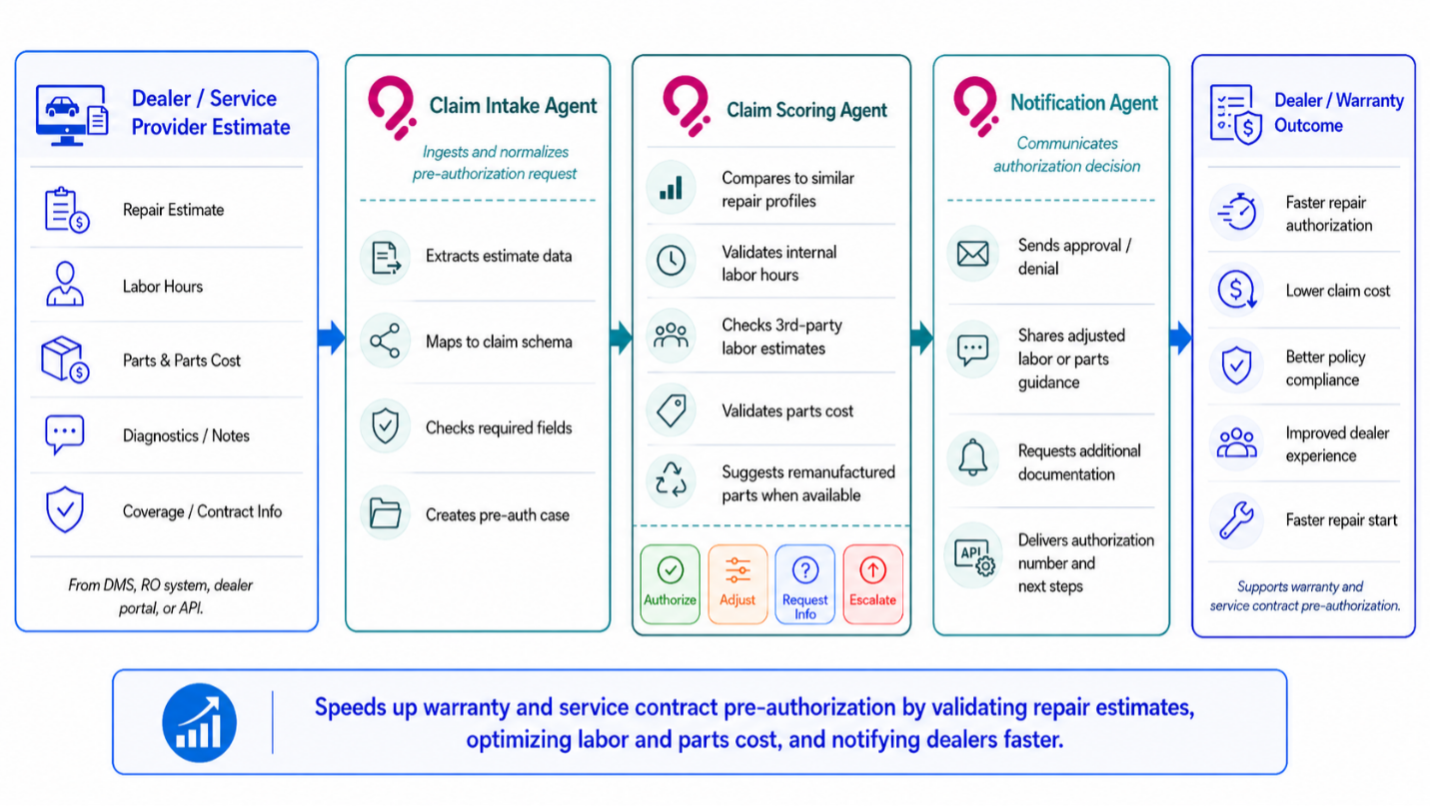
The Claim Intake Agent automates claim pre-authorization by ingesting repair estimates from dealers and service providers, validating labor and parts costs against similar repair profiles, internal and third-party benchmarks, and policy rules, then recommending authorization, adjustment, escalation, or cost-saving repair options such as remanufactured parts.
When integrated with the Notification Agent, it quickly communicates authorization decisions back to dealers and service providers, reducing manual review, repair delays, and claim costs.
How pre-authorization works
The Claim Intake Agent captures repair estimate data from a DMS, repair order system, dealer portal, service provider system, email, API, or uploaded estimate.
The agent then validates the estimate against:
- Similar repair profiles based on historical repairs, approved claims, failure codes, product model, symptom, mileage, and more.
- Internal labor guides and standard repair times.
- Third-party labor time estimates where available.
- OEM or supplier parts catalogs and expected parts pricing.
- Service contract or warranty coverage rules.
- Prior claim history for the same asset, dealer, component, or failure pattern.
- Repair policy rules, exclusions, limits, deductibles, and required approvals.
Cost optimization and repair guidance
In addition to validating the estimate, the Claim Intake Agent can recommend lower-cost repair options when appropriate.
It can also recommend:
- Adjusted labor hours based on standard repair time.
- Approved parts versus non-approved or overpriced parts.
- Lower-cost remanufactured parts when available.
- Additional diagnostic evidence before approval.
- Escalation to a human adjuster for high-value or unusual repairs.
- Automatic authorization for low-risk, policy-compliant repairs.
The output may include an authorization status, approved amount, adjusted labor hours, approved parts, recommended replacement parts, missing information, confidence score, and explanation for the decision.
Notification agent integration
Once the pre-authorization decision is made, the Claim Intake Agent integrates with the Notification Agent to automatically notify the dealer, service provider, adjuster, or warranty administrator.
The Notification Agent can send notifications like:
- Authorization approval.
- Additional documentation requests.
- Escalation status.
- Next steps for completing the repair and submitting the final claim.
Notifications can be delivered through email, SMS, portal alerts, DMS integration, API, or workflow tasks inside the warranty administration system.
Business benefits
The Claim Intake Agent accelerates the repair authorization process by validating the repair estimate before work is completed. It reduces manual review effort, improves consistency, prevents avoidable overpayment, and helps dealers and service providers get faster answers.
It also improves customer experience by reducing delays in repair approval while giving warranty teams stronger control over labor, parts, and total claim cost.
Rich technician information ingestion: turning technician evidence into claim intelligence
The Claim Intake Agent improves claim quality by capturing rich information directly from technicians, service advisors, connected products, diagnostic tools, and inspection reports. The agent collects voice, text, images, video, IoT data, diagnostic files, and inspection evidence at the point of service, then analyzes and maps that information into the warranty claim record.
This creates a more complete, accurate, and defensible claim before it enters review, adjudication, supplier recovery, or parts return workflows.
Voice-based technician narration
Technicians are often more comfortable dictating what they observed and repaired than writing detailed notes or typing into a claim form. The Claim Intake Agent can work with a Voice Agent to capture the technician’s narration and automatically transcribe it into structured service information.
For example, the technician can describe the:
- Complaint — what the customer reported or what symptom was observed.
- Cause — what failed, why it failed, or what diagnostic evidence supports the failure.
- Corrective Action — what repair was performed, which parts were replaced, and what testing confirmed the fix.
The agent converts the voice narration into clean 3Cs data, summarize the repair story, identify missing details, and map the information to the correct claim fields, failure codes, labor operations, parts, and supporting documentation.
Mobile capture of images and video
The Claim Intake Agent can also integrate with a technician or service advisor’s mobile device to capture photos and videos directly during inspection, diagnosis, repair, and final validation.
This allows the technician to attach evidence such as failed part images, diagnostic screen capture, serial numbers, or VINs, and more.
This makes the claim more complete and reduces the need for follow-up requests after the repair is completed.
Connected product, IoT, and diagnostic tool data
When connected products are available, the Claim Intake Agent can ingest IoT data and product telemetry to validate the repair event. The agent can ingest diagnostic files from tools used by technicians, such as diagnostic scan reports, fault code logs, inspection checklists, and more.
This allows the claim to be supported by objective diagnostic evidence, not just manually entered text.
AI validation of claim relevance and completeness
Once the information is captured, the Claim Intake Agent uses AI to analyze the text, images, video, inspection data, IoT data, and diagnostic files for claim relevance and completeness.
The agent can validate whether:
- The submitted evidence (including images and videos) supports the claimed failure.
- The 3Cs are complete and consistent.
- The repair action matches the diagnosed cause.
- The requested parts and labor align with the failure profile.
- The diagnostic codes support the claimed condition.
- The failure is likely warrantable or service-contract eligible.
- Additional evidence is needed before authorization or adjudication.
- The claim should be approved, adjusted, escalated, or returned for more information.
This creates a higher-quality claim package before it reaches warranty administrators, adjusters, suppliers, or recovery teams.
Downstream benefits for supplier recovery and parts returns
By validating technician evidence upfront, the Claim Intake Agent helps reduce No Fault Found issues later in the process. When claims include better diagnostic support, images, videos, and inspection evidence, suppliers and recovery teams have more confidence that the part was actually defective and that the repair was justified.
This can reduce unnecessary parts returns because not every claim requires the physical part to be shipped back for inspection. In many cases, validated photos, videos, diagnostic logs, and inspection reports may provide enough evidence to support the claim or supplier recovery request.
The result is lower logistics cost, fewer unnecessary part shipments, faster supplier recovery decisions, and reduced disputes over whether the claimed failure was valid.
What changes at every step of the process: better intake creates better decisions
The Intelligent Claim Intake Agent affects more than the submission step. Because intake determines the quality of data every downstream process depends on, improvements here compound across adjudication, scoring, and payment.
- Faster submissions: Customers, dealers, and service providers spend less time on data entry because the Agent pre-populates fields from uploaded documents and contract records. Typing out part numbers, labor codes, and 3C narratives manually becomes the exception, not the rule.
- Cleaner data going in: The Agent validates information in real time as the form is completed, catching errors and gaps before submission rather than after. Claims arrive in the system with higher data quality from the start.
- Less adjuster prep work: When the submitted claim is complete and accurate, adjusters can start reviewing immediately. The time spent tracking down missing details, cross-referencing repair orders, or requesting resubmissions goes down.
- Higher automation rates downstream: Clean, structured claims are easier for downstream agents to process. Organizations running the Claim Score Agent, Adjudication Agent, or Payment Agent will see those tools perform better when the intake data feeding them is reliable.
- A better experience for dealers and customers: Guided intake, real-time feedback, and faster authorizations reduce the friction submitters experience, which strengthens the relationship between servicers and administrators.
Purpose-built for warranty and service contract operations
Circuitry.ai's Warranty Decision Intelligence platform is purpose-built for warranty and service contract operations, covering the full claims lifecycle from intake through post-claim analytics.
It layers over the systems you already use, so there's no need to replace your claim management system or existing workflows. Circuitry.ai integrates into your current infrastructure and brings the Decision Intelligence layer to the processes already running inside it.
What sets the platform apart:
- Deep focus, not broad reach. Circuitry.ai goes deep into the service, parts, and warranty lifecycle of complex equipment manufacturers, which is why the platform works with the specific contract structures and claim rules unique to your business.
- Decades of domain expertise. The team behind Circuitry.ai has spent two decades in complex-equipment service and warranty operations, building the industry knowledge that shapes how the platform makes decisions.
- Accuracy paired with autonomy. Circuitry.ai holds itself to answer accuracy above 95%, and autonomy only follows once that accuracy is proven, so decisions get automated without pushing errors downstream.
- Faster time to value. Our Service Decision Unit pricing model (link to pricing page) ties cost to the decisions your team actually processes, lowering upfront investment, and most deployments go live in 30 to 90 days.
If claim intake is where your team's time and data quality are already slipping away, that's the place to start with AI in the claims process. Warranty Decision Intelligence delivers its first measurable impact here because better decisions start with better data.
See the Intelligent Claim Intake Agent in action
Schedule a demo of Circuitry.ai’s Intelligent Claim Intake Agent to see how cleaner claim data, faster authorization, and better downstream decisions can fit into your existing warranty workflow.
Schedule a demo
Claim Intake Agent FAQS
Here are a few of the most common questions warranty leaders have about Circuitry.ai’s Claim Intake Agent.
We use multiple Dealer Management Systems. How does the Claim Intake Agent integrate with them?
The Claim Intake Agent works with any DMS, R system, or dealer portal by ingesting repair orders through APIs, flat files, PDFs, XML, JSON, emails, or exported reports.
The agent uses AI to extract structured and unstructured information, including technician notes, labor, parts, diagnostics, images, and repair details, and maps it into a standardized warranty claim schema. This allows manufacturers to support multiple dealer systems through a single intelligent intake process without requiring integration.
Will the Claim Intake Agent replace our existing warranty administration system?
No. After extracting, validating, and enriching the repair information, the Claim Intake Agent automatically creates the claim within your existing warranty administration system using APIs or other integration methods.
Your warranty platform remains the system of record for claim processing, payments, and financials, while the Claim Intake Agent provides intelligent claim creation, validation, and enrichment before the claim enters the adjudication workflow.
How does the Claim Intake Agent validate claim data before submission?
The Claim Intake Agent performs AI-powered, real-time validation by invoking the Circuitry.ai Claim Scoring Agent during the intake process.
The Claim Scoring Agent evaluates the claim against numerous criteria, including:
- Historical repair patterns
- Warranty and service contract coverage
- Parts pricing and availability
- Diagnostic evidence
- Images, videos, and technician narratives
- Dealer performance history
The result is a confidence score and intelligent recommendation to approve, adjust, request additional information, or escalate the claim before unnecessary costs are incurred.
How does the Claim Intake Agent improve dealer productivity?
The Claim Intake Agent significantly reduces manual effort by eliminating duplicate data entry into warranty portals.
Dealers and technicians continue working within their existing DMS or repair order systems, while the agent automatically:
- Extracts repair information
- Completes claim fields
- Generates structured 3Cs
- Validates required information
- Identifies missing documentation
- Creates a complete claim ready for submission
This reduces administrative effort, shortens claim submission time, and improves first-pass acceptance rates.