How AI is redefining technician enablement
Improve technician enablement with AI-driven Decision Intelligence, enhancing efficiency, accuracy, and service outcomes for modern service...
Many warranty costs are set at the point of service, long before a claim is filed. Guiding technicians on diagnosis, parts, and coverage prevents avoidable expense that claims review can only catch after the fact. Carrying that decision context across CRM, field service, ERP, and claims systems keeps evidence with the repair, strengthening supplier recovery and corrective action. Verified repair outcomes, validated by experts, then feed back into technician guidance. The practical starting point is one repair journey, measured on a shared Productivity, Outcomes, and Efficiency scorecard.

A technician replaces a component. The symptom returns. A second visit adds labor, travel, and another part. Weeks later, the warranty team reviews the claim, while a supplier receives the first component with an incomplete explanation of why it was removed.
Every team may have followed its own workflow. Yet the service organization has paid for uncertainty at several points in the same repair.
That is why technician enablement belongs in the warranty cost and service contract margin strategy. Better diagnosis, parts selection, and coverage decisions can prevent avoidable expense before it becomes a claim. Better evidence can also strengthen supplier recovery and accelerate corrective action.
A warranty claim is often the financial record of decisions already made in the field.
Warranty Week’s April 2026 analysis found that U.S.-based manufacturers paid $30.37 billion in product warranty claims in 2025, up 4% from 2024. The analysis covers reported limited-product-warranty expenses of publicly traded manufacturers; it is not a measure of the service contract market or of avoidable cost.
At the same time, the knowledge burden on technicians is increasing. In the Service Council’s 2024 Voice of the Field Service Engineer survey of technicians:
For service leaders, these findings raise a practical question: how can technicians apply the right knowledge consistently when making expensive repair decisions?
Claims review remains essential. It can identify an unsupported charge, a coverage mismatch, or an unreasonable labor request. But reviewing a completed repair cannot recover the technician hours already consumed or undo an unnecessary part replacement. Rejecting the charge may move the cost to a dealer or customer while leaving the underlying service failure unresolved.
The better intervention comes earlier: helping the technician determine the right repair before work is authorized and performed.
Technicians need more than access to a manual. They need guidance that combines the asset’s configuration, symptoms, service history, applicable procedures, compatible parts, and coverage terms.
Circuitry.ai’s Field Decision Intelligence brings Service Advisor and Parts Advisor into the technician’s workflow. Connecting that guidance with Warranty Decision Intelligence extends the decision from “How do I fix it?” to “What repair is justified, what is covered, and what evidence will the next team need?”
|
Decision at the point of service |
Circuitry.ai capability |
Economic purpose |
|
What failed, and what should we test next? |
Service Advisor uses service knowledge to guide diagnosis and repair procedures. |
Reduce unsupported replacements and repeat work. |
|
Which part fits this asset and repair? |
Parts Advisor uses catalogs, configuration, and service history to recommend applicable parts. |
Reduce wrong parts, excess parts, and avoidable return visits. |
|
Is this repair eligible and covered? |
Warranty Advisor helps interpret warranty and contract terms up front. |
Clarify authorization and customer responsibility before work begins. |
|
Are the proposed labor and parts reasonable? |
Repair profiles and estimate-based pre-authorization compare the proposal with relevant history and rules. |
Address exceptions before costs are incurred. |
|
What proves the repair was necessary and effective? |
Structured 3Cs (complaint, cause, and corrective action), photos, video, and diagnostic evidence support claim validation. |
Reduce rework in claims review and strengthen recovery evidence. |
Circuitry.ai’s claim intake approach supports estimate-based pre-authorization and captures technician evidence for downstream review. Its Claim Scoring Agent evaluates coverage, repair evidence, parts, labor, and repair history together.
Coverage guidance and authorization should remain distinct. An answer about eligibility should lead into the organization’s required approval process. Similarly, a historical repair profile should inform a decision rather than impose an inflexible labor allowance. Unusual conditions need a path to explanation and expert review.
The objective is a justified, effective repair with a clear record of why it was chosen.
The customer complaint may begin in CRM. Work execution and technician time may sit in a field service management system. Parts, suppliers, and financial postings may live in ERP. Coverage and claims may reside in another application.
Connecting those records is necessary, but it does not by itself answer the service question. Someone still has to reconcile what the customer experienced, what the technician observed, what the policy permits, and what the repair requires.
Circuitry.ai’s Service Decision Intelligence platform provides a decision layer across these environments: it combines service knowledge with operational context to recommend the next action. Policy checks, confidence thresholds, and approvals govern how recommendations move into work, while outcome feedback connects the decision to what happened after the repair.
The systems continue to manage their transactions. The decision layer helps teams agree on the next action and carries its reasoning into the next workflow.
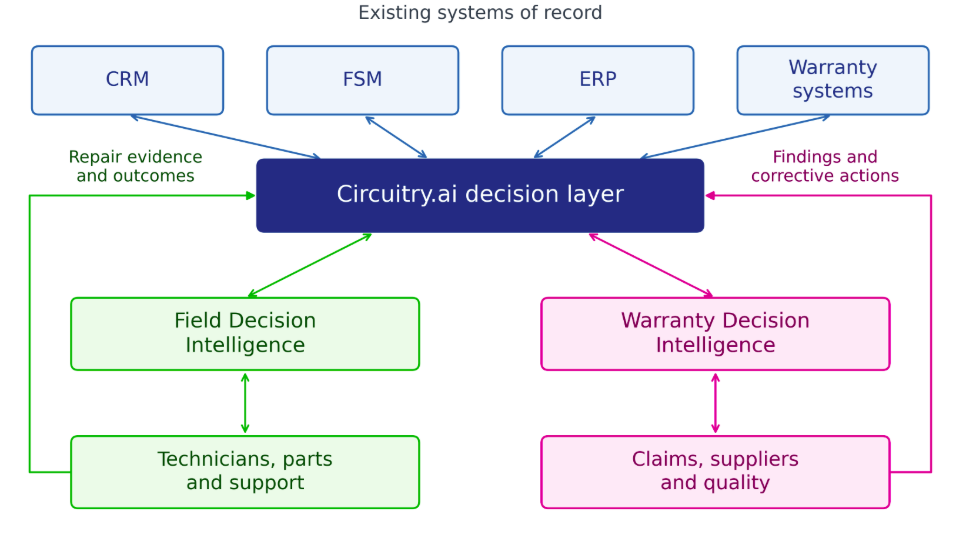
For a service leader, the practical requirement is continuity: the diagnosis should travel with the parts recommendation; the estimate should travel with the authorization; and the repair evidence should travel with the claim and supplier review. Technicians should not have to reconstruct that history in several applications.
Supplier recovery becomes harder when the component arrives without the conditions that explain its removal.
A useful record connects the complaint, observed symptoms, diagnostic tests, failed component identity, corrective action, and verification of the repair. Where relevant, it should also preserve serial information, operating conditions, photographs, video, and the required return disposition.
This matters for both accountability and learning. Supplier quality frameworks call for structured failure analysis, preservation of failure modes, and retained warranty-return records. The expectation is to identify and correct failures, not simply process returned parts.
No-fault-found findings deserve careful interpretation. They can reflect an unnecessary replacement, but they can also indicate a diagnostic or test limitation. SAE’s work on no-fault-found problems connects unresolved diagnostic uncertainty with costly, sometimes unnecessary component replacements. Better field evidence gives the supplier a stronger basis for investigation.
Recovery also depends on the applicable commercial agreement and manufacturer supplier warranty requirements. Those terms define which costs are recoverable and how responsibility is shared, including for no-fault-found cases; a failure finding alone does not settle recovery.
The operating approach should therefore connect three decisions:
Circuitry.ai’s intake, claim intelligence, and evidence-analysis capabilities can support this handoff. Recovery teams and suppliers can then work from the repair’s documented context.
The goal is higher capture of legitimate recoveries with less investigation effort and fewer disputes. As product quality improves, total recovery dollars may eventually decline because fewer failures occur. Recovery performance should therefore include the share of eligible cost recovered and net recovery after handling costs, alongside absolute dollars.
The largest long-term opportunity is the feedback loop between field decisions and warranty outcomes.
Claims history can reveal which combinations of symptoms, procedures, labor, and parts tend to occur together. But frequency is not proof of a good repair. Historical records may also contain unnecessary replacements, repeat visits, and incomplete diagnoses.
A decision-quality flywheel is a learning loop: recommendations inform repairs, verified outcomes show what worked, and expert review determines which lessons become approved guidance for the next repair. All three must stay connected:
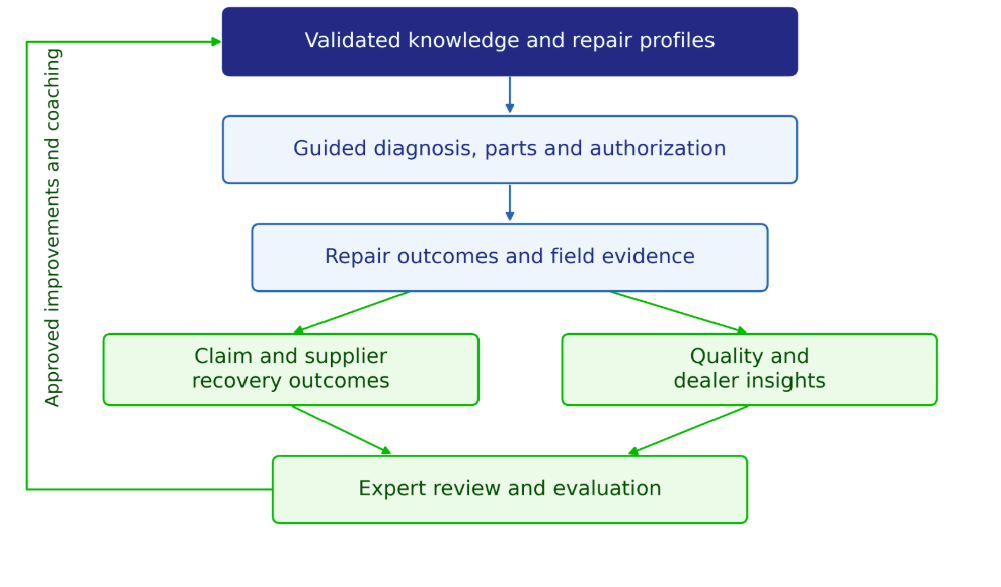
Decision-quality flywheel: evaluated outcomes improve guidance; unverified results do not automatically become approved instructions.
Circuitry.ai’s decision layer connects field and warranty context with outcome analytics. Claims Intelligence and dealer scoring can help identify patterns that warrant investigation or coaching. Service Advisor and Parts Advisor can bring validated lessons back into daily work.
To make the loop effective, capture whether the recommendation was followed, why a technician or reviewer overrode it, whether the repair resolved the issue, whether the same fault returned, and what supplier analysis concluded. Keep “claim approved” separate from “repair effective.”
Technical experts should validate changes to service guidance and evaluate them before wider release. Dealer comparisons should account for product mix and repair complexity. An experienced dealer handling difficult failures should not be judged by the same raw cost average as a network handling routine work.
When the loop works, warranty analysis improves diagnosis, supplier findings improve parts and procedures, and field evidence helps quality teams shorten the time from detecting an issue to correcting it. The next technician receives better guidance because the previous repair produced usable evidence.
Start with a product family or failure category where repair volume, repeat work, and cost are visible. Bring service, warranty, parts, supplier quality, and IT leaders together around that journey.
Establish a baseline, connect the required knowledge and records, and introduce guidance at the decisions that create the most avoidable cost. Use a defined comparison cohort and allow enough time to observe repeat repairs and recovery outcomes.
A shared scorecard should follow Circuitry.ai’s Productivity, Outcomes and Efficiency framework:
|
Dimension |
What to measure |
|
Productivity |
Technician search and documentation time; support escalations; claim-review and recovery handling effort. |
|
Outcomes |
Verified first-time fix; repeat repairs within a defined window; parts accuracy; eligible supplier cost recovered; customer and dealer experience. |
|
Efficiency |
Net cost per resolved service event; service contract contribution margin; net recovery after handling costs; time from issue detection to corrective action. |
Use technical review to determine whether a cost was avoidable. Compare similar assets, failures, coverage, and operating conditions. Track evidence completeness and technician adoption alongside the financial measures, because the flywheel depends on both.
The leadership opportunity is to make field service, warranty, and supplier quality responsible for a connected outcome: a justified repair, an accurate claim, a defensible recovery, and a better next decision.
Request a demo of Circuitry.ai’s Service Decision Intelligence to explore how connecting technician decisions with warranty, parts, and supplier workflows can reduce avoidable costs and improve service contract performance. Bring one product family or failure category, and we’ll walk that repair journey together, from diagnosis and parts selection through authorization, evidence capture, and the measures that prove value.
Improve technician enablement with AI-driven Decision Intelligence, enhancing efficiency, accuracy, and service outcomes for modern service...
AI Workers shift warranty operations from manual, fragmented processes to autonomous service journeys by guiding every repair, claim, and decision.
Discover how Field Decision Intelligence (FDI) can tackle the biggest challenges faced by field technicians.