A practical Q&A for moving from AI experiments to measurable service outcomes and Autonomous Service Journeys
AI pilots are everywhere in field service, but measurable service transformation isn‘t. Service leaders need to know where AI should be applied first, how ROI should be measured, and how much of the service journey can eventually run autonomously.
At Circuitry.ai, we work with manufacturers and service organizations to apply Service Decision Intelligence and AI Workers to the decisions and workflows that directly affect technician productivity, service outcomes, and operating efficiency.
Here are the most important questions we heard from field service leaders at Field Service Next East conference and answers from the experts at Circuitry.ai.
Quick navigation
Short on time? Jump to the questions that interest you the most.
1. What are the best field service use cases for AI?
Start with the service decisions that have the greatest impact on productivity, outcomes, and cost. The strongest use cases reduce diagnostic time, improve first-time-fix performance, prevent repeat visits, or lower cost per service event.
High-value opportunities often include:
- Diagnosing equipment problems and guiding technicians through complex repairs
- Identifying required parts
- Determining warranty or contract coverage
- Summarizing service history before a visit
- Identifying recurring failures and emerging quality issues
Ask: “Which service decisions, if made faster and more accurately, would materially improve our business?”
Once those decisions are identified, AI Workers can be deployed around them. AI Workers handle specialized service tasks, such as diagnostics, parts identification, warranty validation, communication, or quality review. Autonomous Service Journeys orchestrate those workers across an end-to-end workflow so the service process can progressively diagnose, decide, act, and learn with less manual effort.
2. We’re already doing an AI proof of concept. Why should we consider other AI initiatives?
A POC is a valuable way to learn, but it shouldn’t become the boundary of your AI strategy.
Many organizations started with a readily available use case, like a chatbot, knowledge assistant, or call summarization tool. That proves that AI technology works, but it doesn’t necessarily prove that you selected the highest-value business problem.
Ask three questions about your existing POC:
- Does it address an important service decision?
- Can we clearly measure its impact?
- Can it become part of a larger service journey rather than remain an isolated AI tool?
That gives you the opportunity to place your existing POC within a broader roadmap. For example, a technician knowledge assistant may begin by answering questions. It can evolve into Field Decision Intelligence that understands equipment history, symptoms, diagnostic procedures, parts, warranty coverage, and previous resolutions, and recommends the next best action.
The objective is to move from isolated AI experiments → Service AI Workers → orchestrated Autonomous Service Journeys.
3. How can AI help us onboard new technicians faster?
Technician onboarding is one of the strongest applications of Service AI.
Traditionally, technicians develop expertise through training, manuals, mentoring, and years of field experience. Much of an organization's most valuable service knowledge also remains tribal knowledge.
Service AI changes that model. Organizations can mine service manuals, technical documentation, service bulletins, historical cases, work orders, technician notes, support interactions, and successful resolutions to create a continuously improving service knowledge foundation.
AI serves as an on-demand mentor for novice technicians. Instead of searching through a 500-page PDF or waiting on hold for a senior engineer, the technician can ask the AI: “Show me the calibration steps for the turbine valve error E-12." An AI Service Advisor can then guide technicians by helping them understand symptoms, identify likely causes, recommend diagnostic steps, find procedures, and determine the next best action.
Every technician gets access to the knowledge and decision support of your best experts, without needing to know everything from day one. That reduces time-to-competency, shortens the path to independent field work, and improves consistency across the workforce.
4. How do we capture tribal knowledge before experienced technicians retire?
This is becoming an urgent issue for many service organizations.
The good news is that valuable tribal knowledge is already being created every day; it’s just trapped inside emails, case notes, call transcripts, work orders, technician comments, and conversations between experts.
Circuitry.ai's approach is to mine historical service interactions and convert them into reusable AI-powered service knowledge.
AI can identify problems, symptoms, diagnostic approaches, resolutions, and outcomes from previous interactions and make that knowledge available when another technician encounters a similar situation.
Every resolved service interaction becomes an opportunity to improve the next service decision. Over time, this can reduce repeat escalations, improve resolution consistency, and help preserve expert knowledge before it leaves the organization.
5. How do we measure ROI from AI in field service?
AI ROI should be measured in business outcomes. At Circuitry.ai, we recommend organizing value around three dimensions:
Productivity: How much more can the workforce accomplish? Examples include technician productivity, reduced diagnostic time, shorter repair time, and fewer calls to technical support.
Outcomes: Are we making better service decisions? Examples include first-time-fix rate, repeat visits, equipment uptime, SLA performance, and service quality.
Efficiency: Are we delivering those outcomes at a lower cost? Examples include cost per service event, truck rolls, unnecessary parts replacement, and warranty expense.
This is the Productivity, Outcomes, and Efficiency(POE) framework. The strongest AI business cases establish a baseline for these measures and then quantify improvement as AI assumes more of the work and decision-making.
Circuitry.ai recommends measuring tangible improvements across service operations:
| Metric |
What it measures |
Business impact |
| First-Time Fix Rate (FTFR) |
How often issues are resolved correctly on the first visit. |
Every percentage-point improvement can reduce repeat visits and avoid truck roll costs. |
| Mean Time to Repair (MTTR) |
How quickly technicians diagnose and resolve service issues. |
AI diagnostics can materially reduce troubleshooting time and expand technician capacity. |
| Dispatch Leakage and Parts Waste |
How often incorrect diagnoses lead to unnecessary dispatches or wrong part orders. |
Better pre-dispatch decisions can reduce unnecessary parts replacement and avoidable service costs. |
| Truck Roll Reductions |
How often are issues resolved remotely or with guided self-service? |
Remote resolution can lower field service cost while improving customer responsiveness. |
6. We already have an FSM, CRM, ERP, and knowledge management system. Why do we need another AI platform?
Your existing enterprise applications remain essential. They contain transactions, workflows, customer information, service history, parts, entitlements, and operational records.
But these systems were primarily designed to store information and execute predefined processes. AI introduces a different capability: Service Decision Intelligence.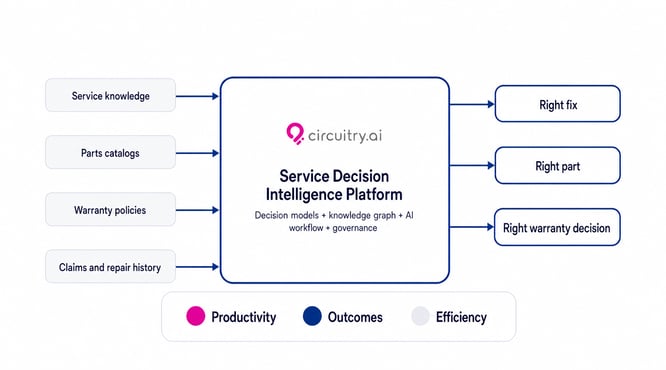
A Service Decision Intelligence layer can reason across information from multiple systems and answer questions like:
AI complements your systems of record rather than replacing them. This intelligence layer reduces support escalation volume, improves decision consistency, and helps teams act faster across disconnected systems.
Your existing systems manage the service process. Service Decision Intelligence helps determine what should happen next.
7. Our service data is messy, unstructured, and scattered across systems. Can we still implement AI?
Yes. You don’t need perfect data to begin. You need enough relevant data to support a bounded, measurable use case.
Service data is often messy because the most useful information lives in technician notes, work orders, emails, call transcripts, scanned documents, legacy repair forms, and free-text complaint fields. Service AI can read, synthesize, and extract useful patterns from these unstructured sources, especially when the problem is clearly defined.
Start with a specific service journey, connect the data that matters for that journey, and improve the knowledge foundation over time. Circuitry.ai helps organizations turn scattered service data into a governed, searchable intelligence layer that supports better decisions without waiting for a multi-year data cleanup program.
8. How accurate does AI need to be before we can trust it?
Accuracy is one of the most important considerations in operational AI.
A generic AI assistant producing a plausible answer may be acceptable for low-risk activities. It’s very different when AI is recommending a repair, selecting a part, determining warranty coverage, or initiating an operational action.
That’s why Circuitry.ai focuses on domain depth, accuracy, and autonomy. AI recommendations should be grounded in trusted enterprise knowledge and data. Where appropriate, the system should provide supporting evidence, confidence, and explanation.
Organizations can then establish different levels of autonomy based on confidence and risk. High-confidence, low-risk decisions can be handled automatically. More complex or uncertain decisions can be escalated to a technician or expert.
Higher accuracy creates the confidence required for higher autonomy and better business outcomes, including fewer misdiagnoses, fewer unnecessary part replacements, and more reliable service execution.
9. What's the difference between automating field service and making it autonomous?
Traditional automation follows predefined rules: If X happens → perform Y.
Autonomy requires the AI to understand the context, evaluate alternatives, make a decision, take the appropriate action, and determine when human intervention is required.
Consider a service request. Automation might route the request to a queue. An autonomous service journey could interpret the request, identify the asset, retrieve service history, determine entitlement, diagnose the likely issue, recommend or order a part, attempt remote resolution, schedule a technician when necessary, prepare the technician for the visit, and document the completed resolution.
AI takes on more of the routine analysis, coordination, and decision-making, freeing people to focus where their expertise adds the most value.
10. Should we deploy one AI agent or multiple specialized AI Workers?
Complex service journeys rarely involve a single decision. They may require knowledge retrieval, diagnostics, parts identification, warranty validation, customer communication, scheduling, and quality analysis.
Trying to make one generic agent an expert at everything can limit accuracy and control.
Circuitry.ai uses specialized Service AI Workers that can be optimized for specific responsibilities. For example, a Service Advisor, Parts Advisor, Warranty Advisor, Voice Agent, Email Agent, or Quality Analyst.
Think about your human service organization. You don't expect one person to be your dispatcher, diagnostic expert, parts specialist, warranty administrator, and quality engineer. AI can benefit from similar specialization.
Orchestrating the right AI Workers around the outcome you want to achieve matters more than simply deploying more agents.
11. How do we get started without creating another endless AI pilot?
Start with a service journey and measurable business outcome.
service workflow example
Service Request → Diagnose → Decide → Execute → Resolve → Learn
Then identify where people spend the most time; where knowledge is hard to access; where poor decisions create repeat work or unnecessary cost; where handoffs create delays; which decisions AI could assist today; and which decisions could eventually become autonomous.
Select a use case where you have sufficient data, measurable baseline performance, and a meaningful business impact. Then define the expected improvement in Productivity, Outcomes, and Efficiency, such as reduced time to diagnose, improved first-time-fix rate, lower support escalation volume, or lower cost per service event.
This turns the conversation from “What can AI do?” into “What service outcome can we improve, and how much value can we create?”
12: What is the next major evolutionary step for AI in field service?
AI in field service is moving from reactive knowledge search to proactive agentic automation. The next generation of AI will continuously monitor connected IoT telemetry, autonomously predict asset failures, pre-order necessary replacement parts, look up matching technician skillsets, and draft dispatch schedules before an outage even occurs.
Circuitry.ai is actively building this predictive, multi-agent autonomous future for our enterprise customers.
From AI experiments to Autonomous Service Journeys
Field service organizations need a roadmap for progressively applying AI to the service decisions that matter most.
The progression
01
Identify the service journey
02
Find the critical decisions
04
Deploy specialized AI Workers
07
Continuously learn from outcomes
As accuracy, knowledge, and confidence improve, AI can take responsibility for increasingly larger portions of the service journey, while people remain involved for exceptions, judgment, and high-value interactions.
That’s how field service organizations move beyond copilots and isolated agents toward Autonomous Service Journeys that continuously improve productivity, service outcomes, and operational efficiency.
Map your Autonomous Service Journey
What service workflow would you like to make autonomous?
Field service leadership now means empowering your workforce with real-time enterprise intelligence. Moving systematically from fragmented POCs to a unified, domain-specific AI framework like Circuitry.ai supports operational resilience, maximized asset uptime, and clear, measurable ROI.
Circuitry.ai works with field service leaders to identify high-value service decisions, map opportunities for AI Workers, quantify potential ROI, and build a roadmap from AI assistance to operational autonomy.
Ready to transform your field operations?
Schedule an AI Advisory session to identify your highest-value autonomy opportunities and quantify the ROI.
Schedule an AI Advisory Session