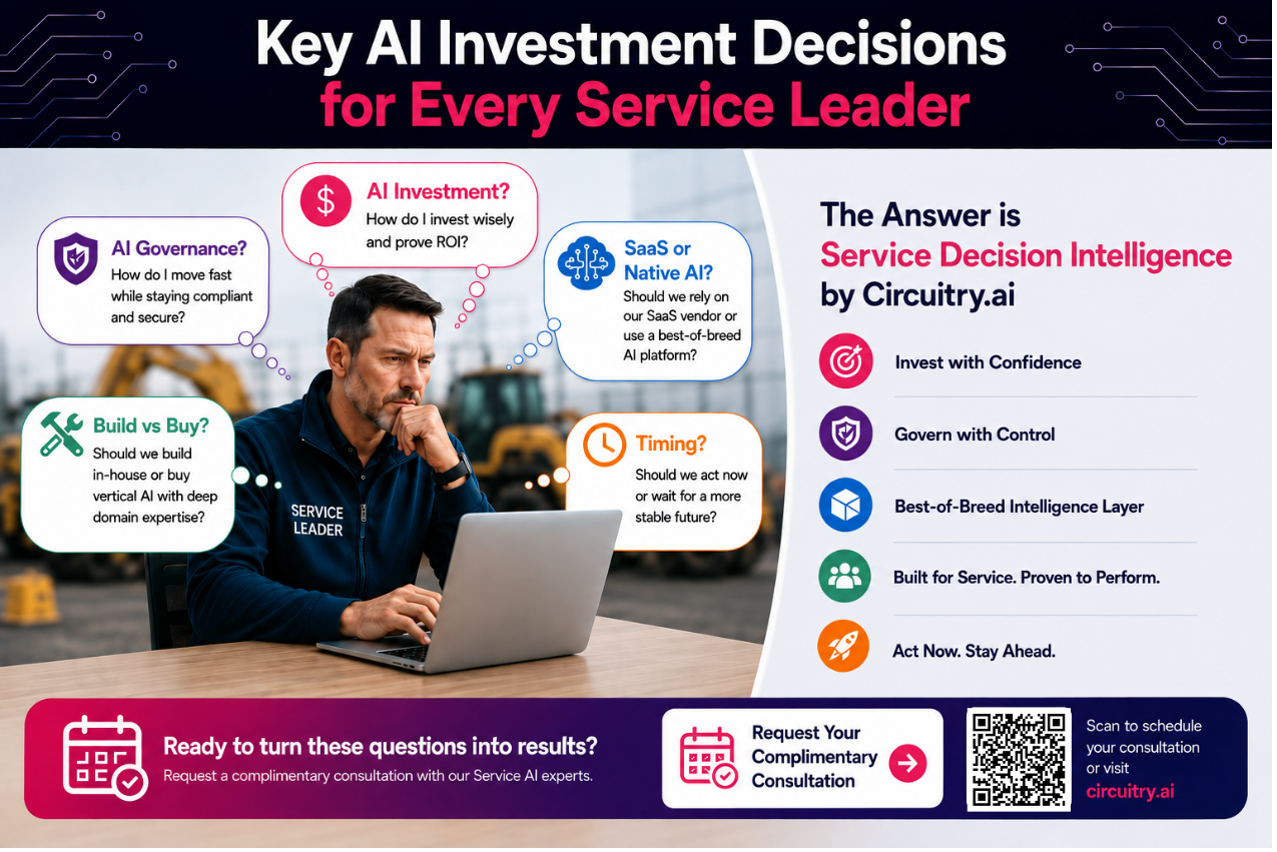
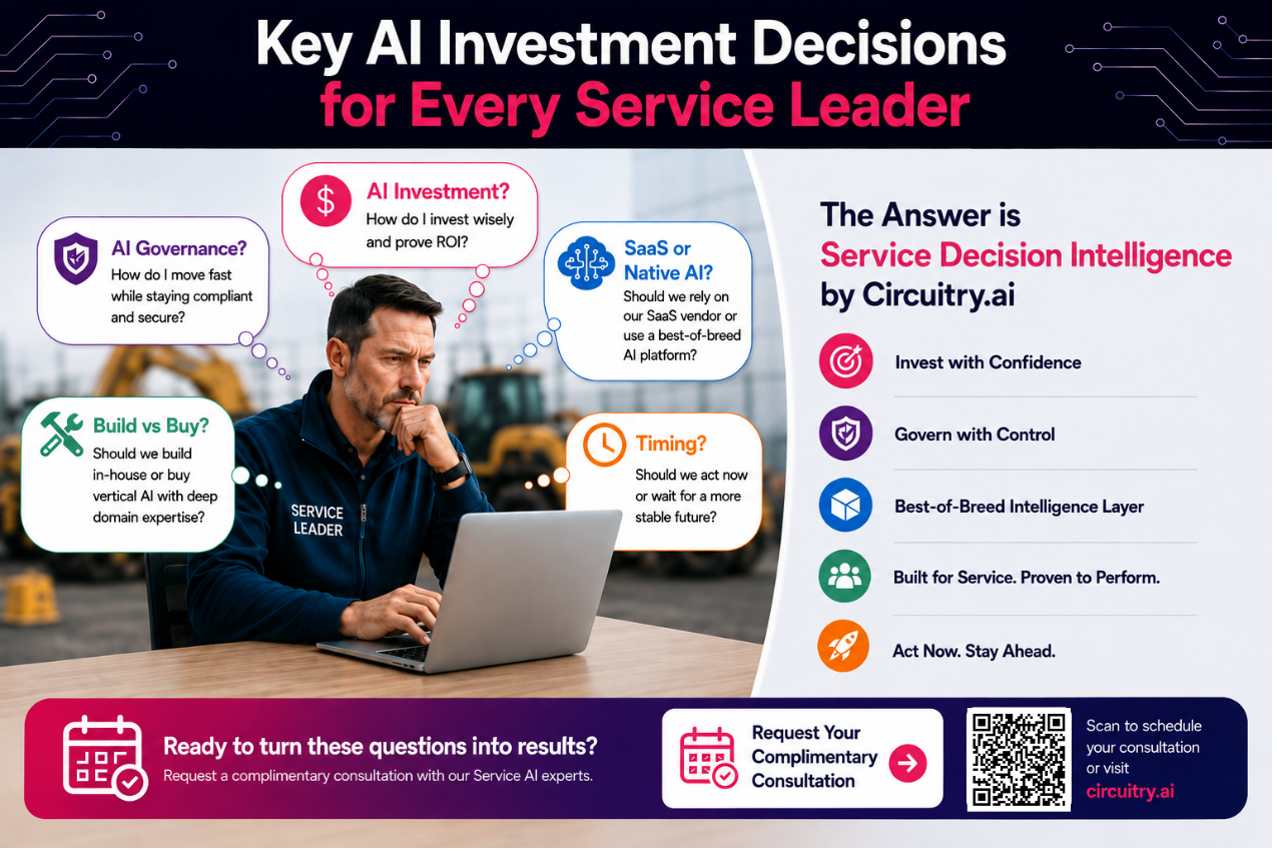
The questions are understandable:
- Will AI require a massive upfront investment?
- Should we wait for our current service platform to add AI?
- Should our internal technology team build the solution?
- Will today’s AI investment become obsolete in a year?
The challenge now is how to invest in a way that produces measurable service outcomes without creating unnecessary cost, risk, or complexity.
Quick navigation
Short on time? Jump to the sections that interest you the most.
1. The cost dilemma: do we need to invest millions before realizing value?
AI infrastructure spending can make it seem like every company should fund its own large-scale AI program. But that’s not how service leaders should think about AI economics.
Consider electricity. Your company doesn’t build a power plant before it plugs in a new piece of equipment. You evaluate the appliance based on the value it creates and its operating cost. The complexity of generating and distributing electricity remains behind the outlet.
AI should work the same way. Your service organization shouldn’t have to forecast:
- The number of tokens each interaction will consume
- Which large language model will be used
- How many model calls an AI agent will make
- The GPU or cloud infrastructure required
Price AI by business outcomes, not technical consumption
This is why Circuitry.ai prices AI around Service Decision Units (SDUs): recognizable business transactions that service leaders already manage and measure, such as:
- A support request
- A repair order
- A service job
- A warranty claim
- A parts request
- Another measurable service decision
For example, a field service leader can compare the cost per repair order with technician productivity, first-time fix rate, mean time to repair, avoided truck rolls, and equipment uptime.
Or a warranty leader can compare the cost per AI-augmented claim with manual review cost, cycle time, leakage reduction, and adjuster capacity.
By connecting SDUs to business transactions rather than seats, tokens, model calls, or infrastructure consumption, Circuitry.ai makes the investment discussion easier to tie to outcomes the business already understands.
Read more about pricing AI by business value with Service Decision Units.
Takeaway: The right pricing model makes AI easier to justify because it connects cost directly to service volume, productivity, and margin impact.
2. The governance dilemma: can we move quickly and remain compliant?
Service leaders are often presented with two alternatives:
- Launch an uncontrolled AI pilot that creates security, privacy, compliance, and risks.
- Wait indefinitely while an enterprise governance program, approved AI platform, data architecture, and model strategy are finalized.
There is a better approach: make governance part of the deployment architecture rather than a gate at the end of the process.
Match governance to the risk of each decision
Not every AI use case carries the same level of risk. Summarizing a service case is different from authorizing a high-value warranty payment.
A governed AI strategy should define for each decision:
1. The data the AI may access
2. The approved models and infrastructure
3. The evidence required to support the recommendation
4. The confidence threshold
5. The actions the AI is allowed to take
6. When human review is mandatory
7. What information must be logged
8. How the decision and outcome will be monitored
Low-risk decisions can progress toward higher levels of automation as accuracy and performance are demonstrated. High-impact decisions can remain human-in-the-loop while AI gathers evidence, evaluates options, calculates risk, and recommends the next action.
Architecture can accelerate compliance
That’s why Circuitry.ai is designed to operate within an enterprise’s approved AI, security, and data architecture. Depending on enterprise requirements, deployment options can include:
- Using enterprise-approved foundation models
- Supporting private or enterprise-managed model deployments
- Deploying customer-specific AI and machine-learning models within an approved environment
- Applying role-based access and enterprise identity controls
- Recording decision-level evidence, model versions, rationale, actions, and outcomes
In practice, this means the governance model is embedded in the way decisions are made.
Governance and innovation don’t have to compete. A well-designed architecture allows the governance team to maintain control while the service organization begins delivering measurable value.
Download the executive brief on aligning Service AI with enterprise AI strategy, architecture, and governance.
Takeaway: Responsible innovation should be repeatable through governance built into every decision.
3. The system dilemma: should we wait for our existing service platform to add AI?
Service leaders have invested heavily in FSMs, CRMs, data warehouses, knowledge platforms, and dealer portals, and want to protect those investments.
But protecting an existing system doesn’t mean limiting innovation to the capabilities that the system eventually places on its product roadmap.
Systems of record weren’t designed to make every service decision smarter
Core platforms are essential for managing transactions. But recording a transaction and making an intelligent decision are different functions.
- An FSM system manages work orders; Service Decision Intelligence determines the right diagnosis, repair, part, resource, and next action.
- A warranty administration system manages claims; Warranty Decision Intelligence evaluates coverage, repair validity, risk, cost, evidence, and approval recommendations.
For a closer look at one example, here's how Warranty Decision Intelligence works with your existing warranty and claims systems.
Add a decision layer across the silos
This is the role Circuitry.ai plays: a Service Decision Intelligence layer that works across existing systems. The decision layer can:
1. Retrieve the relevant asset, customer, contract, service, parts, claim, and knowledge context.
2. Interpret structured and unstructured information.
3. Apply business policies, domain models, predictive models, generative AI, and historical patterns.
4. Recommend the right action or execute an approved action.
5. Explain the evidence, rationale, and confidence behind the decision.
6. Escalate exceptions to the appropriate person.
7. Write the recommendation, decision, action, and outcome back into the system of record.
The current FSM, CRM, ERP, warranty, or administration platform remains in place. Circuitry.ai makes the existing information and workflows more intelligent by reading context, applying AI reasoning, generating recommendations or decisions, automating approved workflows, and writing results back into existing systems.
Don’t automate “the way we have always done it”
There's a second risk in relying exclusively on existing platforms: AI may simply be added to an old workflow without reconsidering the decision itself.
A chatbot attached to a service application might make information easier to find, but it doesn’t necessarily improve the complete service outcome.
True value comes from asking:
- Why does the technician have to search five systems?
- Why are low-risk requests reviewed manually?
- Why is missing information discovered only after the job or claim is submitted?
- Why is the outcome not captured and used to improve the next decision?
Takeaway: The fastest path to value is making the decisions around core platforms smarter.
4. The sourcing dilemma: should we build AI ourselves or buy it?
Foundation models and coding assistants have made it easier to create an AI demo. They haven’t made it easy to operate accurate, secure, explainable, domain-specific Service AI in production.
A production service solution may need:
- Service and repair domain models
- Parts and supersession intelligence
- Warranty and entitlement reasoning
- Service knowledge ingestion
- Ongoing support as models and infrastructure change
The core question becomes: “Is building and continuously operating this service decision capability the highest-value use of our internal technology resources?”
Build what differentiates your business. Buy what accelerates production value
Vertical Service AI complements internal teams: organizations keep the knowledge that makes their business unique, while Circuitry.ai provides the platform, domain intelligence, governance, integrations, and production operations needed to turn that knowledge into measurable service outcomes.
This approach delivers:
- Faster time to first value
- Lower implementation and execution risk
- Greater domain accuracy
- More predictable total cost
- Continuous access to model and platform improvements
- Better alignment with service-specific outcomes
- Less dependence on scarce internal AI specialists
Download the Service AI Build vs. Buy data sheet to learn more.
Takeaway: Internal teams should own the knowledge and workflows that differentiate the business, while buying the specialized Service AI capability that accelerates production value.
5. The timing dilemma: should we act now or wait for AI to stabilize?
Waiting can feel prudent, since models, standards, and governance requirements keep evolving. But a completely stable AI market is unlikely. The durable investment is the service decision capability you build around a model, not the model itself:
- The high-value decisions you identified
- The service data you connected
- The policies and guardrails you documented
- The integrations established
- The adoption and change-management experience your teams gained
Protect against model obsolescence through architecture
An enterprise Service AI platform shouldn’t depend on one model for every task. Different service decisions may require different combinations of:
- Large language models
- Knowledge graphs
- Semantic and keyword retrieval
- Business rules
- Agent orchestration
- Human expertise
A composite, model-agnostic architecture applies the best model for each task and lets approved frontier models be upgraded or replaced without rebuilding the service experience.
Circuitry.ai's model gateway layer supports multiple enterprise-grade models, preserving your provider strategy and cost controls as models evolve.
Start with decision-ready data
AI needs trusted, accessible data, but that doesn't require a multi-year modernization program first.
Start with the data needed for one high-value decision, prove the value, and then expand.
For a diagnostic decision, that may include the asset, symptoms, fault codes, service history, manuals, bulletins, and prior resolutions.
For a warranty decision, it may include the claim, contract, repair details, parts, labor, images, service history, and policy rules.
Circuitry.ai supports this incremental path by normalizing service manuals, parts information, repair orders, warranty policies, claims history, and other service information into decision-ready context.
Waiting has an operational cost
While an organization waits:
- Technicians continue searching for answers.
- Repeat visits continue and customers experience avoidable delays
- Experienced employees continue to retire, and new employees take too long to become productive.
- Competitors begin accumulating operational feedback and adoption experience.
Your technicians and service teams are not waiting for the AI market to stabilize. They need the right answer, part, action, and decision today.
Takeaway: Waiting for AI to stabilize may feel safe, but it delays the organizational learning cycle that creates lasting service advantage.
Where to start: one high-value decision, one measurable outcome
The best starting point is a high-volume, high-value service decision where:
- The current pain is visible
- The baseline can be measured
- The required data is accessible
- Domain experts can validate the result
- The initial risk can be governed
- The outcome matters to customers, employees, or service margins
Circuitry.ai’s TRACK Framework provides a practical model for moving from opportunity to continuous value:
T — Target: Identify the decisions with the greatest value, volume, and feasibility.
R — Review: Assess the current process, baseline performance, service knowledge, governance requirements, and team readiness.
A — Assign: Assign the AI Advisor, Analyst, or Agent to augment or automate the targeted decision, with clear ownership and guardrails.
C — Capture: Capture the evidence, recommendation, feedback, final outcome, and financial impact.
K — Kaizen: Improve continuously, then expand to adjacent decisions after value has been demonstrated.
Explore the TRACK Framework for Autonomous Service Journeys.
Empower people first
The first objective should be to eliminate the gap between your best expert and everyone else.
Place Service Decision Intelligence alongside your team, give them immediate access to the right context, and next action, capture their expertise and feedback, and measure the outcomes. Then, increase automation when the decision class, confidence, and governance controls support it.
This people-first approach helps organizations:
- Accelerate employee onboarding
- Reduce dependence on a small number of experts
- Improve consistency across teams and locations
- Make institutional knowledge available at the moment of need
- Build workforce trust in AI
- Create the evidence required for responsible automation
Make every service advisor your best service advisor. Make every technician your best technician. Then expand from individual decisions to connected, autonomous service journeys.
Turn AI uncertainty into an AI action plan
The most important AI decision is how to create a controlled, economically sustainable path from today’s service challenges to measurable business outcomes.
Ready to see how Service Decision Intelligence works for your organization?
Bring us one service challenge, process, or investment dilemma. We’ll help you identify the decisions involved, define measurable outcomes, evaluate the data and governance requirements, and outline a practical path to value
Request a complimentary 30-minute consultation with our Service AI experts.
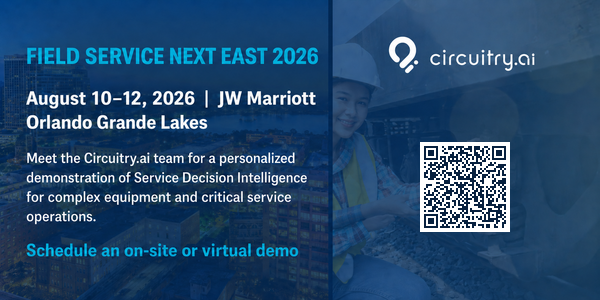
Join us at Field Service Next East 2026
August 10–12, 2026 · JW Marriott Orlando Grande Lakes
We’re proud to be a sponsor and presenter at Field Service Next East 2026, the premier event for service, support, and customer experience leaders.
AUGUST 10 · 11:35 A.M.
AI Labs Presentation: AI-Powered Autonomous Support for Mission-Critical Service at Scale
AUGUST 11 · 11:40 A.M.
Technology Roundtable: From Knowledge Mining to Autonomous Service Journeys: How AI Agents Are Transforming Service and Support Operations
Visit Booth 12 to discuss your AI strategy and highest-value service use cases.
View the Field Service Next East sessions and schedule time with the Circuitry.ai team.
FAQs
Do we need to invest millions before realizing value?
No. Circuitry.ai prices AI around Service Decision Units, like a repair order or claim, so you pay for business outcomes, not infrastructure you'd otherwise have to forecast yourself.
Can we move quickly and remain compliant?
Yes, when governance is built into the deployment architecture instead of a gate at the end. Circuitry.ai operates within your approved AI and data architecture, with human review for high-risk decisions and no cross-tenant model training without consent.
Should we wait for our existing service platform to add AI?
No. Circuitry.ai adds a decision layer across your existing FSM, CRM, or warranty platform, so you get smarter decisions without replacing what you already have.
Should we build AI ourselves or buy it?
Buy the capability, build what differentiates you. Circuitry.ai provides the domain-specific platform and production operations, so your team keeps its unique knowledge while gaining faster time to value.
Should we act now or wait for AI to stabilize?
Act now. The durable investment is the decision capability you build, not any single model, and Circuitry.ai's model-agnostic architecture lets you upgrade models without rebuilding your service experience.