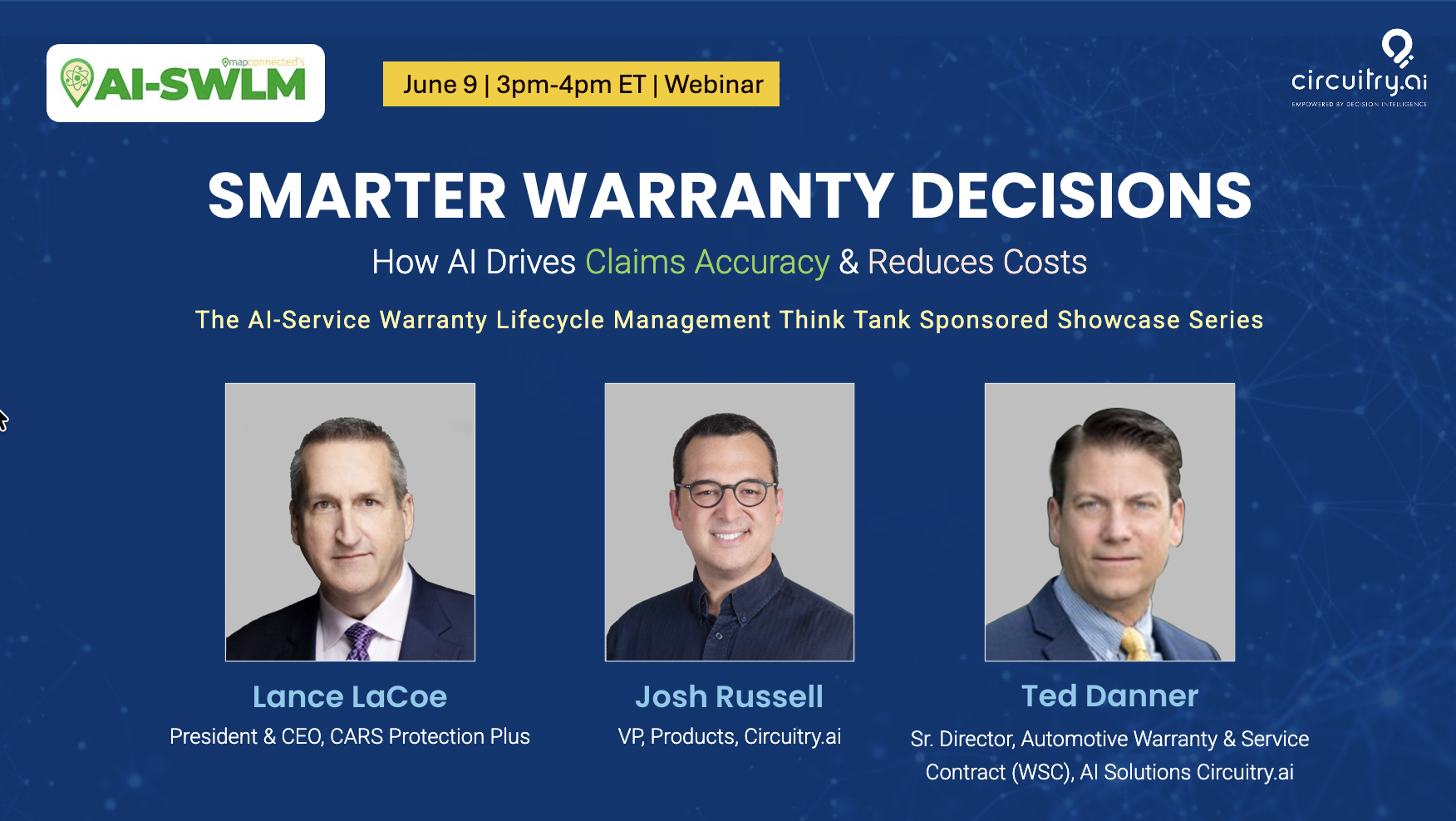
In the MAPconnected webinar "Smarter Warranty Decisions: How AI Drives Claims Accuracy & Reduces Costs", Lance LaCoe, President of CARS Protection Plus, discussed how CARS deployed Circuitry.ai’s AI-powered Warranty Decision Intelligence to improve adjudication accuracy, reduce claims costs, and support growth without disrupting its existing workflow.
Watch the full webinar on demand.
Here are the questions and answers from the webinar.
Quick navigation
Short on time? Jump to the questions that matter most to you.
- Is Circuitry.ai a warranty management system or an admin system?
- Were the benefits what you originally expected, and were there surprises along the way? Were there objectives you weren’t able to meet?
- How does Circuitry.ai actually work on top of an existing admin system?
- Are there specific requirements that the existing admin system has to have in order to be able to interact with Circuitry.ai?
- How is data kept secure and private?
- How is Circuitry.ai typically priced?
- How can Circuitry.ai help OEMs navigate state-specific labor rate legislation?
- Has the platform been deployed in other industries outside of automotive?
- How quickly does the system make a decision?
- Was the primary purpose speed or accuracy?
- Are there any new features being introduced in the future?
- Has Circuitry.ai been implemented in the marine field?
Smarter Warranty Decisions Webinar Q&A
Is Circuitry.ai a warranty management system or an admin system?
Josh Russell: Circuitry.ai is a Warranty Decision Intelligence layer - not a warranty administration platform. It sits on top of the admin system you already use and makes the decisions inside it faster and more accurate, so you don’t have to change or replace your warranty system. Wherever you have process gaps, say you wish you had a notification engine that could automatically send authorization emails, like Lance described - we likely have an agent or advisor that solves it. Our Notification Agent does exactly that, working right alongside your existing platform.
Lance Lacoe: I think one of the really interesting parts to this question is that a lot of people look at this, as well, what do you still need your admin platform for because this has so many capabilities?
But the reality for CARS is we're using more of our administration platform because of Circuitry. It actually makes it easier for our adjusters to use some of the integrations that are already available on the administrative system, which maybe they weren't working before, because we're trying to do calls faster, and it takes so long. But this system can help make sure that we're using things like parts integration more effectively.
I would say that we're doing better on how we handle inspection reports, how we're using integrations from things like JD Power. So it can actually enable the better utilization of your administration platform because it helps the adjuster.
Were the benefits what you originally expected, and were there surprises along the way? Were there objectives you weren’t able to meet?
LL: I would say that there were some surprises, and they were positive surprises. I think that we didn't really know that we wanted to go down the route of the notification agent the way that we did because we were working with our admin platform to develop a similar capability, but we had been working with them for months on it.
After we brought in Circuitry and we were going through the setup, we talked a little bit about what we were doing with our administration system, and they offered a notification agent that could be built very quickly. And again, it was within, say, three weeks. It was probably less than that. So there were definitely benefits that we received that we weren't even thinking about when we first looked at the program. I don't think from my perspective that any expectation that we had has been missed.
Now, after we go through and adjudicate 100,000 claims, you know, with Circuitry, I might have a different answer to that. But as of today, everything that we were expecting is being delivered, and we're getting more than we expected.
How does Circuitry.ai actually work on top of an existing admin system?
LL: We still have the warranty admin system we launched back in 2017. So we still use it today. We're still very integrated with our admin system, and it continues to do everything that we've wanted to do. And as I mentioned, we actually use a little bit more of it now because of Circuitry. Circuitry is really a very interesting add-on where the agents essentially live side by side with the admin platform, and through the integration, we can push and pull data. It can essentially see what's on the screen and then present things like, what the scoring which is really, really amazing.
One of the things that we use heavily on our admin platform is pop-up notes, and that's to advise our claim adjuster if there's any special considerations that they need to have when adjudicating the contract. Circuitry ingests all those pop-up notes, and it incorporates that into its scoring model. So, if we put in there, for example, that a shop is supposed to use a particular labor guide, it picks that up, and it will make sure that the adjuster is using the proper labor guide for them.
Are there specific requirements that the existing admin system has to have in order to be able to interact with Circuitry.ai?
JR: The short answer is no. Most warranty administration systems we work with expose an API or interface we can connect to, and we don’t require any changes on the customer side to operate.
If an API isn’t available, we have other ways to integrate. Where it helps is training on your historical claims, so if a backup of your warranty system is available, that’s a simple way for us to learn your contracts and adjudication patterns. We will create a model tuned to your business from day one. Our objective is to keep the cost to change as low as possible: most customers go live without their team or vendor writing a single new integration.
At CARS Protection Plus, for example, their admin system runs unmodified. We simply display the claim score down the right-hand side of the browser. Deeper integrations are always available in later phases, but they’re never a requirement.
How is data kept secure and private?
JR: Let’s start with the data: it’s 100% yours. We train on it, but the data and the decisions stay yours. Critically, your model is trained only on your data and is never shared or co-mingled across customers.
The system is independently audited and holds several certifications; SOC 2, GDPR, and CCPA, and we’re continuously validated by a third party to maintain them. Your solution runs on a scalable private enterprise cloud; these are private models, not something we’re loading into ChatGPT orClaude. If you’d like the details, you can visit our trust center.
How is Circuitry.ai typically priced?
JR: The commercial model is simple: it’s priced per claim. That scales naturally, whether you’re processing a few thousand claims a month or a hundred thousand.
Unlike token or credit-based AI pricing, you’ll never get a surprise bill because usage spiked; the cost per claim is fixed and transparent, which makes ROI easy to calculate. And that price covers the full lifecycle of the claim, scoring, adjustment, and resolution, so there’s nothing hidden to discover later. It’s the same approach we used when we were building warranty administration systems, and it keeps Circuitry affordable and approachable for every customer.
How can Circuitry.ai help OEMs navigate state-specific labor rate legislation?
JR: A growing number of states now require OEMs to reimburse at the shop’s posted retail labor rate rather than the published SRT from price books. Because those rules are simply data we train the agent on, Circuitry applies the correct rate automatically by state, using your third party, or proprietary price books where it governs, and the statutory retail rate where the law requires.
Your team doesn’t have to track each jurisdiction by hand, and you reduce the compliance risk of under-reimbursing. As legislation changes, we just load the updated statewide rules into the agent.
Has the platform been deployed in other industries outside of automotive?
JR: Yes, and the reason it transfers is that the underlying pattern is industry-agnostic: we ingest policy and contract rules, then score claims against them. That applies anywhere there’s a warranty, a service contract, or a claim. Today, we have customers in medical devices, heavy equipment, agriculture, construction, and consumer durables, and they run the same agents your team would. So you wouldn’t be the first in your space.
How quickly does the system make a decision?
JR: It depends on the step, and each one is timed to beat the human to the next action. Building a claim from our intake agent takes roughly four to seven minutes. Scoring a claim takes under 60 seconds and is performed in batches with the goal of having the score available the moment an adjuster opens the claim.
An adjustment averages less than 30 seconds. Payment and resolution are near-instant, because we’ve already ingested the invoice at the end of the claim lifecycle.
The point is that for every decision point that needs a person, the answer is ready before they get to it. Compare that to a manual adjustment—10 to 18 minutes depending on your line of business—and doing it in seconds instead of minutes is a significant performance gain.
Was the primary purpose speed or accuracy?
JR: Accuracy first, and speed follows. Our bar is that any claim score we produce would match what an independent human auditor would conclude, so we’re never trading accuracy for speed. The agents don’t deviate from your OEM policy or your contract. In practice, the two go hand in hand: when you get the decision right the first time, you also get it faster, and that’s where the efficiency gains come from.
LL: From CARS' perspective, quite honestly, I will take either one of those. My initial intent was on accuracy, but we have so much volume, and our volume is picking up so dramatically; if it could help me only with speed instead of accuracy, I would consider that also an acceptable outcome. I value accuracy more than I do speed. The reality is they do go hand in hand.
None of my ROI is modeled on headcount reduction. Although I'm certain that I will probably add fewer people than I would have to without the platform, I'm certainly not going to reduce headcount. Our whole modeling was that I wanted us to get better at being accurate, answering the questions correctly the first time, and that will bring efficiency down the road as well.
JR: Customer satisfaction is something we measure together with your teams. A claim can come in through our voice agent over the phone, or you can upload a repair order, and we'll build and pre-score the claim for you.
Now imagine getting a ruling and an authorization email back within minutes. As a customer, that’s exactly the experience I’d want. I submit my claim, and before I’ve finished my coffee, the authorization is back. If you’re a service center with a vehicle up on a lift, that’s a great experience: you source the parts and get the repair out the door.
The metric that moves satisfaction here is cycle time from submission to authorization to resolution, and it’s one we can baseline and track together.
Are there any new features being introduced in the future?
JR: Yes. We’re releasing an intelligent claim intake solution that works across both online and voice agents. Claim submission can be initiated in any channel (email, voice, web) the customer prefers and conclude with an already built and pre-scored claim in less time and with less effort than available solutions.
We’re also focused on expanding into part returns and supplier recovery, extending the same decision intelligence to the parts of the warranty lifecycle that recover cost, not just process it.
Has Circuitry.ai been implemented in the marine field?
JR: Marine and marine warranty providers are squarely within our ideal customer profile. The decision intelligence pattern is the same one we apply across other manufacturing verticals, ingesting policy and/or contracts and scoring claims against them, so it translates directly to marine warranty programs. We’d welcome conversations about a marine deployment.
See Warranty Decision Intelligence in action
The CARS Protection Plus deployment shows that AI adoption in warranty operations does not have to mean replacing core systems or forcing teams into entirely new workflows. The biggest gains come from improving decision accuracy, supporting the realities of your repair network, and bringing claims teams into the process early so adoption happens with them.
If you’re exploring how to reduce claims leakage, improve consistency, and move toward a more autonomous warranty operation, request a demo to see how Circuitry.ai applies AI to real-world warranty workflows.