Why the Future of Service is AI-powered Service Decision Intelligence
Service Decision Intelligence helps service and warranty leaders prove AI decisions are accurate, governed and autonomy-ready. See Circuitry.ai's...
Field service AI creates the greatest value when it improves decisions across the entire service journey. Organizations should match each activity to the appropriate level of AI participation: directed assistance, collaborative processing, or autonomous execution within defined guardrails and escalation paths.
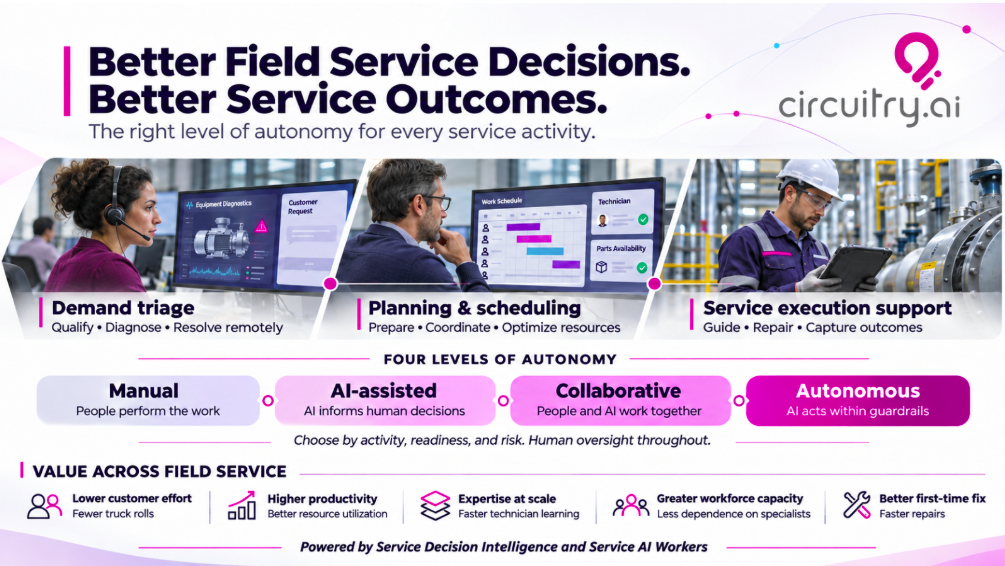
Circuitry.ai’s Service Decision Intelligence connects service knowledge, equipment context, operational data, and business policies, while Field Decision Intelligence brings diagnostic guidance, procedures, history, and parts recommendations into the technician’s workflow. Start with a costly, measurable service decision; retain human accountability for ambiguous or high-risk cases; and measure productivity, first-time-fix rates, truck-roll avoidance, repeat visits, customer effort, equipment uptime, cost per resolution, and human correction effort.
A technician can arrive on time and still be unable to complete the repair. The symptoms may have been misunderstood, the replacement part may not match the equipment, or an earlier troubleshooting attempt may never have reached the technician. Improving the schedule helps, but the quality of the decisions surrounding the visit determines whether the customer gets a resolution.
For service leaders, AI creates lasting value when it improves the decisions behind each visit, from first customer contact through diagnosis, preparation, repair, and follow-up. Each decision deserves its own level of assistance, review, and automation. This post explains how to match AI roles to those decisions, where to start, and how to measure the result.
The Gartner® research report, CIOs: The Fastest Path to Field Service AI Value Is Not Full Autonomy, by Jim Robinson, states:
“The best short-term business impacts for many FSPs extend beyond scheduling efficiency to include truck-roll avoidance, improved first-time-fix rates, reduced customer effort, workforce scalability and technician profit productivity.”
Gartner, CIOs: The Fastest Path to Field Service AI Value Is Not Full Autonomy, Jim Robinson, Sr Director Analyst, Gartner, 19 October 2026.
At Circuitry.ai, we believe service AI should be judged by the work it helps people complete and the outcomes it improves. A faster answer matters when it leads to an accurate diagnosis. An automated action matters when it moves a service event toward resolution within the organization’s policies.
Service Decision Intelligence provides the foundation for this approach. Circuitry.ai connects service knowledge, equipment context, operational data, and business policies so AI can recommend, evaluate, route, and act on service decisions across existing systems.
Field Decision Intelligence applies that foundation to the technician’s work. It brings diagnostic guidance, repair procedures, service history, and parts recommendations into the moments before, during, and after a visit. The goal is to help technicians arrive better prepared and complete the work correctly.
Consider the connection between intake and parts preparation. A more precise description of the fault can change the likely repair, the required part, and the skill needed on site. Capturing that context once and carrying it forward gives the next person a stronger starting point. It also makes accountability clearer: teams can see where a decision helped or where missing evidence created rework.
The same service journey can combine several operating modes. Routine information gathering may run automatically, a proposed repair may need expert review, and a technician may ask for guidance while retaining responsibility for the physical work.
Gartner states:
“The most successful field service organizations are not rushing to automate everything. They are selectively orchestrating work, decision support, approvals and escalations across broader workflows, combining AI roles with human judgment, then measuring customer and operational impact.”
Gartner, CIOs: The Fastest Path to Field Service AI Value Is Not Full Autonomy, Jim Robinson, Sr Director Analyst, Gartner, 19 October 2026.
Circuitry.ai’s Service AI Workers bring three complementary capabilities to that work: Advisors answer and guide, Analysts analyze evidence and patterns, and Agents execute authorized actions. These worker types describe what each can do; their operating permissions determine how independently they work. The table below shows how they combine across Gartner’s three modes, from a directed assistant to an autonomous role.
The following mapping is Circuitry.ai’s perspective on applying the modes labeled in Gartner Figures 2 and 4. It is not a Gartner evaluation of Circuitry.ai.
|
Gartner mode |
Circuitry.ai Service AI Workers |
Human responsibility |
|
Directed AI assistant |
Advisors provide guidance; Analysts assemble relevant evidence for a person to evaluate. |
Direct the work, check the evidence, and decide what happens next. |
|
Collaborative AI processor |
Advisors and Analysts develop recommendations; Agents prepare or execute approved steps. |
Review trade-offs, approve consequential actions, and resolve exceptions. |
|
Autonomous AI role |
Agents coordinate Advisors and Analysts to complete a defined, authorized workflow. |
Set objectives and permissions, monitor results, and handle escalations. |
Mode labels: Gartner, CIOs: The Fastest Path to Field Service AI Value Is Not Full Autonomy, Jim Robinson, Sr Director Analyst, Gartner, 19 October 2026, Figures 2 and 3, pp. 8 and 10. Circuitry.ai mapping and responsibilities: Circuitry.ai.
In practice, an Agent can operate with an approval checkpoint. An Advisor can support an automated workflow as well as a person. This flexibility lets service leaders assign responsibility at the level of the individual decision, even when several AI Workers contribute to it.
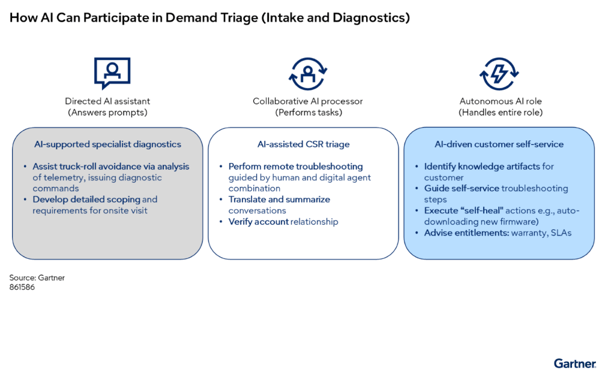
Before dispatching anyone, a service organization needs a useful account of the problem: which asset is affected, what has changed, which checks have been completed, and whether remote resolution is appropriate. Incomplete intake transfers the investigative work to the next person and makes the customer repeat the story.
Figure 2: How AI Can Participate in Demand Triage (Intake and Diagnostics)
Gartner, CIOs: The Fastest Path to Field Service AI Value Is Not Full Autonomy, Jim Robinson, Sr Director Analyst, Gartner, 19 October 2026.
Our application of this idea starts with Service Advisor, which helps support teams and technicians use approved knowledge to investigate symptoms and identify the next diagnostic step. Warranty Advisor adds policy and contract guidance when entitlement affects the response. Service AI Analysts help teams investigate recurring failures and service risks.
With connected systems and configured permissions, Service AI Agents can gather missing information, enrich a case, and route work with its supporting context. Straightforward requests can follow an authorized workflow, while unfamiliar symptoms, conflicting evidence, or consequential decisions go to a qualified person.
The value is in the quality of the handoff. A specialist should receive what the customer reported, what was checked, and why the issue needs attention. A field technician should inherit the same context. Measure remote resolution alongside repeat contacts and subsequent visits so that an apparently closed case does not conceal an unresolved problem.
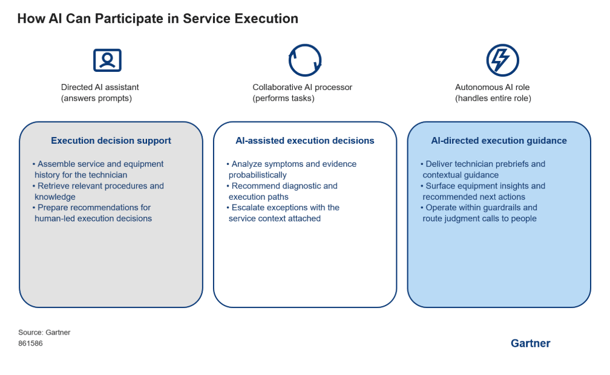
Service execution support is where planning decisions become customer and operational outcomes. Effective execution can improve first-time-fix rates, reduce repair time, and scale scarce expertise across the workforce. Depending on the activity and operational readiness, AI can assist with tasks, collaborate on diagnostic and execution decisions, or deliver guidance within defined guardrails.
Figure 4: How AI Can Participate in Service Execution
Gartner, CIOs: The Fastest Path to Field Service AI Value Is Not Full Autonomy, Jim Robinson, Sr Director Analyst, Gartner, 19 October 2026.
Circuitry.ai’s Field Decision Intelligence brings procedures, equipment history, diagnostic guidance, and parts context into the technician’s workflow. Service AI Advisors can assemble and summarize relevant information; Analysts can evaluate symptoms and evidence to suggest diagnostic paths; and Agents can deliver authorized prebriefs, next actions, and escalations within configured guardrails.
The level of autonomy should match the decision. A technician can remain accountable while AI prepares recommendations; an expert can review ambiguous evidence and coordinate support; and approved guidance can be delivered automatically when conditions are well understood. Safety issues, conflicting evidence, and policy exceptions should route to a qualified person.
Consider a technician who finds that the equipment on site does not match the reported symptom. The technician can describe the new evidence, review a revised diagnostic path, and confirm whether the parts on hand still apply. If the evidence falls outside approved guidance, the workflow routes the question to an expert with the visit context attached. The completed visit should record the confirmed fault, repair, parts used, and result so future decisions start with better evidence.
Our view is that accuracy creates trust, and trust supports greater autonomy. Circuitry.ai’s governance controls connect decisions to evidence, permissions, confidence thresholds, approval rules, and exception handling. Customers choose the steps that remain advisory, require approval, or may execute automatically.
Before extending automation, establish whether the guidance applies to the equipment configuration, whether its source is current, and who has authority to act. Define the escalation path when confidence is insufficient or evidence conflicts.
Record human overrides and their reasons. A missing document, an incorrect diagnosis, and a legitimate exception require different responses. Understanding the difference helps the team improve the process before granting greater independence.
Start with a service decision that has a visible cost of getting it wrong: repeated visits, incorrect parts, or lengthy diagnostic escalations. Establish a baseline and agree on the improvement to demonstrate before deployment.
We recommend measuring value across three dimensions. Productivity covers technician preparation and administrative time. Outcomes cover first-time fix, truck-roll avoidance, repeat visits, customer effort, and equipment uptime. Efficiency covers cost per resolved service event and unnecessary handoffs. Review decision accuracy and human correction effort alongside all three.
Faster intake must still support reliable diagnosis, and automated cases must deliver durable resolutions. Evaluate the complete service event before expanding. This gives CIOs and service leaders a shared basis for investing in AI and deciding where greater autonomy belongs.
Read the Gartner research report, CIOs: The Fastest Path to Field Service AI Value Is Not Full Autonomy, by Jim Robinson, Sr Director Analyst, Gartner, 19 October 2026.
Request a Circuitry.ai demo to see Service Decision Intelligence, Field Decision Intelligence, and Service AI Workers in action. Bring one service challenge, such as repeat visits or incorrect parts, and explore the decisions, integrations, and oversight needed to improve productivity, outcomes, and efficiency.
Gartner is a trademark of Gartner, Inc. and/or its affiliates. Gartner research and graphics are attributed above. The product mappings, examples, and recommendations in this article represent Circuitry.ai’s perspective and do not imply Gartner endorsement.
Service Decision Intelligence helps service and warranty leaders prove AI decisions are accurate, governed and autonomy-ready. See Circuitry.ai's...
Five takeaways from Field Service Next East 2026: connected systems, captured knowledge, and consistent AI decisions across service, parts, and...
Improve technician enablement with AI-driven Decision Intelligence, enhancing efficiency, accuracy, and service outcomes for modern service...