Many service AI pilots look impressive in a demo, but don’t move the metrics that matter: product uptime, first-time fix, customer experience, cost-to-serve, claim accuracy, or service margin. The problem is that teams start with an AI tool before they define the service decision that creates business value.
Service work is a connected sequence of operational decisions: understanding the request, assembling context, like the asset, customer, and history, choosing the likely diagnosis, right part, or next action, and then executing the work across systems like CRMs, FSMs, parts, and claims systems. Finally, the organization must learn whether the decision produced the intended result.
That’s why service leaders should think in terms of an Autonomous Service Journey: an end-to-end workflow in which AI Workers assemble context, recommend decisions, take governed action, involve people when needed, and improve from outcomes.
-
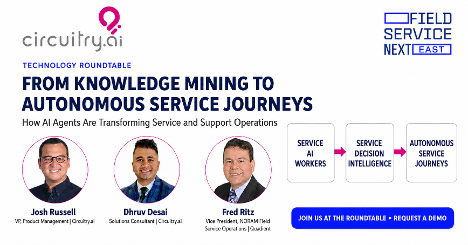
Autonomous Service Journey: one complete service workflow, from trigger to resolution to learning, designed as a sequence of decisions.
-
AI Workers: role-based workers (Advisors, Agents, Analysts, and Orchestrators) that assemble context, decide or recommend, act within guardrails, and escalate to a person when judgment is required.
-
Service Decision Intelligence: the domain knowledge, evidence, and governance that make those decisions accurate, explainable, and measurable at the point they are made.
Autonomy is a deliberate operating design that defines what AI can assist, recommend, execute with approval, execute within guardrails, and eventually manage by exception.
This workshop approach is designed for service executives, field service leaders, warranty and claims leaders, support operations teams, and transformation leaders who want AI investments tied to measurable outcomes.
Quick navigation
Short on time? Jump to the sections that interest you the most.
A path from opportunity to an actionable journey
Work through six decisions with your leadership team. Each step removes a common source of AI program failure: unclear value, vague scope, weak ownership, untested judgment, unrealistic autonomy, or an incomplete proof plan.
| Step |
Question to answer |
Output |
| 1. Outcome |
Which business result should improve? |
KPI, baseline, target, sponsor, and owner |
| 2. Journey |
Where does friction slow or distort service? |
Journey map and decision bottleneck |
| 3. Decision |
What judgment must be made? |
Decision, evidence, action, and expected result |
| 4. Priority |
Which candidate has the best value and readiness? |
Ranked shortlist and selected use case |
| 5. Autonomy |
What should AI assist, recommend, execute, or own? |
Future-state workflow, guardrails, and acceptance criteria |
| 6. Proof of value |
How will the journey be tested? |
POV brief, scenario, success criteria, and pilot scope |
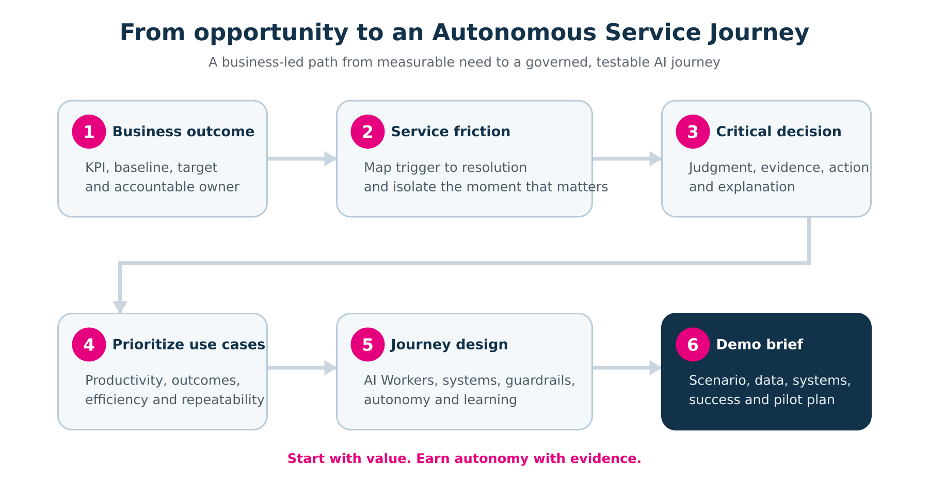
What service workflow do you want to turn into an Autonomous Service Journey? The answer should name a business outcome, a moment of friction, and a decision worth improving.
Step 1: Choose the business outcome before choosing the technology
Start with a result the business already manages. Choose a primary outcome across productivity, service outcomes, operational efficiency, or margin and revenue. Then name the KPI, current baseline, desired target, urgency, executive sponsor, and operating owner.
- Productivity: Handle more requests, work orders, or claims per person while reducing administrative effort.
- Service outcomes: Improve first-time fix, uptime, SLA performance, decision consistency, and customer satisfaction.
- Operational efficiency: Reduce handoffs, truck rolls, delays, escalations, and cost per resolution.
- Margin and revenue: Reduce leakage, improve contract profitability, and increase parts and service capture.
Why it matters: Starting with the outcome makes the AI initiative accountable to the same metrics used to run service operations.
What you get: A named KPI, baseline, target, reason to act now, executive sponsor, and operating owner.
Step 2: Find the friction in one end-to-end service journey
Choose one journey where volume, delays, handoffs, inconsistent decisions, system switching, or tribal knowledge create measurable friction. Some examples are: customer support, diagnosis and resolution, parts, dispatch and field work, warranty and claims, or quality and learning.
Map the current journey from trigger to learning: request or failure, context gathering, decision, action, and confirmation. Then identify the moment that matters most: the point where the journey slows down, becomes inconsistent, creates rework, or requires scarce expert judgment.
- Look for visible friction: backlogs, slow resolution, repeat visits, unnecessary escalations, leakage, and missed SLAs.
- Look for hidden friction: workarounds, expert callbacks, repeated searches, rekeying data, incomplete histories, and decisions made outside the system of record.
- Look for knowledge risk: processes that depend on a few senior technicians, adjusters, engineers, or support specialists.
Why it matters: The best AI use case is often where high volume and human judgment collide. That’s where delays multiply, expertise becomes a bottleneck, and one improved decision can change several downstream costs.
What you get: A journey map, a clearly identified decision bottleneck, and evidence of the operational friction surrounding it.
Step 3: Define the critical decision
This is the pivot from automation thinking to decision thinking. Ask: If the human didn’t perform this step, what judgment would still need to be made? That judgment is the center of the use case.
- Triage: What is the request, priority, entitlement, and next best path?
- Diagnostics: What is the likely issue, supporting evidence, confidence, and best resolution?
- Parts: Which part is required, compatible, available, and economical?
- Dispatch: Can the issue be resolved remotely, and if not, what skill, part, priority, and timing are required?
- Warranty or claim: Is it covered, compliant, complete, and payable, and why?
- Quality: What pattern explains repeat failures, and what preventive action should follow?
For each candidate, name the decision inputs and evidence, such as policies, manuals, asset history, sensor data, prior outcomes, and expert reasoning. Then define what should happen after the decision: answer, resolve, order, dispatch, approve, deny, pay, escalate, or learn.
Why it matters: Accuracy can’t be evaluated until the decision is explicit. A well-defined decision can be tested against evidence, explained to a user, compared with expert judgment, connected to an action, and measured by its outcome.
What you get: Three candidate use cases, each expressed as a decision, its evidence, its action, and its expected business result.
Step 4: Score candidates for value, repeatability, and readiness
Score each candidate from Step 3 from 1 to 5 on productivity, outcomes, and efficiency (POE). Decision repeatability is also a critical qualifier: patterns, policies, and expert reasoning must be learnable and testable. Add readiness as a final gate by asking whether representative data, system access, users, and an accountable owner are available.
- Productivity: How much capacity can be created for technicians, agents, adjusters, dispatchers, or support teams?
- Outcomes: How much can accuracy, first-time fix, uptime, consistency, compliance, or customer experience improve?
- Efficiency: How much rework, travel, handling time, escalation, leakage, or cost-to-serve can be removed?
- Decision repeatability: Can the decision be grounded in recurring evidence, policies, patterns, and expert reasoning?
- Readiness: Can the team provide a representative scenario, data, users, systems, guardrails, and success measures?
Choose the use case with the strongest combination of measurable value, repeatable judgment, evidence, and organizational readiness.
Example: scoring a repeat-truck-roll journey with POE. The before figures are the team's current baseline; the after figures are the target the use case must hit to be worth going first.
| POE lever |
Metric |
Before |
After |
Impact |
| Productivity |
Work orders closed per technician per week |
18 |
21 |
+17% capacity |
| Outcomes |
First-time fix rate |
68% |
79% |
+11 points |
| Efficiency |
Repeat truck rolls per 100 work orders |
22 |
14 |
-36% repeat visits |
| Efficiency |
Technical support calls deferred to L2/L3 |
31% |
19% |
-12 points deferred |
Why it matters: Prioritization keeps the team focused on the opportunity most likely to prove value quickly. A narrow, high-value journey can prove accuracy and ROI faster than a broad transformation program, while building the confidence and operating evidence required to scale.
What you get: A ranked shortlist and one selected use case with a clear reason to go first, plus its most important dependency or risk.
Step 5: Design the future-state journey and choose the right level of autonomy
Design how AI Workers, enterprise systems, and people will work together from trigger to outcome. Adapt the TRACK Framework into a practical future-state journey:
- Target: Define the channel, event, request, failure, alarm, or condition that starts the journey.
- Review: Assemble the required context, knowledge, asset history, policy, entitlement, and evidence.
- Assign: Identify which Advisor, Agent, Analyst, or Orchestrator makes the judgment and reports confidence.
- Capture: Execute or prepare the action, then capture the outcome, value, and ROI.
- Kaizen: Use feedback, overrides, exceptions, and results to improve knowledge, decisions, and automation thresholds.
Use an autonomy ladder
- L1 - Assist: Retrieve, summarize, and prepare information for a person.
- L2 - Recommend: Propose the decision, confidence, explanation, and next action.
- L3 - Act with approval: Prepare or execute the action after human confirmation.
- L4 - Act within guardrails: Resolve routine cases and escalate exceptions based on policy, risk, and confidence.
- L5 - Closed-loop autonomy: Orchestrate the journey end to end, learn from outcomes, and involve people by exception.
Autonomy should increase as confidence, auditability, exception handling, and outcome data improve, reserving human judgment for the moments where risk, ambiguity, policy, or customer impact require it.
Complete the operating design
Define the AI Workers involved, the CRM, ERP, and other core platforms, the actions each system must take, the human-in-the-loop rules, and the evidence and explanation users must see.
Specify how cases, calls, emails, work orders, outcomes, and feedback will improve the journey. Finally, name the KPI that proves the new journey is better and the threshold it must achieve.
Why it matters: Higher autonomy requires better decisions. Accuracy, confidence, explanation, guardrails, security, auditability, and measurable outcomes determine how much work an AI Worker can safely own.
What you get: A future-state workflow, realistic autonomy level, integration map, exception model, decision explanation requirements, feedback loop, and measurable acceptance criteria.
Step 6: Convert the selected journey into a proof of value (POV)
A useful workshop ends with a testable next step. Turn the selected use case into a concise brief that can guide a tailored demo, proof of value, and cross-functional review.
Use case statement: We will use AI Workers to [make or execute a decision] for [user, customer, or asset] so we can improve [KPI] from [baseline] to [target], starting at autonomy level [L1-L5].
- Scenario: A representative request, failure, work order, claim, or asset situation.
- Users and stakeholders: Frontline user, operating owner, executive sponsor, and IT, data, and security participants.
- Decision and action: What the AI Worker should decide, recommend, execute, and escalate.
- Knowledge and data: Documents, interactions, policies, histories, telemetry, images, and outcomes needed for the decision.
- Systems: CRM, FSM, ERP, DMS, warranty, claims, knowledge, telematics, and communication platforms involved.
- Guardrails: Confidence, safety, policy, financial, customer, security, and exception thresholds.
- Success criteria: Baseline, KPI target, business value, acceptance tests, and pilot scope.
Why it matters: The brief converts a concept into observable behavior. It also becomes a compact operating agreement between the business, frontline users, and technical groups.
What you get: A tailored service journey and a credible starting point for a time-boxed proof of value.
In practice: Quadient's path to an Autonomous Service Journey
Quadient, a global provider of customer communications, digital automation, and parcel locker solutions with more than 200 technicians in North America, is working with Circuitry.ai to transform an expert dependent service model into an Autonomous Service Journey.
The initiative connects Circuitry.ai’s Service Advisor and Parts Advisor with Quadient’s Sitecore knowledge base and systems such as Talkdesk, Salesforce, and ServiceMax. That gives contact center teams and field technicians natural-language access to accurate service knowledge, guided troubleshooting, real-time parts recommendations, and AI-powered support across voice, email, and work orders.
By capturing institutional knowledge and delivering it at the point of decision, Quadient aims to reduce assistance requests and escalations, lower mean time to repair and repeat visits, improve first-time-fix rates, and enable frontline teams to resolve more issues independently.
It's a real-world example of knowledge mining, Service AI Workers, and Service Decision Intelligence working together to build an increasingly autonomous service journey.
Explore the Quadient case study.
Why this approach works
This process is intentionally sequential. Each step resolves a different risk before the organization invests in deployment.
- It keeps the business in the lead. Service leaders define the outcome, workflow, decision, owner, and success measure.
- It makes ROI visible early. Productivity, outcomes, efficiency, and margin are designed into the use case before the technology is selected.
- It reduces pilot risk. Representative scenarios, evidence, systems, guardrails, and acceptance criteria are identified before building.
- It creates governed autonomy. Human review is applied to low-confidence, high-risk, financial, safety, and policy exceptions.
- It creates compounding value. Every decision can capture context, evidence, confidence, action, and outcome, making future decisions more accurate and expanding the work AI can safely own.
This is the role of Service Decision Intelligence: turn service knowledge and lifecycle data into trusted decisions, connect those decisions to governed action, and measure the value created at the decision itself. AI Workers become accountable participants in an operating journey.
The business benefits: productivity, outcomes, efficiency, and compounding value
A well-selected Autonomous Service Journey creates value at several levels at once.
For example, a service organization might target repeat truck rolls by using AI Workers to review asset history, symptoms, entitlement, parts availability, and similar outcomes.
The journey could start by recommending the likely diagnosis and required part, then progress to preparing a dispatch plan, escalating uncertain cases, and learning from whether the repair resolved the issue.
The measurable result are shown through fewer repeat visits, higher first-time fix, lower cost-to-serve, and better customer uptime.
- Productivity: Experts spend less time on repetitive triage, search, rework, and routine review. Frontline teams get faster access to the same decision quality as the best specialists.
- Outcomes: More accurate, explainable, and consistent decisions improve first-time fix, uptime, SLA performance, warranty quality, and customer trust.
- Efficiency: Fewer handoffs, unnecessary truck rolls, repeat repairs, escalations, and corrections reduce cost-to-serve and operational drag.
- Margin and revenue: Better coverage decisions, part selection, service capture, and leakage control improve the economics of service.
- Compounding value: Captured evidence and outcomes strengthen knowledge, increase accuracy, expand autonomy, and create a repeatable pattern for the next journey.
Choose your first journey
Use the Field Service Next AI Use Case Roundtable Workbook with your leadership team. In 45 minutes, you’ll have a clearly defined service outcome, a prioritized decision use case, a realistic autonomy level, and a tailored demo plan.
Download the workbook →
If you want expert guidance, request an AI Advisory Lab with Circuitry.ai. We’ll help your team identify the right use case, map the decision, define measurable ROI, and design a practical proof of value.
Request an AI Advisory Lab →
Join the conversation at Field Service Next East
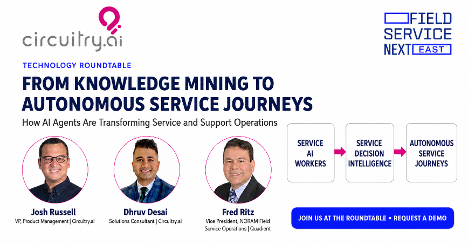
If you are attending Field Service Next East, bring this framework to the conversation. Join the Circuitry.ai team on August 11, 2026, at 11:30 a.m. for the technology roundtable, From Knowledge Mining to Autonomous Service Journeys: How AI Agents Are Transforming Service and Support Operations.
Led by Josh Russell, VP of Products, and Dhruv Desai, Solution Consultant, the working session will help service leaders identify high-value AI use cases and define a path from assistance to governed autonomy. Meet the team at Booth 12 to continue the discussion and see your journey in action.
View Circuitry.ai events at Field Service East Next →
Additional resources for service leaders
- Autonomous Service Journeys: See how AI Advisors, Agents, and Analysts orchestrate service from event to resolution and learning.
- The TRACK Framework: Use Target, Review, Assign, Capture, and Kaizen to deploy Service AI with purpose and scale.
- Service Decision Intelligence: Learn how domain depth, accuracy, governed autonomy, and measurable ROI turn decisions into business value.
- Field Decision Intelligence: Explore AI-guided diagnostics, repair procedures, parts recommendations, and frontline decision support.